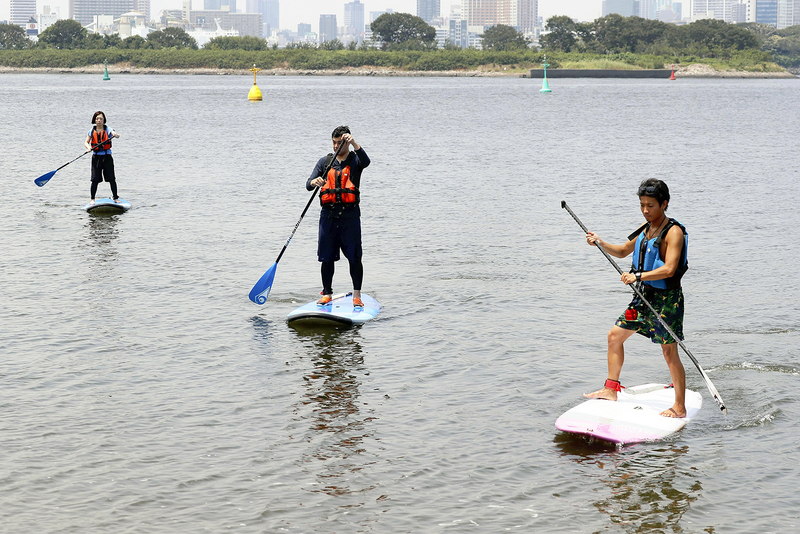
The Japan Coast Guard is calling for stand-up paddleboarders to wear life jackets amid an increase in the number of accidents involving participants of the water sport.
With the growing popularity of stand-up paddleboarding, or SUP, many people have been doing the activity without taking appropriate precautions, such as checking the weather before heading out or wearing a life jacket or other floatation device. Thus, the JCG has produced a "Water Safety Guide," urging people to be more cautious.
SUP, which has become popular among people of all ages, involves standing upright on a board while using a long oar to maneuver along the surface of the water.
According to an estimate by the Japan SUP Organization in Kanagawa Prefecture, the number of people who have taken part in the activity doubled to about 250,000 in five years across the nation.
In Tokyo's Odaiba area, the Ehukai Beach restaurant, which opened a school for SUP riders four years ago, said the number of participants in lessons has been increasing every year. Sometimes as many as 20 people attend classes, it said.
"It felt great because I could see the city from the sea," a 37-year-old woman from Meguro Ward, Tokyo, said.
In 2017, the number of SUP riders involved in accidents who were rescued and taken to hospital increased to 20, though there were no such reports in 2013.
Four deaths have been reported, including a man who drowned in the sea off Kanagawa Prefecture in 2017.
Eleven accidents have been reported so far this year, the JCG said. In late June, a man in his 40s who paddleboarded around Ishikari Bay in Hokkaido was rescued by a JCG patrol boat after he was swept about two kilometers out to sea.
The man reportedly said he had been stand-up paddleboarding about five times, but it was his first time doing it on the sea. "I didn't think about how the wind would affect it," the JCG quoted him as saying.
The JCG collaborated with a private organization to create the water safety guidelines, which carry information such as the necessary equipment and knowledge, as well as information about past accidents. The JCG posted the guidelines on its website at the end of July.
The guidelines also suggest that riders check the weather beforehand; use a leash to attach themselves to the board; wear a life jacket or other kind of flotation device; and carry a mobile phone in a waterproof case.
There has also been an increasing number of accidents involving banana boats and other recreational vessels -- the number of people injured in accidents of this kind increased to 19 in July, up by 10 from the same month the previous year.
The JCG also plans to compile guidelines for the use of such recreational boats, recommending people wear life jackets while onboard and the presence of an observer on towing boats.
Life jackets make a difference
Among accidents involving people falling from small boats in 2017, the mortality rate of those who did not wear a life jacket was six times higher than those who wore one, according to a survey conducted by the JCG.
The JCG said 405 people fell from pleasure boats, fishing vessels smaller than 20 tons or other small boats over the past year. The data shows that 158 were not wearing life jackets, and 70, or 44 percent, died. Meanwhile, 247 were wearing life jackets and 17, or 7 percent, died.
From February this year, it became mandatory for the captains of small boats to make passengers wear life jackets when outside of the cabin.
Besides boat accidents, there are many people who have fallen from wharves and other locations while fishing. Last year, 88 people in such accidents died or were reported as missing.
The death rate of those who wore life jackets in the accidents stood at 21 percent, while the rate of those who did not was 44 percent.
Read more from The Japan News at https://japannews.yomiuri.co.jp/