LY SON, Vietnam — On a warm, cloudless morning in June, a giant vessel blasted through the still waters of the South China Sea toward a wooden fishing boat painted in cerulean blue and flying the red flag of Vietnam.
The veteran fishing captain cranked up the engine to flee, but the approaching ship dropped two motorized dinghies into the sea with uniformed officers aboard. The rubber crafts raced along either side of the fishing boat, squeezing it like a pincer.
As the captain slowed to avoid a collision, the large ship was soon upon them. The large letters across its steel hull read: China.
Crammed into their cabin for safety, the 17 men were knocked to the deck by a jolt that nearly tipped the boat. Then another. And another. "Like war," recalled crew member Nguyen Day.
The Chinese vessel smashed the boat repeatedly, damaging the cabin. Four fishermen tumbled overboard. As the officers pulled them from the water, Day, 41, and the other Vietnamese men piled into lifeboats and watched their craft — laden with several hundred pounds of tuna, mackerel, grouper and flying fish — begin to float away.
The June 10 attack was part of Beijing's hard-nosed offensive in the South China Sea, where Chinese vessels are using increasingly aggressive tactics to deter rival nations and stake control over the strategic waterway.
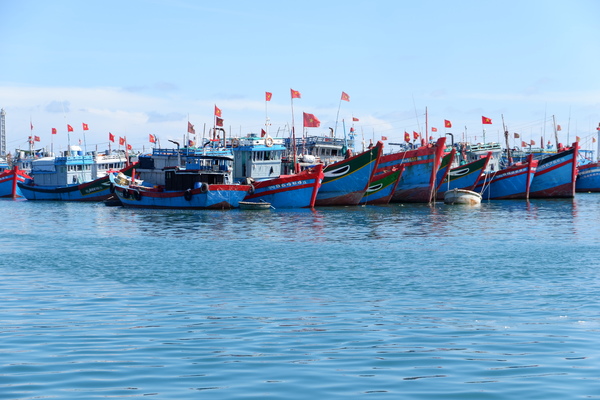
Unfazed by rising global criticism, China's navy, coast guard and paramilitary fleet has rammed fishing boats, harassed oil exploration vessels, held combat drills and shadowed U.S. naval patrols. The escalating show of force has overwhelmed smaller Southeast Asian states that also claim parts of the sea, one of the world's busiest fishing and trade corridors and a repository of untapped oil and natural gas.
Beijing's maritime expansionism illustrates not only the Chinese Communist Party's growing military might, but also its willingness to defy neighbors and international laws to fulfill President Xi Jinping's sweeping visions of power.
In its strategic quest to dominate the waterway separating the Asian mainland from the island of Borneo and the Philippine archipelago, China has built military outposts on disputed islands and reefs that, according to Xi, "are Chinese territory since ancient times ... left to us by our ancestors." The network of bases, harbors and landing strips deep in international waters has created a buffer for China's southern coastline, further encircled Taiwan and challenged the Pentagon's ability to move ships into Asia.
"It appears that China is rapidly developing the capabilities to exclude other navies from the South China Sea," Bill Hayton, an author and associate fellow at the Chatham House think tank, told a congressional commission in September.
Under the Trump administration — which has called China a "bully" seeking a "maritime empire" — the U.S. sailed more warships than normal through the region in 2020 to assert navigation rights. But the operations have done nothing to claw back the islets and waters that five Southeast Asian nations and Taiwan claim Beijing has usurped.
These countries don't have nearly enough naval power on their own to dissuade China. Instead the governments of Vietnam, the Philippines and other states have waged a quieter form of resistance by encouraging traditional fishing communities to continue venturing into disputed waters — placing them on the front lines of Chinese aggression.
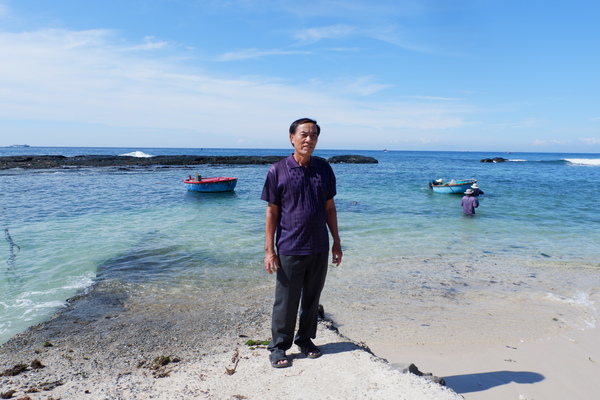
It is a high-seas cat-and-mouse game of almost cartoonish proportions, pitting a superpower with the world's largest armed fleet — including more than 300 navy ships, 130 large coast guard cutters and a maritime militia comprising hundreds of thousands of motorized boats — against men equipped with little more than nets who earn a few hundred dollars per expedition. Piloting aging wooden vessels outfitted with simple navigation systems, fishers must evade capture while hunting for elusive catches in a sea ravaged by unregulated fishing and dredging, much of it by China.
"As fish stocks collapse due to overexploitation and environmental destruction, Vietnamese and increasingly Filipino fishers are heading farther from home and taking greater risks in contested waters," said Greg Poling, director of the Asia Maritime Transparency Initiative at the Center for Strategic and International Studies. "That helps explain why they are the most frequent actors to come into contact with Chinese law enforcement and paramilitaries."
Fisherman Tran Hong Tho acknowledged that Vietnamese traveled farther into the sea these days. "The shore has run out of fish," he said.
Beijing is unapologetic about its actions, which it describes as maritime policing against illegal fishing. In September, the China Coast Guard reported that it had expelled 1,138 foreign fishing boats from the northern half of the South China Sea in the preceding four months, boarded and inspected dozens, and detained 11 boats and 66 foreign crew members, "effectively safeguarding our fishery interests and maritime rights."
For the fishing communities of Vietnam's central coast, confronting China represents a collective obligation — to defend the waters where generations have made their living.
"The Vietnam government sees fishermen as a living monument to assert maritime sovereignty in the East Sea," said Le Khuan, chairman of the fishing union on the island of Ly Son, using the Vietnamese term for the South China Sea.