In the winter of 1879, Vincent van Gogh, aged 25 and filled with evangelical zeal, took up a missionary post in a coal- mining village on the outskirts of Mons in Belgium.
His initial stay was short and unhappy. The impassioned young lay preacher felt compelled to live like local people, dressing in rags and sleeping on straw in a small and squalid hut at the back of the local baker’s, where he was heard sobbing at night. The church was not impressed and criticised him for “undermining the dignity of the ministry”.
Difficult as it was, however, this visit and successive stays with the miners of the region inspired Van Gogh to swap preaching for painting.
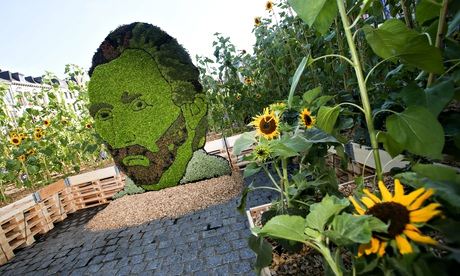
Today Mons, currently the European capital of culture, is making the most of its brief brush with fame, stealing some of the limelight from the neighbouring Netherlands, where Van Gogh was born, and France, where he settled and made his name. On Friday evening, Mons unveiled a giant maze of 7,500 sunflowers inspired by its most celebrated visitor. The installation, by French artist Fanny Bouyagui, will be tended for a week, after which the plants, comprising five varieties of sunflowers, will be distributed among local people.
The event follows a successful exhibition at the city’s Fine Arts Museum which, for the first time, explores the work of Van Gogh during the two years he spent in the region.
“We started working on this project two years ago, trying out various plants in the lab. The big challenge was whether they would be in bloom on the day of the opening, and they are,” said Bouyagui. “There are around 15,000 flowers, some of them four metres high, so people can really lose themselves in the flowers in the middle of the city. It’s very Van Gogh and very poetic.”
While a number of painters including the 16th century artists Nicolas Neufchatel and Jan Provoost were born in Mons, their names are far from household.
Local residents have sought to put Mons on the map as a key stop in Van Gogh’s lifetime journey from Amsterdam to Arles in Provence, where he painted some of his finest works. (Incidentally, the French poet Paul Verlaine, who spent two years in Mons prison between 1873 and 1875 after shooting his lover Arthur Rimbaud in the arm, is also getting the celebrity treatment for the culture year).
“Little is known and even less has been written about this period in Van Gogh’s life, but it was a decisive point in his career,” said Marie Noble, deputy director of Mons 2015. “He arrived in Mons to be a pastor and it was here he decided his dream was to become an artist. Here was this fabulous vision and transformation, and while the pictures he did here were not particularly good, they contain the artistic grammar we see in his later works. So we want to show how Mons woke the artist in him.” Two of the houses Van Gogh lived in outside the city have been restored and can be visited.(Sadly, a model thatched cottage built for the culture year and based on those painted by the artist in 1890 at Auvers-sur-Oise, mysteriously went up in flames last weekend.)
The Borinage region around Mons was one of the most important industrial areas of Europe when the young lay preacher arrived in December 1878. In letters to his brother Theo, Van Gogh wrote of the booming area with its tall chimneys, coal mountains and the local people “full of character … and reminiscent of Bruegel’s medieval paintings”.
“The people are completely black, like chimney sweeps. Their houses could be better called huts, scattered along the sunken roads and against the slope of the hills,” he wrote. “At first sight everything around it has something dismal and deathly about it. The workers are emaciated and pale due to fever, and they look exhausted and haggard, weather-beaten and prematurely old.”
Few of Van Gogh’s works from the period remain. In another missive, which included two small pencil drawings of miners, Van Gogh wrote: “I can see it is not any good yet … but it is starting to come.”
Van Gogh went on to paint a dozen different versions in his “sunflower series”. In 1987 the Japanese insurance magnate Yasuo Goto paid $39.9m for his Still Life: Vase with Fifteen Sunflowers at auction at Christie’s London, a then record-setting amount for a work of art.