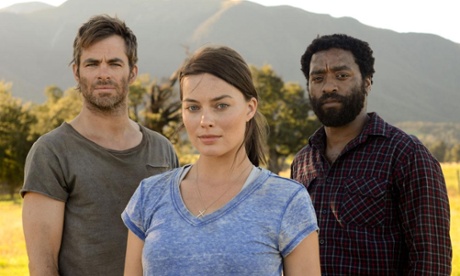
Turns out microclimates do more than aerate the grapes of your favourite Côtes de Rhône. They may just protect your family farm from a never-quite-explained radioactive event that killed off the rest of the world. Margot Robbie, the young Australian actor who came out of nowhere to make Leonardo DiCaprio crawl across the carpet in The Wolf of Wall Street, stars as Ann Burden (and that last name surely is no coincidence) bravely surviving on her own in a valley somewhere in the American south. One day a man in a seriously sci-fi-looking protective suit stumbles her way. It is John (Chiwetel Ejiofor), who was working in a government bunker during the time of the initial devastation.
He gets sick from radiation poisoning, but she invites him into the house and slowly they begin to trust one another, even become somewhat domestic. She may not survive another winter, but a nearby poisoned waterfall may be their saviour. If they build a waterwheel they would have power, but that would mean tearing down a local chapel and using transforming the wood. Despite the clear transubstantiation metaphor, this still doesn’t fly with Ann, who still clings to her Christian faith in the face of all this suffering. (Her family left to look for survivors and never returned.)
Just as the sexual tension between the two seems to have reached its breaking point, there enters a third party. Caleb (Chris Pine) finds his way to “the holler” and it’s hard to tell at first if he’s a threat. In contrast to John he shares Ann’s faith – or maybe he’s just saying so. Maybe he’s just a nice (extremely handsome) guy, or maybe he’s scheming to bump John out of the way to win Ann. Maybe John realises Caleb is a better match for Ann, or maybe John’s about to recognie he truly loves her.
That’s a lot of maybes, but these small psychological moves are the meat of the second half of Craig Zobel’s loose adaptation of Robert C O’Brien’s popular young adult novel from 1974. There’s a lot of bare symbolism and unspoken feelings, but not a lot of action. No comment about race is made until far into the film, and its mention also doubles as one of the films sole jokes. But what begins as a deeply philosophical survivors’ story eventually deflates into a soap opera-ish love triangle. While these story points are perhaps the easiest to relate to, they ultimately aren’t that interesting. Yet the depth of the world and all three of the performances are just enough to stay through from A to Z.