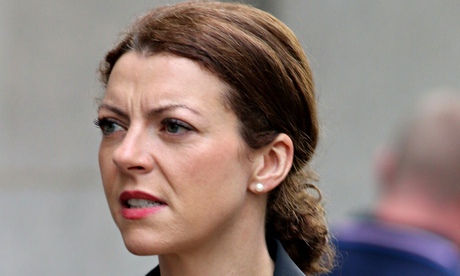
A former editor of the Sun did not have “the balls” to run leaked details of Labour’s last budget, a jury at the Old Bailey was told on Thursday.
The Sun had a tip off about an increase in duties on fuel, alcohol and cigarettes, and had prepared a double-page spread under the headline “Don’t Fudge It” the day before former chancellor Alistair Darling’s speech in 2010.
Clodagh Hartley, the paper’s Whitehall editor at the time, told a jury at the Old Bailey that a senior colleague, who cannot be named for legal reasons, told her “Dominic Mohan did not have the balls to run it” and replaced it with a story that included just two paragraphs from the tipster.
The Sun journalist was in the witness stand in relation to a charge that she unlawfully paid a government press officer working for Revenue & Customs who had given her the details of the Budget at a Starbucks cafe the night before the announcement.
Hartley, 40, of Brockley, south-east London, denies conspiracy to commit misconduct in public office.
The jury heard that Hartley believed there was “massive public interest” in running the story before it was subjected to “spin” by the government press office.
She told the court that she was bullied by a senior colleague and made to feel the “most junior and lowly member” of the team even though she had landed what she believed to be a scoop.
Hartley is accused of arranging payments of £17,475 to HMRC press officer Jonathan Hall over more than three years, in exchange for a series of stories.
Asked by her defence counsel if she thought she was doing anything wrong by arranging payments for the tips, she replied: “Absolutely not”. Asked did she keep it from her superiors on the Sun, she replied: “Not at all”.
She told how a senior colleague had instructed her to find a different name other than Hall to pay the tip fee. Hall then suggested his girlfriend, Marta Bukarewicz, who also denies conspiring to commit misconduct in public office.
Hartley said the information – based on “defensive lines” to be used by HMRC press officers – was supplied by Hall.
But to her dismay, the potentially “award-winning” scoop was edited down to a few tiny paragraphs in a spread focusing on the results of a poll of Sun readers.
She reported a conversation with a senior colleague, who cannot be named for legal reasons. “[Hartley’s senior colleague] said that Dominic Mohan did not have the balls to run it, which meant he did not trust that I had the correct information,” she said.
“He did not want to put details into the newspaper which were potentially incorrect.
“This is the conversation I had with [Hartley’s senior colleague]. The phrase I have just used [‘… balls’] was [Hartley’s senior colleague’s] opinion of why Dominic Mohan had not run it, having spoken to Dominic Mohan several times at length the evening we had those details,” she said.
Although she boasted in internal emails she had got hold of “the entire budget”, Hartley admitted to jurors this was “a bit of an overbold claim, as I feel I’m fighting for my job”.
She defended her wish to give Sun readers the inside story on the budget, before it had been formally revealed.
“We had the information, therefore it should be given to our readers as soon as possible,” Hartley said.
Hartley was asked about the pressured working environment and her strained relationship with the unnamed senior colleague. “Pretty much after I started, he was bullying. I can’t put it any other way. I thought that the exclusives like this helped as this was the currency he seemed to want … I was quite frightened of him but I tried to maintain a professional front and carry on.”
The reporter said she was “treated very much like … the most junior and lowly member of the team” by her senior colleague.
She told jurors she had spent a week investigating Labour candidates’ constituency literature in the run-up to the 2010 election.
Hartley was able to show that many MPs failed to reference PM Gordon Brown, perhaps out of “embarrassment”.
But after assembling the data, the senior colleague “stole all the glory for it without doing the work”.
She told jurors how he was guilty of “shifting the goalposts” and seemed to treat male journalists preferentially.
He told her in 2010 he was not worried about her winning exclusives – encouraging her to get to know ‘the beat’ – but in 2011 berated her for a lack of them.
Hartley also said she had “no idea it was in any way wrong” to request payments for Hall.
She was told to change her source’s name on the Sun’s payment system, duly entering Marta Bukarewic, “in the same way as Jonathan’s details had earlier been inputted”.
Asked why she thought bosses had requested the name-change, Hartley replied: ‘I didn’t give it much thought, beyond anybody could see who was on the system – anybody being fellow journalists.’
Hartley said she would not be returning to journalism after her experience at the Sun ended in a court charge, but continued to robustly defend her work as in the public interest, exposing waste and inefficiency in government.
The reporter was asked about a series of texts with James Chapman, political editor of the Daily Mail, in February 2011. Asked why she appeared to be feeding a rival newspaper a story provided by Hall, Hartley explained she was on maternity leave and felt little loyalty to the Sun after her poor treatment by an unnamed senior colleague.
“By now … my appeal of my appraisal was very quickly knocked back and I had spent the intervening weeks writing memo after memo and dealing with it.
“It had been revealed to me that [the senior colleague] had said I would not be returning to that [Whitehall] job.” She also said that this colleague “had succeeded in stealing contacts from me on two occasions”, the court heard.
Hartley said she was “out of the loop” when Sun journalists began to be arrested, as she was organising her wedding in Ireland. “I did not know at the time that it was illegal to pay police officers, soldiers,” she said.
Hartley said she now knows “it was being said that it was illegal to pay public officials”.
Her barrister pointed out that paying public officials was not illegal per se, as the trial indictment shows.
“I thought that sources would be protected,” Hartley said of News International’s decision to hand over swaths of internal emails to Scotland Yard. “That was the journalist’s duty.”
Her counsel Alexandra Healy asked: “Did you have any idea that it could be suggested that what you were doing was criminal?”
Crying, Hartley replied, “I had no idea, no idea it could be criminal.”
”Whatever the outcome of these proceedings, do you propose to return to journalism?”
“No,” Hartley replied, in a definite tone.
The trial continues.