KATSURAGI, Nara -- Kehaya-za, a sumo museum run by the city government of Katsuragi, Nara Prefecture, is set to celebrate its 30th anniversary in May.
The museum plans to honor Taima no Kehaya, believed to be originator of sumo in ancient times, and to pass down the history of sumo to future generations.
The number of museum visitors has been on the rise in recent years, including a record-high figure for foreign guests in fiscal 2019.
In addition, Tokushoryu, who is from Nara Prefecture, won the championship at the New Year Grand Sumo Tournament, though his rank had been the lowest in the makuuchi division. The upcoming Tokyo Olympic and Paralympic Games are also expected to give the museum a boost.
The momentum of visits by foreign tourists is likely to continue and an official of the museum said, "We want to illustrate [Katsuragi] as the birthplace of sumo by holding events and other activities to commemorate milestones."
Kehaya-za opened in 1990. In the wake of modification of its dohyo and refurbishments to its facilities, the museum has held unique events in recent years to increase its popularity and name recognition.
For instance, mock wedding ceremonies are held on the dohyo, and women can take part in "Ohitorisama Sumo," in which each woman performs sumo maneuvers alone on the dohyo.
For foreign visitors, tablet-type devices are installed to provide explanations about the exhibits in six languages. Copies of pamphlets in each of the foreign languages are also on hand at the museum.
Museum officials have made a great deal of effort to work with the prefectural Nara Visitors Bureau, including proactively soliciting group tours.
About a decade ago, there were years when the numbers of visitors were just on the 1,000 level.
But the number hit 8,300 in fiscal 2016, then 9,500 in fiscal 2017 before going to 8,800 in fiscal 2018. In fiscal 2019, the figure exceeded 6,300 as of the end of November. The number of foreign visitors over the same time frame also rose to 390, 740, 1,400, and nearly 1700.
There is a concern moving forward about negative impacts of the new coronavirus. But the number of foreign visitors in fiscal 2019 -- as of the end of November -- reached nearly 1,700. Non-Japanese visitors, mainly Chinese, helped the facility surpass its record high.
In addition to the increase of overseas tourists, museum officials think the jump in guests has been because visitors can take photos at most locations inside the facility.
There have been many guests who have taken photos with the dohyo, which is the same size as the ones used at Grand Sumo Tournaments, in the background, and posted them on social media.
Thus, museum officials said, name recognition of the sumo museum has been on a gradual upswing.
Yoshiyuki Himei, 83, who entered the museum when he happened to see a sign, stepped onto the dohyo and checked how the soil feels.
"I didn't know how hard it was," he said. "I can imagine how wrestlers feel when they have sumo matches."
Hironao Koike, 52, an assistant chief of the city government's commerce, industry and tourism section, who has done sumo, spends his working hours at the sumo museum.
"We are proud of more than 12,000 stored items, including nishiki-e [multi-colored woodblock prints] and old banzuke ranking sheets. Probably this is the only place where visitors can come away with a comprehensive sumo experience."
In March, Grand Sumo Sakurai Basho, a local tour, will be held at the Shiba Integrated Gymnasium in Sakurai, Nara Prefecture.
Yoshihiko Nishikawa, 46, another assistant chief of the Katsuragi city government's section, said, "We hope people will visit both the Sakurai Basho event and the sumo museum, so that the sumo boom in Nara Prefecture will get a boost."
Ahead of the 30th anniversary, the city government officials are considering measures to encourage visitors to post information about the city via social media.
Another city government official said, "In Katsuragi, there are many historical sites, such as Taimadera temple and Kakinomoto Shrine, where visitors can learn about history. We want visitors to have experiences in the sumo museum and also tour many other places in the city."
Gathering for sumo jinku
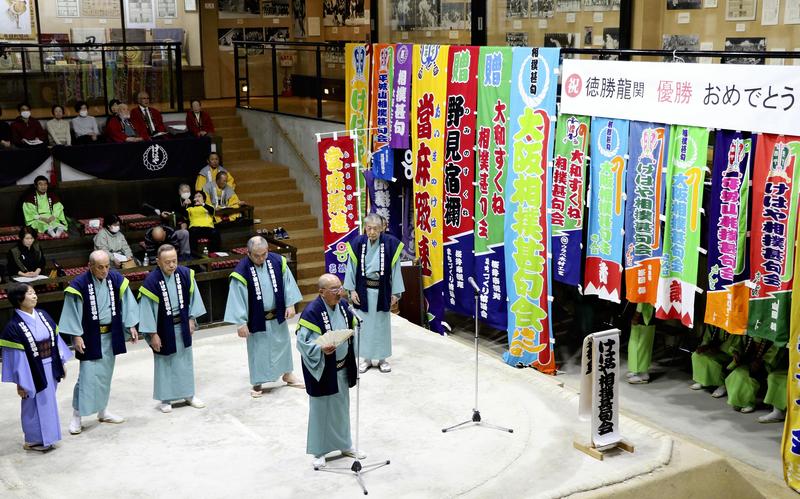
Participants sang traditional songs about the sport at an event called "Sumo Jinku Nigatsu Basho" that was held in Kehaya-za on Feb. 2.
Seven associations in Nara Prefecture and Osaka Prefecture -- including Kehaya Sumo Jinku-kai in Katsuragi -- that feature lovers of sumo jinku songs took part in the event.
The festivities kicked off with a performance of wadaiko drums, called "yosedaiko" (drumming to lure spectators). Members of each of the associations stepped onto the dohyo and sang portions of the songs in the order from maeuta (prelude) to hon-uta (main part) and hayashi-uta (singing with music).
The lyrics were sung in unique tones, and had lines with seven and five syllables. During the song, others shouted rallying cries such as "haa dosukoi dosukou," and "dosukoi hoi."
Some of the spectators sang the songs from their seats, reading the lyrics on their program-guide pamphlets.
A larger event of associations of sumo jinku lovers from nationwide is scheduled for n June 7 in the Kehaya-za.
Read more from The Japan News at https://japannews.yomiuri.co.jp/