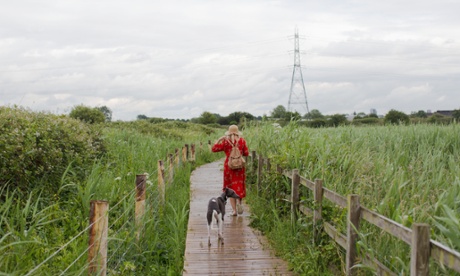
I sometimes joke that I was feral until I discovered pubs, boys and clothes at the age of 15, because the vast majority of my childhood was spent in dungarees, running wild in the Kent countryside. In 1981, my parents, who at the time were something of a taboo for being unmarried and with child, fell madly in love with an old farmer’s cottage near the village of Leeds and left London with my older sister to settle there. My mother recalls how there were rabbits burrowing in the dirt under the house where foundations should have been, but that the setting, with a river at the bottom of the garden and fields and orchards all around, had them smitten.
Kent is known as the garden of England for good reason; it’s a green, fertile, fruit-growing county, and growing up there with parents who cared about food has had a huge impact on the way I cook and eat. I live in London now, in a flat without a garden, but when the summer comes, bringing with it the ingredients I enjoyed out in nature as a child, I track them down from suppliers – occasionally from the area of London where I live – and am transported back into the garden. Food is incredible like that, I think.
As a kid, trees held particular intrigue for me; they were worlds all of their own, begging to be explored and conquered. And best of all – come summer – they were generous snack stations for a greedy little girl. I used my aptitude for scaling trees (something that never ceases to amaze me as a mildly acrophobic adult) to help me feed the insatiable hunger that should have hinted that I’d go on to work with food. Summer meant handfuls of jammy cherries, stained lips and later, pockets filled with fleshy Victoria plums, damsons, apples, and – if we got there before the squirrels – juicy Kent cobnuts.
These seasonal wild hazelnuts drove my food-loving father to distraction. He’d lurch around our wild garden with carrier bags, zealously filling them and later cracking open the fresh, milky nuts on the kitchen table, dipping them into salt and munching away. He taught us that cobnuts – along with the mushrooms we picked on early-morning walks and the cherries harvested from the garden tree – were precious and fleeting treasures, to be cherished and gorged on with glee.
Photograph: Elena Heatherwick for the Guardian
A news journalist and editor, Dad loved the long summer evenings when he could come home from the stresses of Fleet Street and still have daylight hours to tend his vegetable patch. My mum is an excellent home cook, and knew just how to cook his veg haul to preserve the delicate flavour of young green things, such as broad beans and peas, probably because her father – a gruff and fiercely intelligent Yorkshireman – had doted on his veg patch and inspired my father to plant his. My favourite thing of all was to pluck pea pods straight from their tendrils, popping open the tops and running my finger down the seam, springing the sweet, crunchy seeds straight into my mouth.
Being a child of the 1950s, my dad also had a real penchant for salad cream, which was popularised during rationing as a less perishable alternative to mayonnaise, made by emulsifying egg yolks, oil, water, sugar and vinegar. Food snobs scoff at it, but I totally get it – it hits those key bases of sweet, cream and acidity and is great on crunchy green lettuce like little gem, and with fresh raw peas. Dad would have loved this homemade recipe I’ve created, and I’m dedicating it to him, not least because this feature is being published on the 10 year anniversary of his death, which came as a terrible shock to us on that hot summer’s day in 2005. July is always poignant for me; Dad, a man who taught me so much about food, has been particularly front of mind as I’ve written this piece.
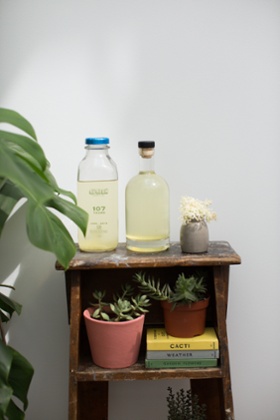
Grown-up life in London is very different to my free-range youth, but I’m very lucky to live where I do, right by Walthamstow marshes. I was drawn here because, a bit like the Kent countryside, the marshes sprawl for miles and bristle with plants, trees and wildlife, keeping my inner wild child satisfied. You can walk for miles without ever crossing the road and even go on foraging walks for wild food with local expert John the Poacher. During the early summer, you can’t help but be struck by the scent of fragrant wild elderflower. As soon as it’s in full bloom, I fill bags with heads of the pretty little white flowers and take them home to steep in sugar syrup to preserve their essence into cordial.
It doesn’t matter if the British summertime lives up to its reputation and you find yourself holed up inside while the heavens open – this sweet solution is like sunshine in a glass. Elderflower will be gone soon, so now is the time to swipe its last heady bouquets and keep that taste of this short season alive that little bit longer.
Elderflower cordial
I like to make at least two bottles, drinking one as cordial/in cocktails and leaving the other to ferment into fizz in the fridge. It’s great with gin or fino, lots of lime, ice and sparkling water.
Makes 1.5 litres
20 heads of elderflower, picked over to remove any green or black fly
500g golden caster sugar
1 large unwaxed lemon, finely sliced
1 Fill a large, clean pan with 1.5 litres of cold water and stir in the sugar. Put over a medium heat and warm until the sugar has dissolved.
2 Remove from the heat and allow to cool almost completely. Add the elderflower and lemon and leave to infuse for as long as you can – at least 3 hours, preferably overnight.
3 Store in a sterilised jar or bottle, and drink as you please.
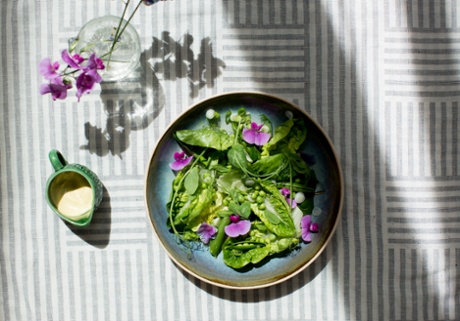
Fresh peas and salad cream
A celebration of early summer. Make sure your peas are not just freshly-picked but young.
Serves 4
2 heads of little gem, washed, outer leaves removed, hearts split in half
200g freshly picked peas, podded
Pea flowers (if you have them)
A handful of pea shoots
4 spring onions, washed thoroughly, finely sliced
Mint leaves
Smoked trout or smoked mackerel (optional)
For the salad cream (makes 150ml)
3 eggs
20ml double cream
25ml rapeseed oil
20ml extra virgin olive oil
1 tbsp cider vinegar
2 tsp caster sugar
1 tbsp water
1 tsp dijon mustard
½ tsp English mustard
A pinch of ground white pepper
A pinch of salt
1 First, make the salad cream. Boil the eggs for 10 minutes, then cool them in cold water for 5. Tap the eggs all over, peel off the shell, then peel the whites from the yolks (save the whites for something else). Blitz the yolks in a food processor (I use a nutribullet for this, it’s perfect) with the other ingredients for 3 minutes, or until fully emulsified and thickened. Taste for seasoning. Store in the fridge for up to 2 days.
2 To assemble the salad, toss the lettuce with some salad cream, divide it between plates, scattering with peas, spring onion and shoots and flowers. Season, and add salad cream to taste. You could serve this with some smoked fish, such as trout or mackerel, though I like to make the peas the star here.
Rosie Birkett is a food writer, stylist and author of A Lot On Her Plate (Hardie Grant). rosiebirkett.com, @rosiefoodie