At least 13 people have been killed by a group of gunmen, including two suicide bombers, who stormed a coffee shop in a town north of Baghdad.
The incident came on the heels of a two-day wave of bombings in Baghdad which killed nearly 100 people - attacks that have been claimed by Isis. The deadliest struck the sprawling Shiite neighborhood of Sadr City in north-east Baghdad on Wednesday, killing 63 people.
The Balad attack started when three gunmen, armed with machine guns, opened fire into the crowd in the cafe shortly after midnight on Thursday, the officials said.
Once police arrived at the scene, two of the attackers detonated their suicide vests, they said.
No group has claimed responsibility for the attack in Balad, 50 miles (80km) north of the capital.
The Isis bombings bombings this week have exposed lingering gaps in Baghdad's defences, which are manned by an array of security agencies and militias who do not always co-operate. They also point to the resilience of the extremist IS group, which has increasingly resorted to bombings in civilian areas far from the front lines as it has lost some territory to Iraqi forces backed by US-led air strikes.
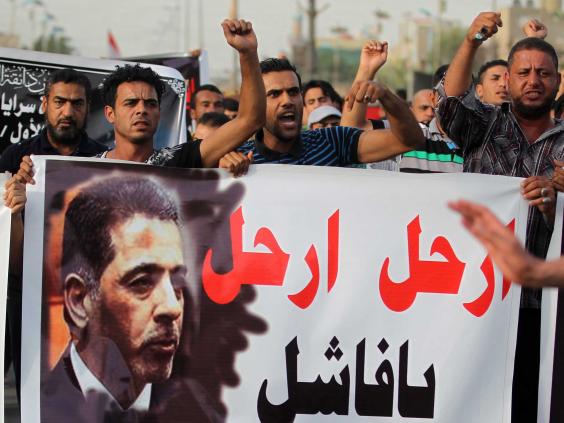
On Thursday evening, hundreds took to the streets in Baghdad's Sadr City to demand government accountability for the security breaches. Protesters carried signs calling for the interior minister to resign while others called for the defence minister and Prime Minister Haider al-Abadi to also step down.
Anti-government protests first erupted last summer as temperatures soared and millions were left without electricity. While Mr al-Abadi proposed a series of government reforms in August 2015 that he claimed would combat corruption, very little has been implemented.
Repeated delays in Iraq's parliament sparked another wave of protests this year, led by influential Shiite cleric Muqtada al-Sadr. In late April the cleric's supporters stormed Baghdad's heavily fortified Green Zone and the parliament building.
Since the unprecedented breach of the compound, which is home to many of Baghdad's ministries and foreign embassies, the country's government has been largely gridlocked as many politicians are boycotting parliament.
Iraqi officials and analysts warn that the deepening political crisis may be distracting Iraq's security forces from the fight against IS. The Iraqi government claims IS only occupies 14% of the country's territory after a string of battlefield losses, but the extremist group still controls key border areas between Iraq and Syria as well as Iraq's second largest city of Mosul.
AP