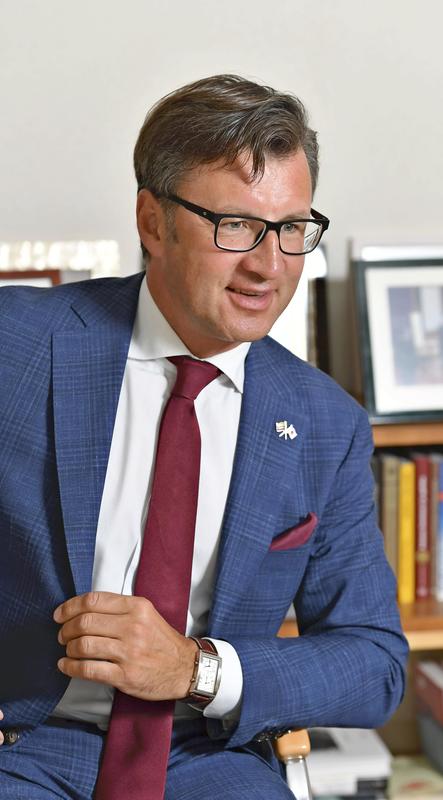
After declaring its independence in 1990, Baltic state Lithuania achieved high economic growth as an EU nation, leading it to become a member of the OECD in 2018. Its ties with Japan have developed through the courageous actions of Japanese diplomat Chiune Sugihara (see below). During a recent interview with The Japan News, Lithuanian Ambassador to Japan Gediminas Varvuolis spoke about the two countries' close ties as well as his perspective on the future.
Q: How did you first become involved with Japan?
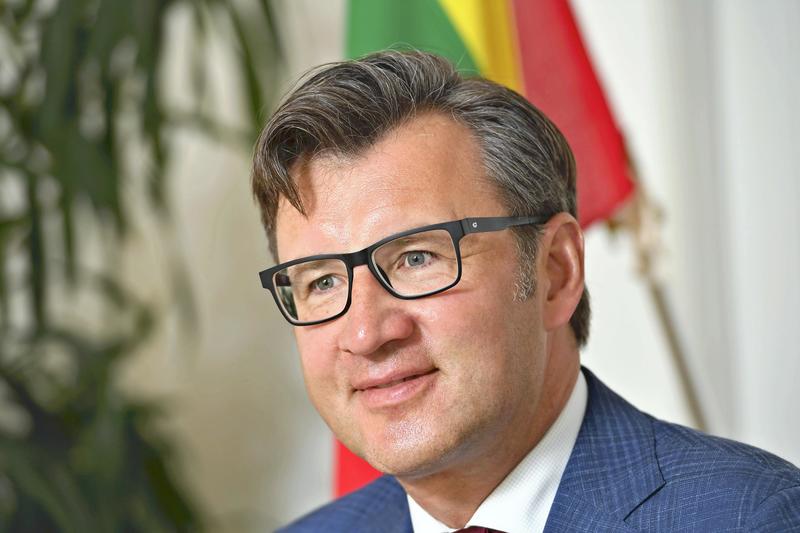
Varvuolis: I have always been fascinated by Japan and Japanese culture because Japan is quite popular in Lithuania. Even without visiting, I already knew about the country and followed it a bit in the news. Of course, the popular culture, things like martial arts, are very popular in Lithuania.
My first visit to Japan was in 2013. I stayed for about a week in the context of my previous position related to security policy. I attended some seminars organized by MOFA [the Ministry of Foreign Affairs of Japan] on security issues and was invited in that capacity.
Q: What was your first impression?
A: The impression was very nice. I think it was springtime, the perfect season. That was the first impression that comes to my mind when I recall that visit. Also, very hospitable people and the extremely good organization of that particular event. I have very positive memories of that first visit. This also played into my later decision when I was offered the chance to become ambassador. This first experience played a certain role because the memories were great.
Q: When it comes to the relationship between the two countries, Chiune Sugihara is a symbolic figure.
A: In Lithuania, people know Chiune Sugihara very well. He is a kind of hero for all humanity. We adopted him as our hero as well in a certain sense. One should never underestimate the crucial importance that Sugihara plays in our bilateral relations, as being one of the bridges -- I dare say the strongest bridge -- that links our countries together. He is a kind of moral beacon, an example of humanity, and he is perceived in such a way in Lithuania.
There is a memorial in his honor in Kaunas, the city where the Japanese diplomatic mission was located before [and during] World War II and where Sugihara issued "visas for life." This memorial, the Sugihara House as we call it, has become a kind of pilgrimage place for many Japanese people. Through this Chiune Sugihara legacy … we are very happy that Japanese people learn about our country.
Q: The embassy has held a lecture featuring him.
A: Yes. We have some Lithuanian historians who are trying to assess the phenomenon of Sugihara from a professional point of view. He performed his moral duty until the very last minute before he left. Even when the Consulate General of Japan was closed, he was still trying to save people, trying to issue as many visas as possible. Sugihara also witnessed the occupation of Lithuania by the Soviet Union. For us, he is an extremely important factor in our bilateral relationship with Japan.
Next year, we will be commemorating the 80th anniversary of Sugihara's "visas for life." I think this will provide a perfect occasion to reinforce our relationship further. We expect many reciprocal visits and some high-level visits.
Another aspect of Sugihara is that his legacy not only provided grounding for the political relationship between Lithuania and Japan, but also became an instrument of people-to-people relationships. Sugihara was born in Gifu Prefecture. Because of that fact, Gifu Prefecture kind of became the most Lithuanian prefecture in Japan. We have many people-to-people relations that go on between Gifu and Lithuania.
Q: What kinds of people or episodes do you think best represent the relationship?
A: There are other episodes despite the distance. Lithuania is a country in the central European region, so we don't have this kind of global reach. And yet, there were episodes in the past and some other names we could mention, for example, Yukichi Fukuzawa [1835-1901].
Q: He might have been one of the most influential people outside government service.
A: Yes, one of the Japanese philosophers and founders of modernism in the Meiji era. He visited Lithuania in 1862 with one of those missions to Europe to explore European countries. There are official records that he crossed Lithuania on a train, and made a stop in Kaunas, the same city where Sugihara later worked. This is a kind of first official record that we have of a Japanese personality recording his impressions about Lithuania.
Also there is one less-joyful episode ... that is our common fate in Siberia. After World War II there were many war refugees from Japan that were sent to Siberia. We suffered the same fate. We suffered huge deportations after the Soviet occupation that Sugihara was able to witness at the very beginning. And we know from some personal memories from Lithuanian deportees to Siberia that they used to live side by side with Japanese.
There are some personal memories of how they communicated with Japanese neighbors on a day-to-day basis; some memories of common customs, for example, taking off shoes when entering, because we Lithuanians also, in the countryside in particular, traditionally take off shoes. This is an unusual story that we share.
Business opportunities
Q: The Lithuanian government has asked Japanese companies to invest more in Lithuania. What is the attraction of Lithuania for Japanese companies?
A: This is one area that has the biggest potential in our bilateral relations. As an ambassador, one of the key priorities is to try to reinforce our economic relations. Lithuania is one of the fastest-growing EU economies. There are some natural prerequisites for stronger cooperation. In terms of bilateral trade, we are doing quite well. I hope that the free trade agreement that entered into force between the European Union and Japan [in 2019] will help increase trade volumes even further.
We would like to see more Japanese presence in the area of investment. We still have untapped potential for Japanese companies. We want them to have a closer look at what Lithuania has to offer.
Q: For example?
A: We have some areas that could be very attractive for Japanese investors. Not only traditional areas, but also some new areas such as ICT and fintech. Lithuania in the last few years has become one of the major points of attraction for European fintech companies because of a very favorable regulatory system, which creates conditions for the very fast registration of those fintech companies. This is one of the reasons why we had so many fintech companies registering and establishing their headquarters in Lithuania. This is a trend that was recognized globally. We hope Japanese companies such as Rakuten and others will also take note of this development and have a closer look at Lithuania.
Life sciences and biotechnologies are areas where we have been cooperating over the last few years. There is already a quite good record for bilateral cooperation in the area of biotechnologies. Japanese companies, especially scientists, are regular guests at our major life sciences Baltic conference that takes place in Vilnius every two years.
Q: How about traditional industries?
A: Agriculture and the food industry are traditionally very strong in Lithuania. This is where we hope we will have the biggest impact from the free trade agreement between the EU and Japan. We hope that our food producers and different agricultural producers will be able to export their quality products to Japan. Lithuania is a little bit like Hokkaido -- it has the same kind of agricultural, food industry identity. I visited Hokkaido last year and had this impression that it is the breadbasket of Japan.
Cultural similarities
Q: You joined a movie conference in Kyoto recently.
A: You are talking about the EU Film Days. We regularly have Lithuanian movies featured in those festivals. This year, we had a Lithuanian movie in the EU festival in Tokyo and then when it moved to Kyoto.
We have to spread the message about Lithuania culture because we feel that our culture is appreciated in Japan. There is mutual sympathy between Japan and Lithuania. We sometimes say that we are the last pagans of Europe, the last country to be baptized and become Christian in Europe. Before that, we had our own religion. That's why for us the Japanese culture and Shinto traditions, this relation to nature and worship of nature, is something that is very close. When we see in Shinto shrines that [people] worship nature, this is something that we feel is very close to our ancient religion, our pagan religion before Christianity. So there are some points of mutual sympathy and a better understanding of each other that need to be exploited further.
That's why usually when we have those film festivals we try to present movies about our nature. This year we had a movie about old forests in Lithuania. We were surprised to see it was a silent movie, only the natural sounds of nature you could hear in the movie, "Sengire" (The Ancient Woods). The cinema was full of people because nature is something that is so close to Japanese people.
Q: Lithuania has a singing tradition.
A: The Lithuanian singing tradition is something that we should promote. Our traditional song festivals that we have in not only Lithuania, but also Latvia and Estonia, have been included in the UNESCO heritage list. For Japanese friends and the public, this is another source of fascination about Lithuania because they really like the singing tradition that we have.
Q: I would also like to talk about your former position related to security policy. Prime Minister Shinzo Abe visited Lithuania in 2018, the first Japanese prime minister to do so. Our article at that time said that the two leaders agreed to reinforce pressure on North Korea because Lithuania has diplomatic relations with North Korea.
A: Regarding North Korea, we support the line of our ally Japan because for us Japan is a kind of global ally. It shares the same principles of free economy, free media, free elections, personal freedom. Therefore, as far as North Korea is concerned, we support [Japan's] positions and we understand the concerns. We also share the same security guarantees. [Japan has] a bilateral security agreement with the United States. We share a multilateral agreement with the same ally through the NATO umbrella. Naturally, we are allies and therefore, it is only natural that we support this particular issue, and support [Japan's] policies.
Q: For the Olympics next year, Hiratsuka,Kanagawa Prefecture, is one of the host towns for Lithuania. What are your expectations for the Olympics and host towns' contribution?
A: I can expect a lot, but it's a little bit a matter of luck whether you get medals. We hope our athletes will perform well. We have some hopes in some areas.
I think the good thing about the upcoming Olympics is we have some places like Hiratsuka where our Olympic athletes can feel at home. They have already come several times for pre-Games training camps in Hiratsuka and they always bring back very good impressions and memories from Hiratsuka. They are always treated very well and Hiratsuka takes very good care of them. We also have a Paralympic team that is preparing for the Games. They also had their camp in Hiratsuka. Toyohashi [in Aichi Prefecture] also helps us with some Paralympic training.
We hope that, thanks to this good hospitality of Hiratsuka and other places like Toyohashi, our athletes will perform very well and we will get medals. But again, I cannot foresee the future. I can only keep my fingers crossed and say, "Ganbarimasho!"
This interview was conducted by Japan News Deputy Editor Takeshi Nagata.
--Chiune Sugihara
A Japanese diplomat born in 1900. Serving as vice consul in Lithuania, Sugihara issued in 1940 transit visas to Japan at his own discretion for about 6,000 Jewish refugees fleeing Nazi persecution. The visas are called "visas for life." Sugihara died in 1986.
--Profile
Varvuolis became ambassador to Japan as well as to New Zealand, Australia, Singapore and Malaysia in 2018, and to the Philippines and Indonesia in 2019. Before that, he had been ambassador to Belgium, Luxembourg and Algeria. He has also been involved in security issues, such as NATO, in important positions for a long time.
He was born in 1970 in Pasvalys, Lithuania. After graduating from Vilnius University, Varvuolis undertook postgraduate studies at the Institute of Political Sciences in Paris.
Read more from The Japan News at https://japannews.yomiuri.co.jp/