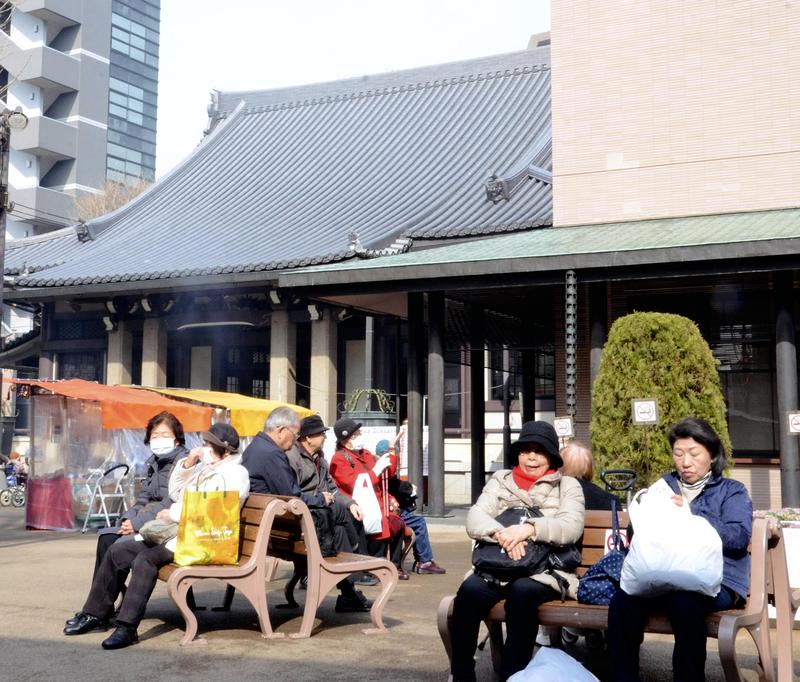
Tokyo's Sugamo district is known as the "the grandmas' Harajuku," thanks to its many clothing stores displaying items popular with elderly women such as plain-colored kappogi aprons, sweaters with unusual patterns and pants with elasticated waists.
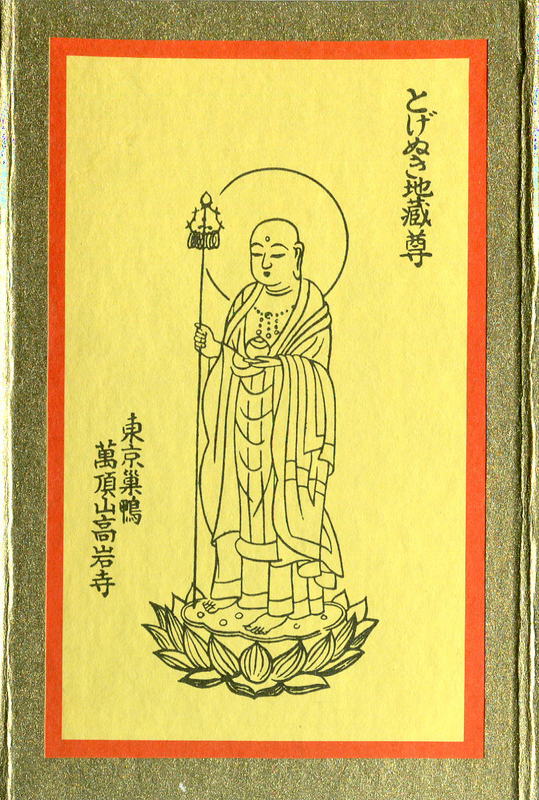
Sugamo is also home to the Togenuki Jizo statue, frequently visited by senior citizens as it is believed to have powers of "togenuki" (extracting the splinter from worshippers), which means healing the mind and body, and bless people with long lives.
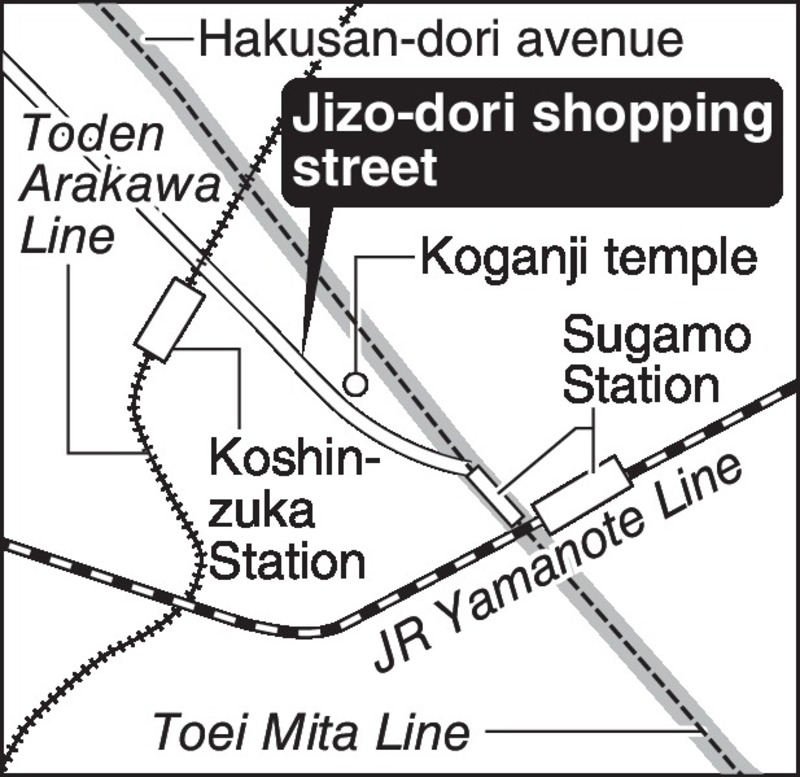
Koganji temple is located just off the Sugamo Jizo-dori shopping street, the most crowded road in the area, and where the aforementioned shops can be found.
Those stores sell clothes that are probably not appealing to young people. However, Haruko Takase, in her 80s, who was visiting the street, said, "Women love clothes even when they grow old. I often come to Sugamo, because the stores have many clothes to my taste."
One outlet with a variety of shopping trolleys for seniors, known as "silver cars," may be unique to Sugamo. I was also impressed to find a crowd of people in front of a senbei rice cracker store.
"In the 1970s, we expanded our stock of clothes and foods that elderly people like," said Shigeo Kizaki, 75, president of the association to promote the local shopping district.
Around that time, large supermarkets began to emerge in the vicinity. People in the local shopping district fought hard for its survival, and they came up with a strategy to attract worshippers of the statue.
These days, salesclerks in the district talk to shoppers in loud voices and the shop signs display large letters and no non-Japanese words. The association has also increased food-and-drink-tasting promotions.
As a result of these efforts, the number of repeat visitors went up, and temple festivals are said to attract so many people that it is hard to walk around without bumping into others.
The spread of the neighborhood's nickname also spurred the increase in the area's popularity.
Its origin was in a Yomiuri Shimbun article published on Jan. 22, 1987. Appearing in a front-page series of articles on the theme of leading long, healthy lives, the headline trumpeted, "Grandmothers' Harajuku."
The catchy phrase was taken from a line in the article by Masashi Nyui, 74, a former Yomiuri Shimbun staff writer at its city news department, who wrote of the older crowd frequenting the area, "Emulating the young, Sugamo is now known as 'the grandmothers' Harajuku.'"
A few years before the Yomiuri article, the owner of Nyui's favorite sushi restaurant in Sugamo told him that "more and more elderly people come here, and it has become like a grandmothers' Harajuku." At that time, young people known as takenoko-zoku, who performed a trendy dance wearing colorful, distinctive styles in the Harajuku neighborhood of Tokyo, were causing a buzz. Nyui made a mental note of the phrase, and he used it in the series.
In his story, Nyui's wording was "obaasan no Harajuku" (grandmothers' Harajuku), but the name evolved to become "obaachan no Harajuku" in everyday use. Obaasan and obaachan both mean grandmother, but obaachan is slightly friendlier. Although the wording had changed slightly, the phrase was picked up by other media, and Sugamo became a well-known district nationwide. Kizaki recalled the days when 80 large buses would be lined up there.
Meanwhile, the center of activity has always been the Togenuki Jizo, the symbol of Koganji temple. I also spoke to Akinori Kuruma, 56, a priest at the temple.
The story of the Togenuki Jizo statue's healing powers dates from the Edo period (1603-1867) when the temple was in the Ueno district of Tokyo. A man was praying for his wife's recovery from illness and then saw the statue in a dream. The man was inspired to follow the jizo's oracle and his wife recovered, according to Kuruma. The statue went on to become the symbol of the temple.
On another occasion after that, a woman was in pain after accidentally swallowing a needle, but it somehow came back out after she swallowed a piece of Japanese paper depicting the jizo. The Togenuki Jizo is named after this anecdote, according to folklore.
The temple also contains the Arai Kannon, a statue that elderly women pour water on and then rub with towels. The statue was donated for a memorial service by a man who lost his wife in the Meireki no Taika (Great fire of Meireki) in 1657. It is said that the afflicted part of one's body can recover by washing the same part of the statue.
"Both the jizo and the kannon became religious objects after incidents related to a husband's love for his wife, and that might be the reason why they attract women visitors," Kuruma said.
After hearing this story, I walked around the shopping street again and saw an elderly man gently watching his wife shopping. Sugamo, or "the grandmas' Harajuku," might actually be a romantic place.
Read more from The Japan News at https://japannews.yomiuri.co.jp/