This is the third installment in a series reviewing the first six months of Prime Minister Yoshihide Suga's administration.
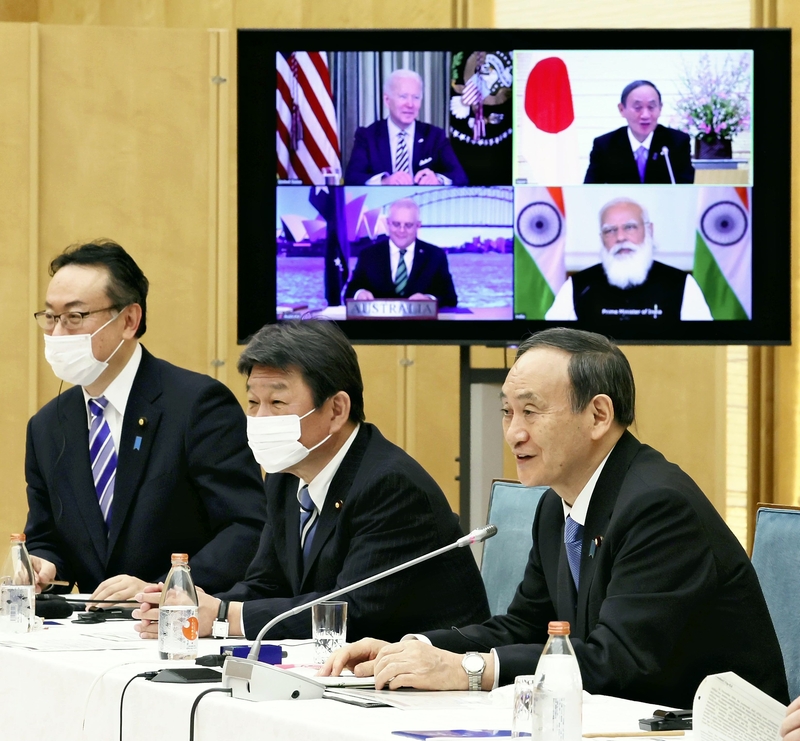
The Foreign Ministry issued a clear instruction to the Japanese Embassy in the United States prior to a March 12 announcement by the government that Prime Minister Yoshihide Suga would visit the United States in the first half of April to hold a summit meeting with President Joe Biden: "We must be the first."
The summit is indeed expected to be Biden's first face-to-face meeting with a foreign leader since he took office.
The launch of the Suga Cabinet has provided the Foreign Ministry with a golden opportunity to restore its standing.
Under the preceding administration of Shinzo Abe, which lasted for seven years and eight months, the Prime Minister's Office played a central role in diplomacy. Japan-U.S. relations depended completely on the top-level diplomacy between Abe and then U.S. President Donald Trump, while bilateral negotiations with Russia over the northern territories and with North Korea were handled behind the scenes by Takaya Imai, special adviser to the prime minister, and other officials.
Senior Foreign Ministry officials repeatedly expressed their frustration that they were not being informed at all.
With the change in power, some Foreign Ministry officials expect diplomatic efforts to return to normal operations with a bottom-up style, under which the ministry builds up arrangements through working-level to higher-ranked officials. This was why the ministry put particular focus on coordinating the Japan-U.S. talks this time. The ministry's enthusiasm was so strong that a senior U.S. government official found it surprising, wondering why Japan was so determined to become the first country to hold a face-to-face summit with the Biden administration.
Legacy left by Abe
There are several factors behind the United States' decision to hold its first in-person summit with Japan. Among other things, Washington aims to hold Beijing in check by demonstrating the importance it attaches to Tokyo as its biggest ally in Asia.
"The legacy of Abe diplomacy is still at work," a former cabinet minister said. Abe pushed the enactment of security-related legislation in the Diet in September 2015, which permits limited exercise of the right of collective self-defense. His administration had to deal with opposition parties that were strongly against the enactment, but Abe recalled that the legislation helped the Japan-U.S. alliance become "one in which we help each other."
The initiative for "a free and open Indo-Pacific," which Biden has touted since he took office, was repeatedly advocated by Abe, who helped make it known worldwide.
Abe championed a diplomatic approach that took "a panoramic perspective of the world map" and exercised his strong presence in the fields of diplomacy and security. In contrast, Suga gives the impression that he focuses more on domestic affairs. "I cannot handle diplomacy as well as Mr. Abe," the prime minister has been quoted as telling those around him.
The differences in their interests are illustrated by numbers compiled by The Yomiuri Shimbun. Abe had a total of about 670 meetings with senior officials in diplomacy and security over the last six months before he resigned, while Suga had only about 190 meetings with such officials over his first six months in office -- although a simple comparison would not be appropriate because the two periods involved different circumstances.
The National Security Council, which was established at Abe's initiative, also does not have a conspicuous presence under the new administration. Abe held council meetings twice a month, while Suga held his first meeting two months after his Cabinet was inaugurated. Suga took over from Abe discussions concerning whether Japan should have the capability to attack enemy missile bases, but they have effectively been shelved.
"The [Suga] administration has not had substantial discussions [on this issue]," a senior Defense Ministry official said.
Momentum for LDP
The Foreign Affairs Division of the ruling Liberal Democratic Party has gained momentum under the Suga administration. When the division held a meeting on March 11 at LDP headquarters, many members called for a tough stance on China.
"The government should show clearly Japan's position with regards to the human rights issues in that country," said one member. Another said, "Japan should rebut China's assertions concerning its Coast Guard Law."
"Mr. Suga lacks enthusiasm for diplomacy and security," said an LDP member with expertise in diplomatic affairs. "We have to take the lead."
Conservative members of the LDP urged the Prime Minister's Office to change its policy in connection with border control related to the novel coronavirus pandemic, as it had been cautious about suspending new entries from China and South Korea. The government eventually decided to ban all non-resident foreign entries, which these conservative members view as a victory. This kind of development was not seen during the Abe administration, under which lawmakers within the LDP did not hold much sway.
Regarding the northern territories, Suga delivered a video message when a national convention was held in Tokyo on Feb. 7 to demand their return to Japan.
"Based on the various agreements Japan has made with Russia so far, we will steadily proceed with negotiations in the future as well," Suga said. Abe attended the annual convention every year while in office.
While regular members of the audience took part in the convention remotely, Yukio Edano, leader of the Constitutional Democratic Party of Japan, and executives of other parties attended in person.
"Prime Minister Suga did not show up himself, but reportedly stayed at the public dormitory for Diet members," said a source at a private-sector entity that organized the convention. "He doesn't seem very enthusiastic [about this issue]."
A petition adopted at the convention included a statement that the northern territories "have been occupied with no legal grounds for the past 75 years."
The petitions adopted in the previous two years did not refer to "illegal occupation by Russia," in consideration of bilateral negotiations that the Abe administration had been engaging in. The revival of this wording in the latest petition means that organizers' hopes regarding the negotiations have faded.
Countries around the world are gradually getting diplomacy back on track as they roll out vaccines against the pandemic. This means the Suga administration's diplomacy will soon be put to the test.
Read more from The Japan News at https://japannews.yomiuri.co.jp/