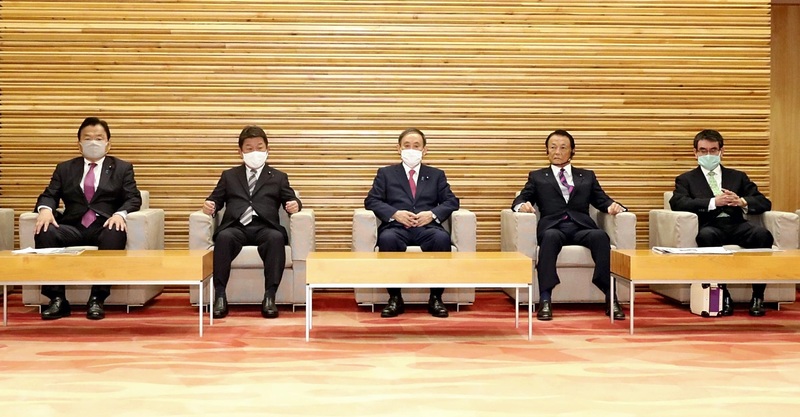
One month has passed since Yoshihide Suga became prime minister and launched his Cabinet. The policy-making process has changed from that of the administration of former Prime Minister Shinzo Abe, with instructions to cabinet members coming directly from Suga being more apparent. The prime minister's approval rating remains reasonably high for now, but a looming scrap with opposition parties over the government's decision to reject six candidates for the Science Council of Japan is shaping up to be Suga's first major hurdle as prime minister.
In an effort to ignite action, Suga has been summoning ministers including Takuya Hirai, minister for digital reform, to the Prime Minister's Office for special assignments.
"My job is to smash any resistance," Suga told them. "If you have any problems, tell me."
During his meetings with experts and businesspeople, Suga has set targets on issues including establishing an agency tasked with promoting the wider adoption of digital technologies, reducing mobile phone fees and enabling fertility treatment to be covered by insurance.
Speed is a hallmark of Suga's leadership style. The prime minister frequently checks on the progress of projects with the ministers in charge.
"The prime minister is quite impatient," Taro Kono, minister for administrative and regulatory reform, said during an address on Wednesday, but added, "Speeding up the process is what's needed right now."
The prime minister's stance is partly due to his desire to quickly build up his achievements and get his administration on the right track.
During Abe's tenure as Japan's leader, bureaucrats at the Prime Minister's Office -- including Takaya Imai, a secretary and special adviser to the prime minister who started his career at the Economy, Trade and Industry Ministry (METI) -- would essentially draw up an overall policy. Abe would often then attend meetings with his ministers and give them policy instructions. Abe's Cabinet was even dubbed the "METI cabinet" and often relied on the minitry's expert panels in compiling policies.
But these days, the commonly held view within Kasumigaseki, the area of Tokyo where many central government offices are located, is that METI is losing some of its power. This shift is symbolized by the abolishment of the Council on Investments for the Future, a panel whose establishment was spearheaded by the economy ministry to serve as a "control tower" for the nation's growth strategy.
This council will be replaced by a new council. However, the chief cabinet secretary -- not the prime minister -- will head this new entity, in what is effectively a demotion in status.
However, there also have been some grumbles about Suga's one man show.
While Abe was in power, Suga, who was then chief cabinet secretary, and Imai often were tasked with coordinating arrangements with the ruling parties and the government ministries and agencies.
There may be some difficulty in coordinating issues such as expanding insurance coverage for fertility treatment and making online medical consultations a regular practice because such issues tend to split camps between those who strongly agree and those who strongly disagree.
"It's impossible for the prime minister to do everything," a senior government official said. "If one of these policies ends in failure, he will leave himself open to direct criticism."
Science council controversy smoldering
The Suga Cabinet's fortunes could be shaped significantly by the extraordinary Diet session scheduled to be convened on Oct. 26.
The Cabinet received strong support in opinion polls conducted by various media companies soon after its launch, with the approval rating reaching above 60% or even 70%. The support rate of 74% logged in a Yomiuri Shimbun survey was the third-highest for a new cabinet.
However, an NHK survey conducted this month found support for Suga's Cabinet had slipped seven percentage points to 55%. This sent a shiver through the government and ruling parties.
"The Science Council of Japan issue is behind that drop," an LDP lawmaker said. "If the opposition bloc hounds the prime minister over this, the buoyant mood that greeted the new Cabinet will evaporate further."
The opposition camp has been on the offensive ever since the revelations that Suga rejected the appointment of six nominees to the council. Constitutional Democratic Party of Japan leader Yukio Edano slammed Suga's move as "improper interference in academia." Opposition parties are gearing up to grill Suga on this issue in the Diet, including in the budget committees of both Diet chambers.
Within the ruling parties, there have been whispers that if Suga can get through the extraordinary Diet session unscathed, he might dissolve the House of Representatives for an election soon after the next regular Diet session convenes in January.
"The prime minister will put himself in the race while his support rating remains high," a young lawmaker said.
However, Suga's close aides have hinted that dissolution of the lower house and a general election could be pushed back to autumn 2021.
"I think he will want to focus on bolstering his image by producing good economic results, hosting the Tokyo Olympics and Paralympics and conquering the novel coronavirus pandemic," one aide said.
Read more from The Japan News at https://japannews.yomiuri.co.jp/