
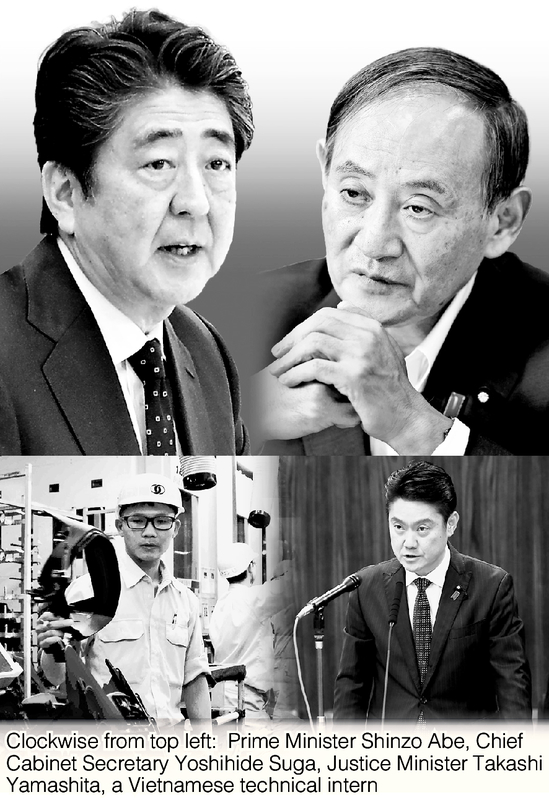
The revised Immigration Control and Refugee Recognition Law was recently enacted, allowing Japan to accept more foreign workers. Following is a look behind the scenes at how this historic policy change took place.
Chief Cabinet Secretary Yoshihide Suga did not hide his irritation during a study meeting held in a room of a hotel near the Prime Minister's Office in spring 2018.
"Do your jobs more seriously," Suga told senior officials of ministries including the Health, Labor and Welfare Ministry and the Agriculture, Forestry and Fisheries Ministry.
The purpose of the study meeting was to scrutinize actual conditions of personnel resources in industries before examining whether it was necessary to accept more foreign workers. However, what was submitted by each ministry at the meeting was nothing more than superficial data, such as the ratio of job openings to job seekers.
"There's no point in having this meeting any longer," Suga said, wrapping up what was to have been a two-hour meeting in just 30 minutes and leaving the room. His behavior left the participating officials with frozen faces.
Suga's direct bargaining
Circumstances had made bureaucratic circles cautious about the use of foreign manpower back then.
At the Cabinet Office's Council on Economic and Fiscal Policy held in February this year, Prime Minister Shinzo Abe expressed his willingness to accept more foreigners, saying the government needs to "swiftly examine our systems for accepting foreign personnel." However, Abe's support base in the Liberal Democratic Party are mainly members who have unfavorable opinions on a more open immigration policy. Back then, the LDP presidential election was still ahead, scheduled for autumn.
Under the circumstances, many senior ministry and agency officials were skeptical about Abe's intentions, wondering if the prime minister would ever work seriously on a policy likely to clash with those lawmakers' views.
In fact, Abe was not really positive about accepting more foreigners. Rather, it was Suga's initiative.
In autumn 2017, Suga learned through acquaintances about a shortfall in manpower in the nursing-care industry, and he began to grow concerned that the issue might become a drag on Abenomics if it was left unsolved.
At the end of 2017, Suga negotiated personally with Abe at the prime minister's office to let him address the issue. Abe conditionally accepted his offer, reportedly saying, "As long as it's not an immigration policy."
Stricter criteria
In order to save face for Abe, it was important to come up with a mechanism to help the government argue in the Diet that the new policy has "nothing to do with immigration policy." To that end, a bill was written that set the period of stay for foreign workers with so-called Category 1 status -- the majority of workers to be accepted under the policy -- at up to five years.
However, Japanese companies may have second thoughts about hiring employees whom they would train with care only to see them go back home after five years. The bill then created a two-tiered system whereby skilled workers with Category 2 status are allowed to bring their spouses and children and effectively stay permanently in Japan. At the same time, the bill stated that whether those workers can continue to extend their stay in Japan must be examined regularly, providing logic to defend the policy on the grounds that foreign workers "cannot always stay in Japan permanently only because they have the status," according to a senior Justice Ministry official.
Even so, cautious arguments over the policy were heard in the process of bill-screening by the LDP's Judicial Affairs Division, which started on Oct. 22. The division's director Gaku Hasegawa made phone calls to those around Abe and reportedly said, "The party won't stand for this without touching on measures to tighten conditions for the Category 2 status."
On Oct. 29, the judicial division compiled a written resolution demanding the government meet a list of 10 requests, including tougher prerequisites for the Category 2 status, and then gave an approval. Apparently due to the resolution, creation of the Category 2 status in construction and shipbuilding industries was passed on for the time being, which was a stumble on the part of the government, which had long explained that it "is considering introducing" the status in those industries.
Sympathy for Justice Ministry
In the Justice Ministry, which has jurisdiction over immigration law, many bureaucrats have career experience as prosecutors. Therefore, it is undeniable that compared to bureaucrats of other ministries, such as the Finance Ministry, who excel at behind-the-scenes work for ruling and opposition parties and communication with other ministries and agencies, those in the justice ministry are poor in those skills.
Their nature in that regard is symbolized by a scene at a meeting of the LDP's judicial affairs division.
"Why is it [the start of the new system] next April?" one of the participating lawmakers who was skeptical about the bill asked in questioning the Justice Ministry.
One of the ministry officials in charge responded, "Because the prime minister and the chief cabinet secretary made such remarks."
Opposition parties stepped up their criticism, with a senior Constitutional Democratic Party of Japan member quoted as saying that the government was "rushing to introduce a half-done system because the LDP wants to gain votes from industrial bodies in the House of Councillors election next summer."
A senior Justice Ministry official who heard the remark said with a sour face, "We should have said nothing but, 'Because Japan is suffering a labor scarcity.'"
Abe picked Takashi Yamashita, who had been elected three times and was a member of the LDP faction led by Shigeru Ishiba, as justice minister, putting him in charge of the passage of the bill, which Abe calls "the most important agenda at an extraordinary Diet session."
As a result, Yamashita often struggled to reply to questions before the Diet, and Abe's pick of Yamashita is seen among LDP members as a method of retaliation by the prime minister against Ishiba, with whom he faced off in the LDP presidential election.
Toward the end of this year, Yamashita and others have been busy compiling a basic policy to give the new system for accepting foreign workers specific form.
Officials of the other ministries and agencies feel sympathetic to the Justice Ministry, with one of them saying: "The prime minister's office did nothing but take an initial idea and then left the rest to the Justice Ministry. I feel sorry for them."
Read more from The Japan News at https://japannews.yomiuri.co.jp/













