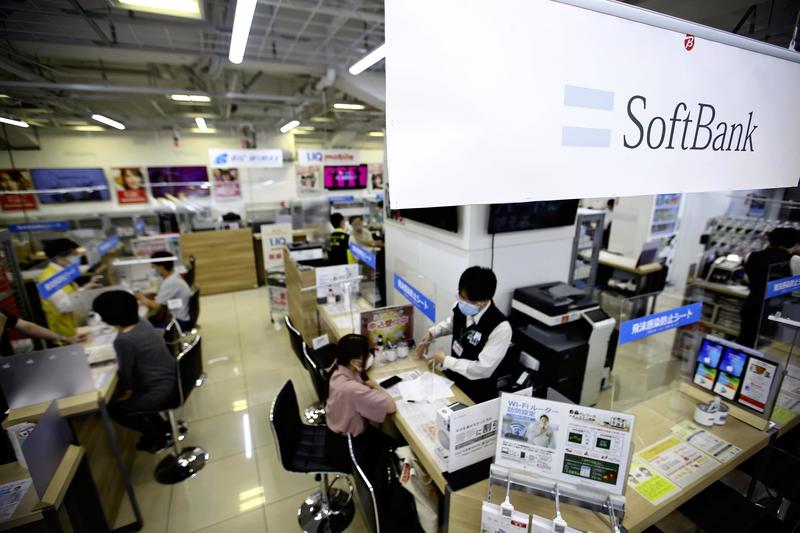
Prime Minister Yoshihide Suga on Friday instructed Internal Affairs and Communications Minister Ryota Takeda to begin working on lowering mobile phone service fees.
For Suga, who has adopted a motto of slashing certain vested interests, the reform of mobile phone fees is a long-cherished policy goal that can show the public what kind of Cabinet he is leading.
However, the government has already implemented various practical measures, so it is uncertain whether his Cabinet can hammer out further pragmatic actions.
Unless the goal is realized with a sense of haste, the public's expectations of the prime minister may quickly shrink.
-- Eye-catching policy
During the Liberal Democratic Party's presidential election campaign, Suga insisted that mobile phone fees "can be lowered by 40%," presenting it as an attention-grabbing policy.
Suga is highly sensitive to public opinion and has always made judgments based on the idea of, "What do members of the public consider to be a matter of course?"
The number of mobile phone contracts nationwide exceeds 180 million, meaning there is more than one mobile phone per person. Mobile phone networks are also seen as important infrastructure in the event of a disaster.
Suga's opinion is that "radio waves are public assets." Thus he judged it necessary to improve circumstances so that the burdens on the public are lighter.
Suga aims to continue with his predecessor's economic policy of Abenomics, but many people have pointed out that ordinary people who do not possess stocks or other financial assets have not felt its benefits.
As the issue of mobile phone fees could become widely popular, it seems that Suga aims to make the issue a stand-out feature of his Cabinet.
Consumers' expectations are high. In a survey the Internal Affairs and Communications Ministry conducted on 6,000 men and women nationwide in March this year, the percentage of respondents who replied, "I feel the subscription fees I pay to mobile phone service carriers are high" reached 40%.
A 67-year-old man without an occupation who visited a large-scale home electronics store in Tokyo on Friday said, "If [the government] lowers the fees, I'll be glad."
Shunsuke Kobayashi, chief economist of Mizuho Securities Co., said, "Lowering fees by 40% has the same level of impact as lowering the consumption tax rate by 1 percentage point."
-- Paradigm remains unchanged
The reason why Suga has been increasingly on the offensive with mobile phone carriers is because the financial burden on the public has not been reduced, even though the government has introduced various measures to make the companies lower fees and to encourage more competition among carriers since 2006, when Suga was internal affairs and communications minister.
According to the ministry's Family Income and Expenditure Survey, expenditure on mobile phone service fees per household in 2019 was 103,000 yen. This figure had increased by nearly 30% over the previous decade.
The ministry encouraged low-fee mobile phone carriers, which lease the telecommunication networks of major carriers, to enter the market so that users would find it easier to switch from major carriers.
Despite that, many Japanese consumers prefer the generous services provided by the major carriers and the sense of security that comes from using big companies. Thus the measure did not result in any remarkable change.
In April this year, Rakuten Inc. fully entered the mobile phone carrier market. Suga and Hiroshi Mikitani, president and chairman of Rakuten, hold meetings several times a year and have had a close relationship through exchanging opinions on topics such as developments in the industry.
It seems that Suga expected Rakuten would become a game changer. In spring this year, when Rakuten announced its mobile phone carrier plan for which the fees are about half those of the major carriers, Suga predicted to his aides that the major carriers "will surely lower their fees."
But Rakuten was slow to prepare, such as in setting up transmission bases, so has not yet become a presence that can drastically change the paradigm of the mobile phone industry.
The oligopoly, in which the three major carriers -- NTT Docomo Inc., KDDI Corp. and SoftBank Corp. -- hold nearly 90% of market share, has not changed.
There are no more practical measures in sight to further lower the charges. A senior official of the ministry said: "We have spent all our available bullets. We have to keep beating our brains out."
During the LDP presidential election campaign, Suga suggested raising the fees mobile phone carriers pay to the government to use radio waves in accordance with the number of their transmission bases and other factors.
If the payments increase, it is possible that the major carriers will instead pass the burdens on to their customers.
A source said, "It was no more than a verbal intervention." Some see Suga's remarks as an expression of the fact that he has few steps available to him.
Read more from The Japan News at https://japannews.yomiuri.co.jp/