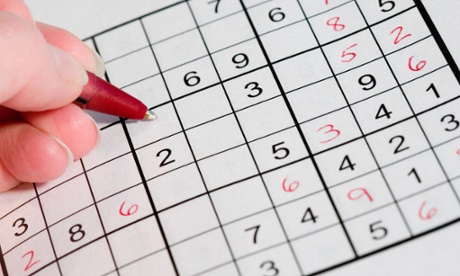
A team of doctors working at the University of Munich reports the unusual case of a young man who experiences epileptic seizures every time he tries to solve a sudoku puzzle.
The 25-year-old right-handed physical education student was buried in an avalanche during a skiing holiday, as a result of which his brain was deprived of oxygen for some 15 minutes. He then developed shock-like contractions of the muscles in his mouth when he tried to talk, and in his legs when he tried to walk.
Several weeks later, while trying to solve Sudoku puzzles, he developed clonic seizures in his left arm. These produce repeated jerking movements, and are far rarer than tonic-clonic seizures, which are typically preceded by muscle stiffness, and cause loss of consciousness.
In this case, the seizures stopped immediately when the patient stopped solving the Sudoku puzzle. He also experienced similar seizures when performing other visuo-spatial tasks, such as sorting random numbers into ascending order, but not when he read a book, wrote something down, or did calculations.
From Feddersen et al. (2015).
The doctors used functional magnetic resonance imaging (fMRI) to scan the patient’s brain while he was solving a Sudoku puzzle, and found that the seizures were caused by abnormally high levels of activity in the right central parietal cortex, a part of the brain involved in processing visuo-spatial information.
Diffusion tensor imaging (DTI) further revealed what appeared to be a complete loss of inhibitory fibres in the same part of the brain.
The unique case is an example of reflex epilepsy, characterised by seizures that are induced by external stimuli. The most common form is photosensitive epilepsy, in which seizures are triggered by flashing lights, but there have also been reports of people whose seizures are induce by reading, touching, taking a warm bath, or playing games. And in 2008, doctors at New York University Medical Center reported the case of a 24-year-old woman whose seizures were induced by the Sean Paul song Temperature.
In this latest case, the patient stopped solving Sudoku puzzles five years ago, and has been free of seizures ever since.
Reference
Feddersen, B., et al. (2015). Seizures From Solving Sudoku Puzzles. JAMA Neurol., DOI: 10.1001/jamaneurol.2015.2828 [Abstract]