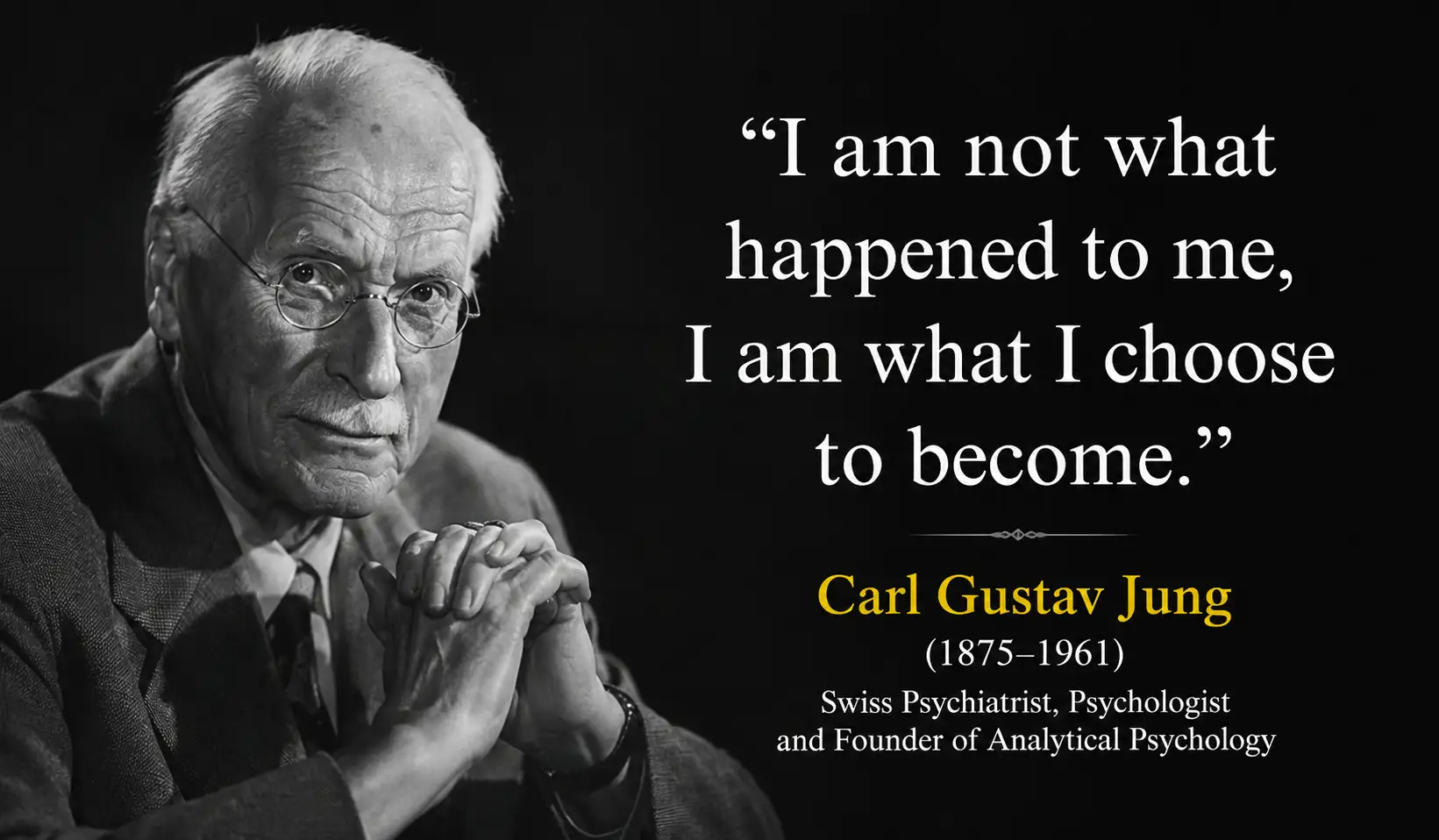
Success mantra of the day: Some ideas refuse to age because they speak to a struggle every generation inherits. Today's Success Mantra of the Day is one of them. The words, “I am not what happened to me, I am what I choose to become,” continue to resonate because they shift the conversation away from blame and toward responsibility.
At a time when many people feel trapped by setbacks, difficult childhoods, failed relationships, or professional disappointments, this insight offers something far more valuable than motivation—it offers direction.
The Success Mantra of the Day reminds us that identity is not frozen in past experiences. Instead, it is shaped by conscious choices made repeatedly over time.
As psychologist Carl Gustav Jung believed, lasting transformation begins when people stop seeing themselves as passive products of circumstance and start participating in their own growth.
Success mantra of the day: Carl Jung's most powerful success lesson still changes lives today
“I am not what happened to me, I am what I choose to become.” — Carl Gustav Jung
The enduring power of this Success Mantra of the Day lies in its rejection of victimhood without denying suffering. Jung never argued that painful experiences disappear or become unimportant. Instead, he believed that people possess the capacity to examine those experiences honestly and decide how they will respond. That difference is profound. One path keeps a person imprisoned by memory, while the other turns memory into wisdom.
History repeatedly reflects this truth. Leaders, innovators, artists, and ordinary people who rebuilt their lives after failure rarely erased their past. They learned from it. As another famous saying reminds us, “The wound is the place where the light enters you.” Growth often begins where comfort ends, and every meaningful achievement carries the imprint of difficult decisions made long before success became visible.
Meaning of the Success Mantra of the Day
The deeper meaning of this Success Mantra of the Day is that character is created through repeated choices rather than inherited circumstances. Modern psychology supports this principle through research on resilience, mindset, and personal agency. People cannot rewrite childhood, economic hardship, rejection, or unexpected loss, but they can reshape the beliefs and habits that follow those experiences.
Jung spent much of his career exploring the hidden parts of the human mind. He argued that genuine growth requires individuals to confront their fears, weaknesses, and unconscious patterns instead of avoiding them.
He described this lifelong process as becoming one's authentic self. Success, therefore, is not merely financial achievement or public recognition. It is the gradual alignment between actions, values, and purpose. The Success Mantra of the Day captures this idea in a single sentence, reminding readers that every decision either strengthens the person they hope to become or reinforces the person they no longer wish to remain.
Life Lessons From the Mantra
The first lesson here is agency. Trauma explains behavior; it doesn't have to script the future. People who've survived genuinely hard things — loss, failure, betrayal — often describe a turning point where they stopped asking "why me" and started asking "what now." That shift alone changes outcomes. Small decisions, repeated daily, quietly outweigh any single bad chapter, no matter how loud that chapter was.
The second lesson is subtler: victimhood and grief are not the same thing. You can grieve what happened and still refuse to be defined by it. Growth doesn't mean pretending the wound never existed. It means letting the wound teach you something instead of controlling you. That's the whole engine behind resilience — not the absence of pain, but the refusal to let pain write the ending.
About the Philosopher
Carl Jung, born in 1875 in Switzerland, founded analytical psychology and spent his life mapping the unconscious mind — dreams, archetypes, the shadow self. His central idea was individuation: becoming your true, integrated self by facing the parts of you that are easiest to ignore.
There's an old Stoic thread running underneath this too. Epictetus, centuries earlier, argued that it's not events that disturb us but our judgment of them — we don't control what happens, only our response to it. Jung's psychology and Stoic philosophy meet right here: both insist that freedom lives in the response, not the circumstance. It's a small shift in framing. But it's the difference between carrying your past and being carried by it.
Success Mantra Recap: Your history may explain you, but it does not define you. What you build today, decision by decision, is always heavier than what happened yesterday.