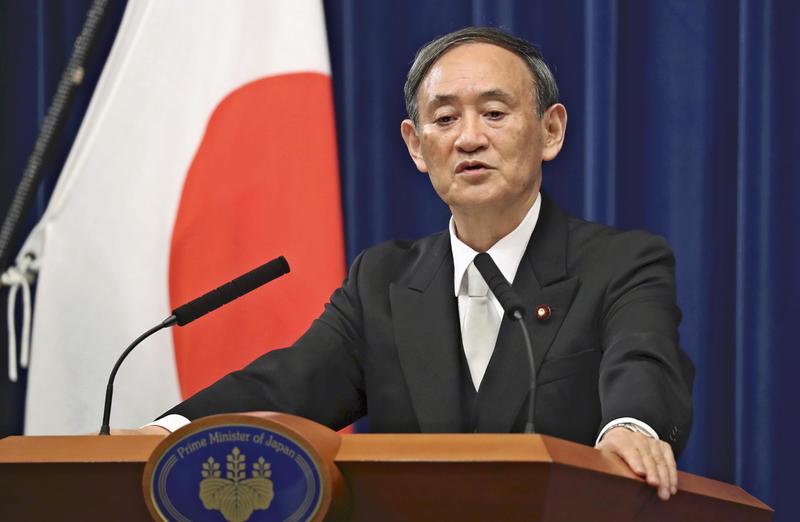
As one of its key priorities, along with the novel coronavirus and economic measures, the newly launched Cabinet of Prime Minister Yoshihide Suga has listed measures to cope with the declining birthrate that center on insurance coverage for fertility treatment. It is concerned that the declining birthrate will accelerate further due to the pandemic. Creating a social environment in which people can bear and raise children without anxiety is an urgent task.
At his first press conference since taking office on Sept. 16, Suga stressed his intention to step up efforts to tackle the declining birthrate. One of the government's items in its five-point basic policy, approved by the Suga Cabinet on the same day, called for "tackling the declining birthrate and building a secure social security system." To that end, it stipulated the goal of "realizing insurance coverage for fertility treatment."
Support for fertility treatment was one of the policy priorities included in the Outline of Measures for Society with Decreasing Birthrate, which the government announced in May. Although this had not been a major item at the time the outline was being drafted, it suddenly became a major issue as nearly half of 3,800 public comments, or about 1,700, which were collected before the outline was unveiled, were about fertility treatment. In light of this, the outline included an additional statement that the government would conduct research to study measures to reduce the economic burden of fertility treatment, including how to use medical insurance programs for effective treatment.
Apparently aware of such "public sentiment," Suga expressed his willingness to "provide wide-reaching support for households hoping to have children." Some people welcomed the proposal, with such comments as: "Infertility treatment costs several million yen. The burden is huge economically, mentally and timewise." Others say the policy could become "a step forward in creating a society in which people bear children more easily." On the other hand, others voiced caution, saying that a measure that will allow women to have children while they are young is more necessary in terms of cost effectiveness.
Currently, only some fertility treatments, such as using fertility drugs to induce ovulation, are covered by public health insurance. Assisted reproductive technologies, such as expensive external fertilization and microinsemination, are not subject to insurance coverage. The government subsidizes medical services that are not covered by public health insurance. A household in which a married couple earns less than 7.3 million yen a year is eligible to receive a subsidy of 300,000 yen for the first time and 150,000 yen for subsequent times.
The number of children born through assisted reproductive technologies performed in 2017 was about 56,000, or 6% of all babies born that year. It is said that one out of every 5.5 couples has been tested or treated for infertility.
Instructed by the prime minister to work on the issue "as soon as possible," Health, Labor and Welfare Minister Norihisa Tamura said the government will aim for early implementation of the insurance coverage for fertility treatment. "As there are various methods for infertility treatment, it is necessary to confirm the safety and effectiveness of the treatment to be covered by insurance," Tamura said. "We want to create a system that will obtain public understanding."
As it will be a certain period of time before insurance can cover fertility treatment, the government is urged to first consider expanding the current subsidy system. The ministry plans to include funding for fertility treatment subsidies in its budget request for the next fiscal year.
As a measure to tackle the declining birthrate, Suga also vowed to put "an end" to the issue of childcare waiting lists by expanding childcare services.
The outline also calls for considering creating a paternity leave system and increasing financial aid during childcare leave and benefits for families with many children, among other matters. To eliminate the number of children on childcare waiting lists, it is necessary to secure more nursery teachers and improve their working conditions. Raising childcare leave benefits requires a reasonable amount of financial resources.
Seiichi Eto, who was state minister for measures for the declining birthrate when the outline was announced, addressed the need to take such steps as strengthening taxation on assets and using companies' internal reserves. Whatever measures will be taken, the government is urged to secure financial resources to avoid supporting child-rearing by imposing "debts on children and grandchildren."
Read more from The Japan News at https://japannews.yomiuri.co.jp/