The cultural and entertainment sectors are being hit hard as the coronavirus pandemic shows no signs of being brought under control.
Japan's live entertainment market in 2020 is estimated to have shrunk to about one-fifth the previous year's level. The government has decided to extend the ongoing third state of emergency and the Cultural Affairs Agency launched a new subsidy program in late April, but problems remain.
-- Silent demonstration
On Thursday evening, about 80 people involved in theater, live music, mini-theaters and other entertainment businesses stood silently in front of the Prime Minister's Office, holding signs that read, "Culture and arts are necessary to live."
The demonstration was organized by We Need Culture, a group of people who have come together from various industries amid the pandemic. The group is calling strongly for financial aid and other support for artistic activities.
Under the current state of emergency, which started on April 25, the government has made such requests as asking theaters to hold performances without audience members, and asking movie theaters with a floor area of more than 1,000 square meters to close.
As the state of emergency, which was initially planned to end Tuesday, will be extended until May 31, the government decided to ease some of the restrictions for theaters and certain other facilities. However, the states of emergency imposed so far have weighed heavily on entertainment businesses.
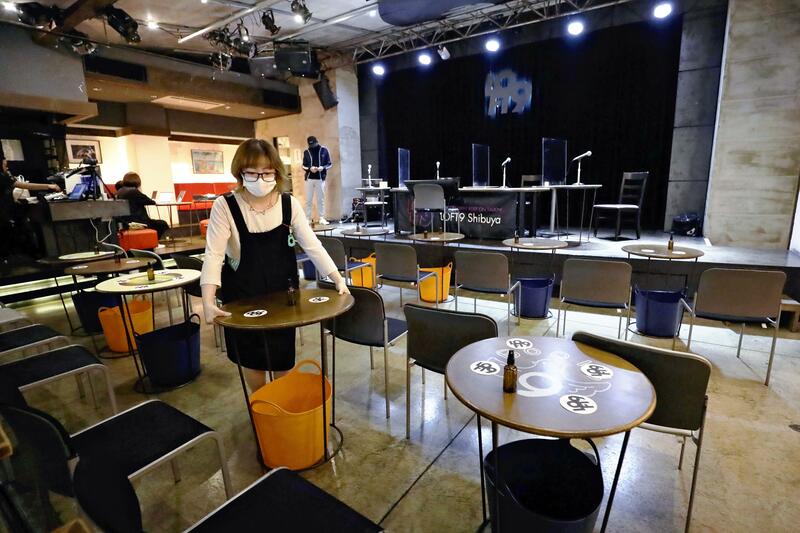
Loft Project is a company that operates live music venues mainly in Tokyo. When the third state of emergency was declared, company President Umezo Kato decided to operate the venues until 8 p.m., serving food but suspending the provision of alcoholic beverages.
The venues are open with their seating capacity reduced by half.
"Sales are now 30% of what they were before the pandemic," said Kato, 54. "Live music venues are not just space for rent, they are places that create culture. We hope these venues will be recognized as cultural facilities and provided with support to stay in operation."
-- Support via organizations
In late April, the Cultural Affairs Agency began accepting applications for its first large-scale support program for cultural and art activities amid the pandemic since last July. The program is called "Arts for the future!" and provides subsidies in a wide range of areas including movie theaters, museums and live music venues.
The program was funded with 25 billion yen from the third supplementary budget for last fiscal year.
"Arts for the future!" extends support for "proactive efforts" such as hiring young people and streaming performances online. The agency will provide up to 25 million yen for such efforts to subsidize performance fees, venue costs and other expenses until the end of this December.
It also subsidizes the costs incurred by canceling performances that were initially scheduled for Jan. 8 or later, in areas subject to a state of emergency.
Another feature is that support is intended to be delivered to individuals through organizations. Last year, the government allocated 50.9 billion yen to support freelancers and other individuals involved in culture and entertainment, as well as small groups in those fields.
However, after the program was launched in July last year, applications for subsidies stalled due to the complexity of the procedures involved. Ultimately, the application period was extended.
About 79,700 applications were accepted, but about 12,000 were turned down due to incomplete submission of documents and other reasons.
-- Various aid sought
The new subsidy program has also created strong dissatisfaction among people in the field. The government's support is intended for organizations and people with concrete plans for activities. However, many people in the entertainment industry have been forced into financial hardship due to the pandemic, and do not have the wherewithal to continue their work.
In light of this, some people are calling for compensation for the loss of work.
"We appreciate such subsidies, but performers struggling amid the coronavirus crisis can't afford to continue their activities, and organizations and businesses have lost their strength and can't even apply [for the subsidies]," said Koichi Iriyama, 58, chairman of the Japan Association of Classical Music Presenters.
"I wonder if money could be provided not as a subsidy but in the form of benefits, compensation or cooperation money," Iriyama said.
Shintaro Fujii, a Waseda University professor specializing in cultural policy, stressed the need to prioritize speed and simplify the framework for support.
"Artists and performers, including those work on a freelance basis, are at the center of culture. If funds aren't delivered to them with a high degree of freedom, it's meaningless," Fujii said.
Read more from The Japan News at https://japannews.yomiuri.co.jp/