When the Liberals won government in 1996, the first of the six Collins Class submarines were just coming into service.
From the start, there was controversy.
In the parliament, we were constantly pointing out what a hash the previous government had made of the execution of this naval contract.
The problem started with selecting the Swedish Saab Kockums' submarine over its German rivals in the 1980s. The final product built in Adelaide had several shortcomings, and the Collins Class were labelled 'dud subs', when they first came into service. Initially, the periscopes didn't work, the internal IT couldn't be easily updated, and the diesel engines were too noisy.
In the parliament, we rubbished the Hawke-Keating government for such poor defence decision-making, which also had the effect of lowering public confidence in Australia's defence and gave comfort to any potential enemies.
Looking back, it is hard to believe that we were so irresponsible when scoring political points. Such harsh criticism of a preceding government's policy on submarine purchase has become a pattern since then.
With every new prime minister since Howard, there has been a change in Australia's submarine acquisition policy.
This was the prime ministerial merry-go-round: Rudd (ordered Attack class), Gillard (didn't progress the Attack class), Abbott (Japanese 'off the shelf' Soryu submarines), Turnbull (Attack class - again, with a French partnership), Morrison (nuclear powered US or UK or hybrid subs).
With every new PM since Howard, there has been a change in Australia's submarine acquisition policy.
Australia's submarine program has stood still for 14 years because of this chaotic decision-making. The consequence is that the arrival date for the new submarines has blown out to 2040.
Australian naval security remains dangerously exposed despite the historical significance of the new AUKUS defence agreement, which will deliver highly effective nuclear-powered submarines as part of our defences.
With the new submarines not in service for another 20 years, Australia will face an increasingly hostile Indo-Pacific naval environment, until at least 2040, as China rapidly builds its maritime fleet.
So what should Australia do to fill the capability gap?
In the new century, Australia faced a similar problem with air defences.
The nation had an aging fleet of F/18A fighter aircraft. The air force had signed up for 70 US F35 Lightning 11 stealth fighters, which are only now being delivered. To close the gap, in 2007, we bought 24 F/A -18F Super Hornets very cheaply from the US. Problem solved.
We now need a similar stopgap solution to maintain a viable submarine fleet over the next 20 years.
There are several things we can pursue to reduce our security exposure. With our six Collins Class submarines nearing the end of their lives, the government plans to gut each of them in turn and replace the internal hardware and software in a 'life of type extension' at the cost of at least $6billion.
This is a second-rate, but now unavoidable, measure because of the naval policy dithering. Australia should also buy/lease ASAP several existing nuclear submarines to create a powerful deterrent in the 2020s.
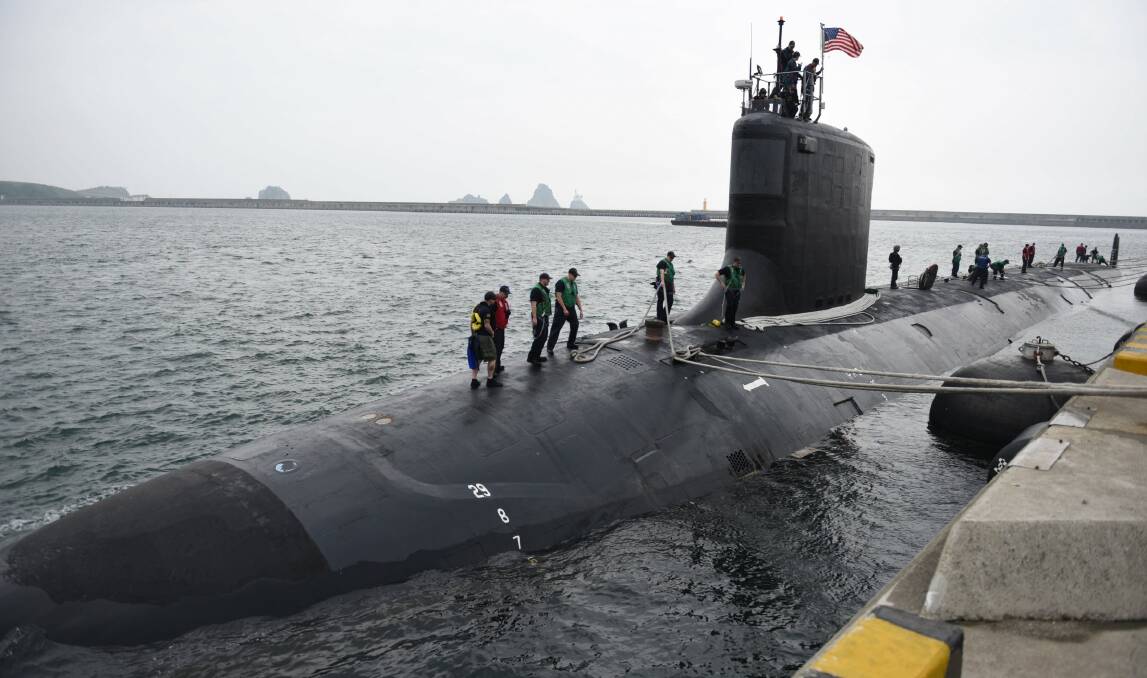
We should not choose the UK Astute-class submarines because of the delay created by the necessary US weapon system modifications. Instead, Australia should immediately buy/lease several existing US Virginia-class nuclear-powered submarines, which could be operational before the mid-2020s.
With the planned build of the 12 nuclear-powered submarines in Adelaide, we should stick with the US Virginia-class model. We can cut many years off the Australian build of the submarines if we don't redesign the US model or build a US/UK hybrid.
This would be repeating the terrible mistakes that have bedevilled Australia's previous naval projects with cost overruns, schedule slippages, and technical problems.
We need to bring off-the-shelf submarine capability onboard as soon as possible.
With China aggressively boosting its submarine fleet in the Indo-Pacific, we cannot have too many submarines as a deterrent.
Without the additional stopgap plan, our naval defences will be left dangerously exposed towards the end of the 2020s in an increasingly hostile Indo-Pacific region.
This would not be a good time to have fewer Australian submarines in the water.