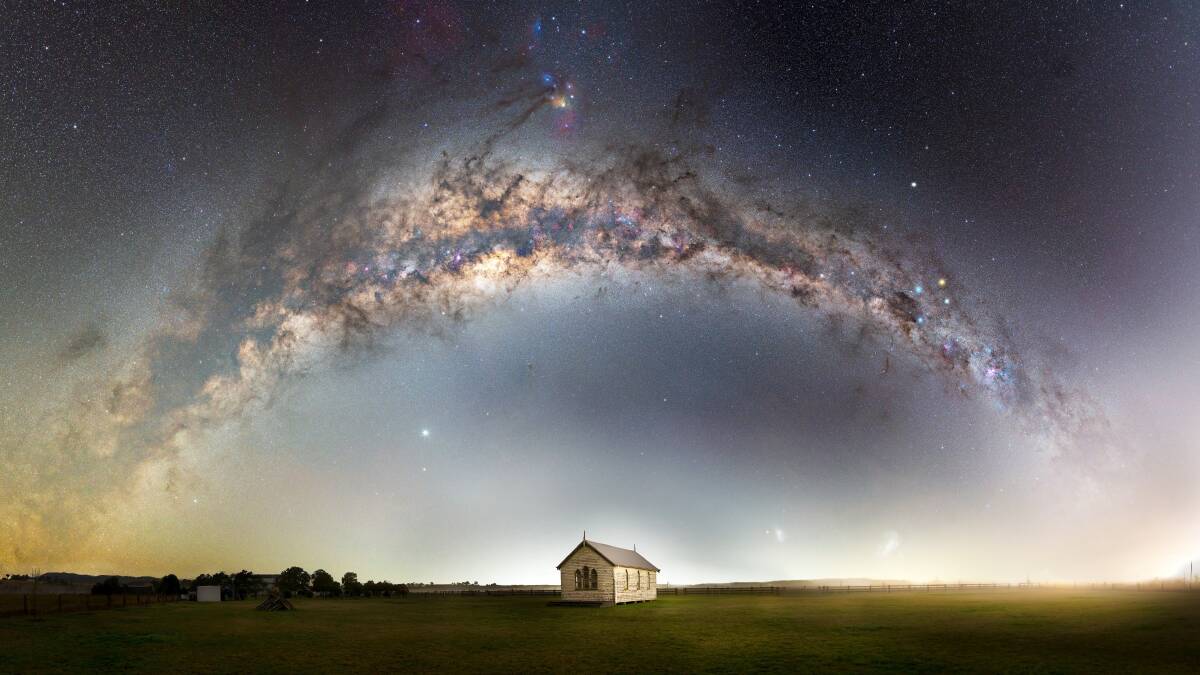
Everything changed for John Rutter when he pointed his camera skywards.
"Cameras can see things that our eyes just can't - intense colours, billions of stars, other galaxies and of course our home galaxy - the Milky Way," said John, of Branxton.
"The mind-blowing part is, due to the size of the universe and the speed of light, astrophotography is literally taking a picture of the past."
John's photo of the arched Milky Way, titled Heavens Above, has been featured on the travel blog Capture the Atlas. Each year, the blog selects the best photographs of the Milky Way galaxy from around the world.
John's image captured the Milky Way arch above the Little Paddocks Chapel at Glendon in the Hunter Valley.
"I have always had a fascination with the night sky," John said.
"While travelling around, I would always look up and just be blown away with how many stars were out there."
Dark skies are needed to capture Milky Way images.
"This means I only get around 10 days a month to shoot - when the moon is not prominent in the sky."
Weather plays the biggest part.
Wind, fog, cloud and haze all affect the image. "Planning is the key to Milky Way photography," he said.
This involves going to locations during the day, using apps to show where the Milky Way will be at night.
Capturing the images usually involves "a cold, long night, taking anywhere from two to four hours per image".
"I take my images all over the state, but due to needing to get away from light pollution - it's mainly country towns well away from major cities," he said.
John said the best places in the Hunter for stargazing were away from the city and towns.
"Light pollution will wash out the sky and hide all the goodness," he said.
"The vineyards are a great spot to take the family for a night of stargazing. Set up away from any lights and let your eyes adjust for 20 minutes.
"Avoid the temptation to get your phone out, as this will ruin your night vision. Lay back and enjoy the show. Satellites, meteors and even the international space station are all common sights."
Once you've photographed or observed the Milky Way, you may want to "explore a little more and see a little further".
"A telescope is a natural progression. Although Milky Way photography will always be my passion, deep space astrophotography with a telescope is something I also enjoy. Just like our seasons, astronomical objects are visible at different times of the year for the same reason [the Earth's orbit around the sun]. This means that we only see the core of the Milky Way for about eight months of the year.
"During the other months, the perspective is a little different but no less jaw-dropping."
The Shug
Ellalong's Sally Butler has created a new way to hug.
Influenced by the elbow-touch - used as a substitute for the handshake [often comically] during the pandemic - she came up with a "substitute for hugging".
"Stand back to back, touch shoulders and rub," she said.
"I've dubbed this the shug - sort of a safe hug. Share the shug not the bug."
Joke of the Day
The Milky Way has been reviewed on TripAdvisor. It received 100 billion stars.