
- Used electric cars are the best option for people who want to save money in the long run.
- A new study from the University of Michigan found that a used EV can save owners as much as $13,000 during the car’s lifetime.
- Meanwhile, a comparable gas car can save drivers up to $3,000.
Huge monthly car payments are now a thing in the United States, with more than 20% of Americans having agreed to pay over $1,000 each month for a new car loan.
That can be incredibly stressful on a household’s budget, but new research shows that there are cars out there that cost a lot less to purchase outright, and–more importantly–will save you money as time goes on.
Used EVs are now the cheapest cars to own over a 10-year vehicle life period, according to a new study from the University of Michigan published in Environmental Research Letters. In short, a three-year-old electric mid-size SUV can offer an average lifetime savings of $13,000 compared to a new gas-powered mid-size SUV. Meanwhile, a used gas SUV from the same category can deliver a lifetime savings of just $3,000, according to the study’s authors.

"Transportation is the second-largest portion of the average household's budget and, in the new vehicle market, EVs are usually more expensive," said Maxwell Woody, the lead author of the study. Woody is a research assistant at the U-M Center for Sustainable Systems, or CSS, and the School for Environment and Sustainability, or SEAS. "But 70% of all vehicle purchases are used, and used EVs have the lowest cost of ownership across vehicle classes."
That’s just the big picture, though. When digging deeper into the data, it shows that used EVs can deliver big savings in most parts of the United States. However, there are scenarios where electric cars will struggle to break even with their combustion-powered counterparts, and it’s important to note that the study’s results are based on two big factors: EVs depreciate more than gas cars after the first few years on the market, and owners will predominantly use home charging to keep costs down.
That last part can prove a little difficult for drivers who are constantly on the road and need frequent top-ups at public DC fast chargers. In fact, the study says that using only public charging, someone who drives a used EV may spend more on fuel than someone who drives a hybrid, but will still save some money compared to someone who drives a pure gas car.

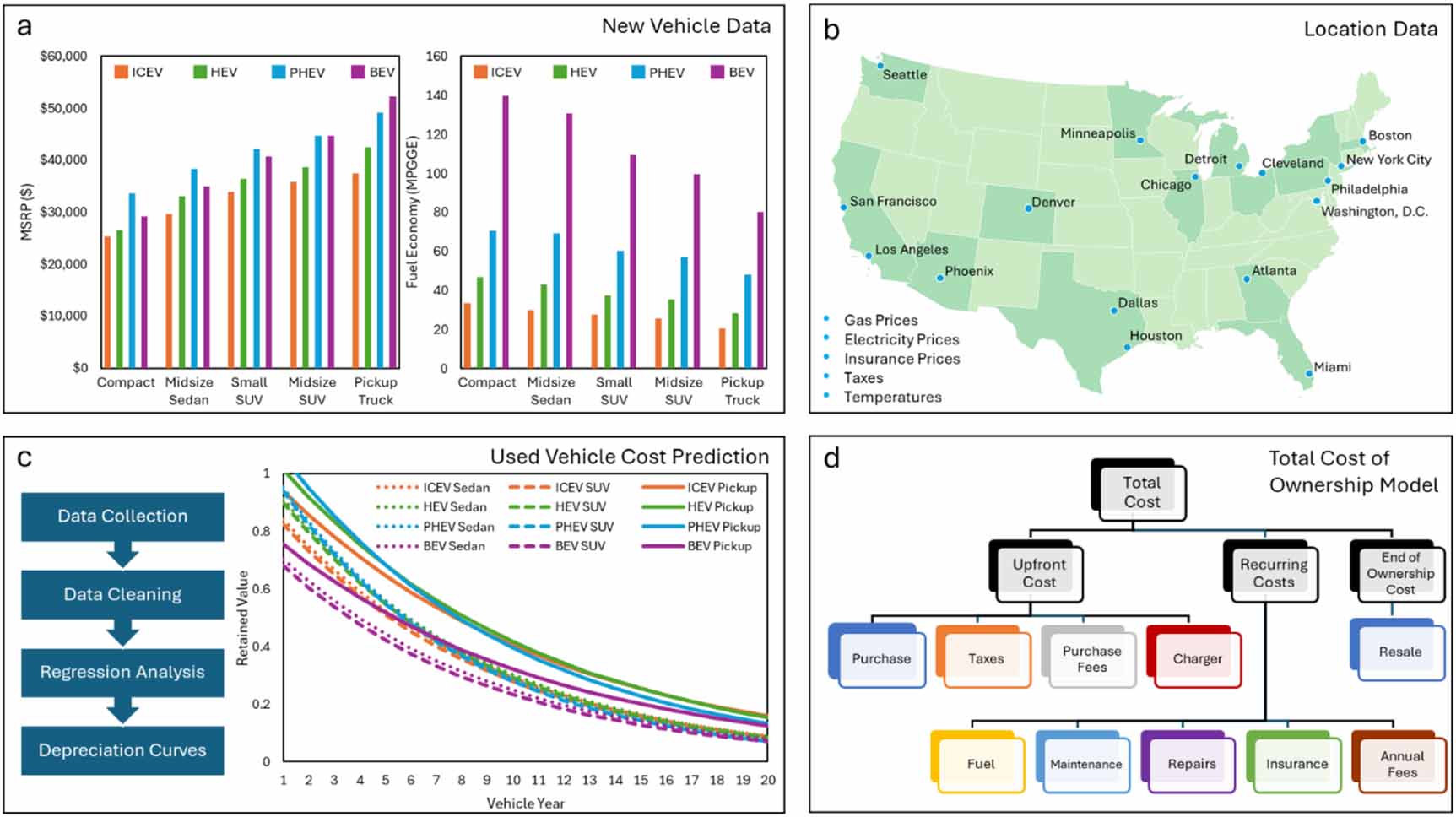
As a result, the authors assumed that owners will charge 80% of the time at home and 20% at home chargers. For at-home charging, the researchers took into account 50% off-peak prices, 25% part-peak prices and 25% peak prices, where these apply. The costs of installing and permitting a Level 2 home charger were also taken into account, seeing how the majority of EV owners have never owned an electric car before and most likely do not have a home charger. For public charging, the study used 50% level 2 charging and 50% DC fast charging.
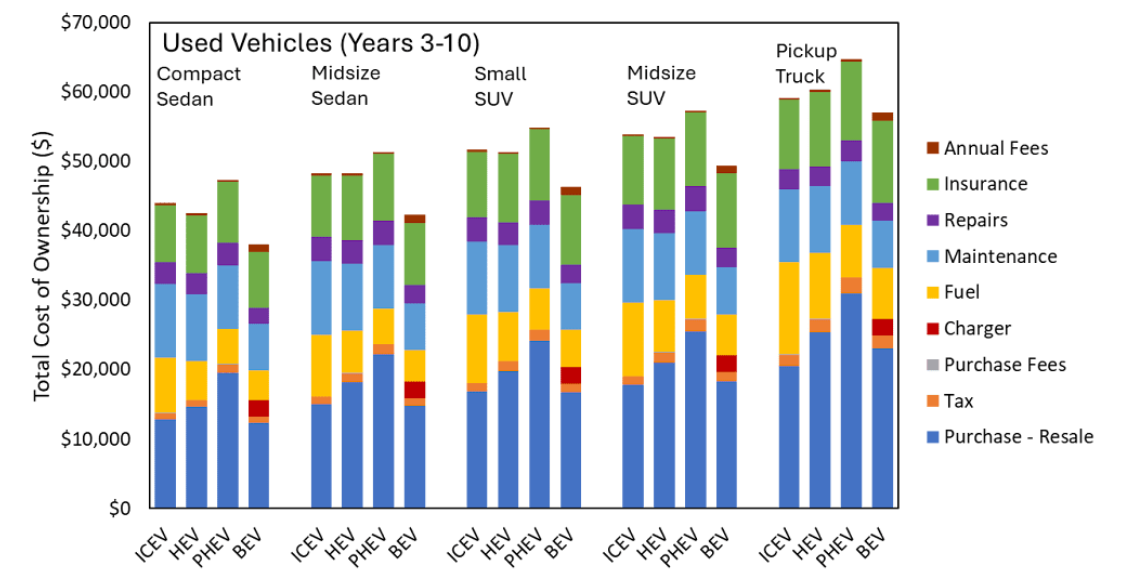
Researchers zeroed in on used cars that were put up for sale after 3 years, and considered a vehicle’s life to be 10 years, leading to a 7-year ownership period. The total cost of ownership was calculated using various formulas that took into account the upfront costs, recurring costs and end-of-ownership costs, and three-year-old EVs came out on top in every single category.
The study assumed an average annual mileage of 15,000 miles, with four powertrain types and five vehicle classes thrown into the mix. Pure combustion vehicles (ICE), hybrids (HEV), plug-in hybrids (PHEVs) and battery electric vehicles (BEVs) were analyzed using 260,000 Craigslist listings for used cars. What’s more, the average fuel and electricity costs in 17 cities were considered, and key vehicle parameters from Argonne National Laboratory’s Autonomie model were used to come up with virtual characteristics.
In other words, the cars used in the study are not real models from real manufacturers. Instead, they are representative synthetic vehicles that meet certain performance thresholds, enabling researchers to compare across powertrains. This is good for consistency, but it also comes with its own problems, one of which is the fact that there are no plug-in hybrid pickup trucks for sale in the United States.
According to the study, going for a new EV will rarely be cheaper over a seven-year ownership period compared to gas or hybrid counterparts. In fact, in the small SUV, mid-size SUV and pickup truck categories, EVs have the highest total costs of ownership, according to the University of Michigan’s study.
However, the data changes considerably when looking at three-year-old EVs that are used over a seven-year period. In all vehicle categories, the electric option is much cheaper to run, coming in under $40,000 for a compact sedan, just about $40,000 for a midsize sedan, about $45,000 for a small SUV, about $50,000 for a midsize SUV and under $60,000 for a pickup.
So, what does all of this mean for America’s car market? "It's not the most positive news if you're in the market for a new EV, knowing that your resale value may be impacted by the faster depreciation," said Greg Keoleian, senior author of the study and co-director of the Center for Sustainable Systems. "But if you're in the market for a used vehicle, it's very positive news."