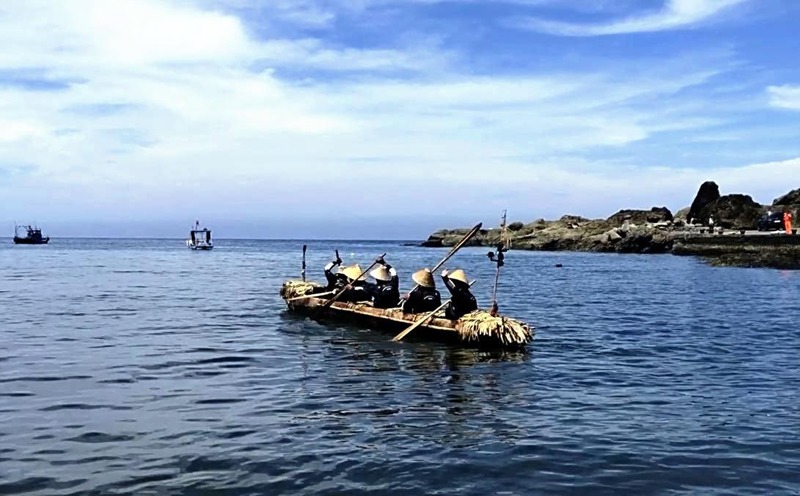
A research team led by Prof. Yosuke Kaifu from the University of Tokyo's The University Museum concluded that Japan's forebears sailed from Taiwan to the Ryukyu Islands, present-day Okinawa Prefecture, about 30,000 years ago and did not drift across the waters, in a paper published in an international scientific journal.
Various studies show the path of the Kuroshio current running between Taiwan and Yonagunijima island into the East China Sea has not changed over the past 100,000 years.
The researchers floated 138 buoys -- equipped with transmitters used to study ocean currents -- from the coasts of Taiwan and the Philippines between 1989 and 2017, and 127 were carried north by the Kuroshio current.
However, six traversed the strong current, and among them, four floated to within 20 kilometers of the islands of Okinawa Prefecture.
Using the current prediction system developed by the Japan Agency for Marine-Earth Science and Technology, the team calculated that these six buoys crossed the Kuroshio current, which were churned by typhoons and north winds.
Ancient rafts or canoes usually would have capsized in the rough seas.
"Many drifting buoys ended up north of Taiwan," Kaifu said. "It's realistic to assume that people who failed to cross the Kuroshio current had to rethink their operations and aim for Yonagunijima," Kaifu said.
In July 2019, Kaifu and his team succeeded in re-creating the journey using a dugout canoe, crossing from Taiwan to Yonagunijima. However, it was not possible at that time to prove whether Japan's forebears sailed to Yonagunijima as their destination or merely drifted ashore, carried by the tide.
Read more from The Japan News at https://japannews.yomiuri.co.jp/