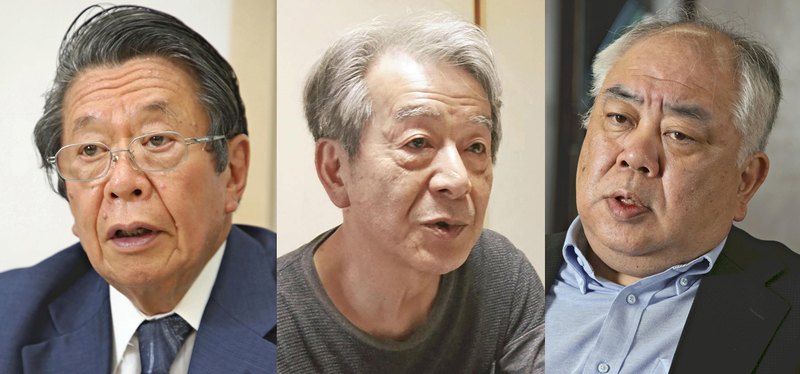
Former Aum Supreme Truth cult leader Chizuo Matsumoto, also known as Shoko Asahara, and six followers who were senior leaders of the cult were executed on July 6 for their involvement in a series of horrendous crimes. To learn how Japan's legal system, antiterrorism measures and other aspects have changed since the incidents, and to examine the links between religion and terrorism, interviews were conducted with former heads of the Public Prosecutors Office and Tokyo Metropolitan Police Department and a religious studies scholar. The following are excerpts from the interviews.
(From The Yomiuri Shimbun, July 7, 2018)
Victims' voices reflected in criminal trials
The attacks carried out by the Aum Supreme Truth cult were unprecedented acts of indiscriminate murder aimed at overthrowing the state. These crimes were unimaginable in what the public thought was a peaceful country.
The Aum attacks led to major changes in the criminal justice system, with the victims being the driving force behind these changes. After previous incidents, victims and bereaved family members rarely spoke publicly.
In the Aum attacks, people and their parents, spouses and children suddenly had taken away from them their lives and livelihoods, by a religious organization they had nothing to do with. The victims and their families expressed their sadness and anger in the media.
Seeing this, the public confronted anxiety and fear that they, too, could become victims, and public sympathy for the victims became widespread. At the same time, there was a surge of interest in investigations and trials.
Under public scrutiny, several flaws in how investigations and trials were conducted came to light.
For example, victims and family members were sometimes unable to view trials because of full courtroom galleries, and they had no opportunities to speak in court. The prosecutors and judges who had prided themselves on working for the sake of victims realized this was just a preconceived notion.
Following these considerations, starting in the 2000s improvements to the system were undertaken to better reflect the views of victims and the public. These included making trials faster, giving victims preferential seating and providing redress to victims. This also played a role in helping to realize the lay judge system, which enables the public to participate in criminal trials, and a system that allows victims to participate in the process, such as by directly questioning defendants in court.
In investigating the Aum attacks, investigators used an understanding of the cult's doctrines to obtain confessions from former senior cult members and others, which helped them solve the cases. The strong bonds among conspirators in organized crime make obtaining objective evidence difficult, which can hinder investigations.
Nevertheless, I hope investigators will become more proficient in new methods of countering organized crime. These include the use of "digital forensics" to analyze electronic data from computers and smartphones.
It can't be stated unconditionally that the system for suppressing terrorist organizations is sufficient. After the attacks, the Subversive Activities Prevention Law was not applied to forcibly break up Aum. The group's continued existence leaves us with a feeling of discomfort.
The "new Aum law," which allows for the surveillance of groups that could carry out terrorist attacks, has so far only been applied to the Aum group. It remains to be seen if it can effectively be used against other groups attempting to carry out indiscriminate terrorism.
The problems we were forced to confront after the Aum attacks should not be treated like things of the past. Society as a whole needs to learn lessons from them.
-- This interview was conducted by Yomiuri Shimbun Staff Writer Katsuro Oda.
-- Keiichi Tadaki / Former Prosecutor General
Tadaki, 75, is a lawyer who served as administrative vice minister and deputy vice minister of the Justice Ministry before being appointed prosecutor general in 2006. After retiring, he served on a panel to study how prosecutors should perform their duties that was created at the ministry in response to scandals involving prosecutors.
Turning point in police antiterrorism policies
The sarin nerve gas attack on the Tokyo subway system carried out by the Aum Supreme Truth cult was an unprecedented, indiscriminate act of terrorism using chemical weapons in Japan.
Such a terrorist attack was made possible with the "money" collected from followers and the "scientists" among the cult's leadership who had graduated from universities of science.
When the attack occurred, I was head of the security department at the Osaka Prefectural Police Department. The idea that terrorism could be bought with money was shocking. At the time, we were implementing antiterrorism measures as Osaka prepared to host a meeting of the Asia-Pacific Economic Cooperation forum.
I remember that after the attack, we quickly checked the flow from air vents at the hotels where important figures would be staying, envisioning a terrorist attack with chemical weapons.
Until the subway attack, the police's antiterrorism measures were mainly concerned with domestic extremists. These focused on protecting government-related facilities and important foreign visitors that could be targeted by extremists as a means of conveying their messages.
This terrorist attack by a religious group, however, was not so much based on any ideology, to state it radically, but was dependent on the mood of cult leader Chizuo Matsumoto, and thus more difficult to deal with.
The cult had gotten into trouble in several places and was seen by the police as a "suspicious religious group," but not as having the capacity to carry out a major terrorist attack. The label of religious group caused the [law enforcement] authorities to hold back, and the lack of intelligence on the cult made the authorities ill-prepared to realize the present danger.
We never envisioned that sarin nerve gas would be used in a terrorist attack. We paid attention to weapons such as bombs and firearms, but chemical weapons were not seen as a realistic threat.
The subway attack was a turning point for antiterrorism policing. Security measures were no longer limited to important facilities and were strengthened at so-called soft targets where large numbers of people gathered. The private sector also became involved in antiterrorism efforts, which until then had been seen as only the job of the police.
Special units for exclusively dealing with nuclear, biological and chemical terrorism were created in nine prefectures. However, because chemical weapons such as sarin nerve gas are considered military weapons, they cannot be dealt with by the police alone. Collaboration with the Self-Defense Forces has increased, such as through joint training and knowledge sharing on the strong points of various materials and resources available to the SDF and police.
The group that succeeded Aum seems to treat Matsumoto as a subject of worship. His deification must be prevented. The police need to focus on how believers are treating Matsumoto's death and make sure they do not utilize it to attract more followers.
The Tokyo Olympics and Paralympics will be held in two years. Intelligence capabilities must be strengthened to ensure a second Aum does not appear. As time has passed since the subway attack, the number of people who know little about it is increasing. The lessons on what allowed this terrorist attack to occur should not be left in the past.
-- This interview was conducted by Yomiuri Shimbun Staff Writer Go Tateishi.
-- Katsuhiko Ikeda / Former Metropolitan Police Department Superintendent General
Ikeda, 65, entered the National Police Agency in 1976. After holding posts that included chief of the security department at the MPD and of the security bureau at the NPA, he was appointed MPD superintendent general in 2010. From 2012 to 2015, he served as the first secretary general of the Secretariat of the Nuclear Regulation Authority.
Fight exclusivism, hostility toward society
The Aum Supreme Truth cult first appeared as a yoga group that encouraged meditation for health, beauty and other purposes. Young people were attracted by mystical experiences. They gathered in dark rooms and their sleep and food intake were restricted to reach extraordinary states of consciousness.
It was Chizuo Matsumoto who cleverly systematized such experiences of a world outside the mundane as "religious training."
Normally, humans live by compromising with other people in everyday life. Our society is a multidimensional world made up of a wide variety of values. Since the Meiji era (1868-1912), religious organizations have carried out their activities as part of social order and have continued to exist by compromising with the nation.
However, Aum, which introduced a live-in community system, rejected relations with the outside world. Followers closed themselves off in their own world and sought bliss by training to reach higher stages. Through this process, they deepened their dependence on Matsumoto and Aum.
Though initially a yoga group, Aum became radicalized in its own enclosed society, transforming into an abnormal group that treated murder as a positive doctrine it called "poa."
I was cross-examined as a witness for the defense during appeal hearings for Kiyohide Hayakawa, an Aum member [who was executed on July 6]. I gave my analysis and opinions on the Aum Supreme Truth cult from my position as a religious studies scholar. Hayakawa and many other believers left their homes to live together in the closed space where Matsumoto's unified sense of values could be purely cultivated.
It seems likely that Matsumoto came to perceive himself as a charismatic, absolute figure through the process of being approved by senior members of the cult. With this in mind, Aum's dangerous doctrines were not the result of Matsumoto's notions alone, but were created out of the relationships between followers and the cult's leadership.
Aum's exclusivism and unified values led to conflict with society. When this was combined with a sense of victimhood, Aum became even more hostile to regular society. Because they saw regular society as hindering their true faith, they carried out a variety of attacks.
While some may have thought twice about carrying out crimes, followers considered the crimes a form of training that would help elevate them to higher stages. Broadly speaking, therefore, their participation was voluntary. It appeared quite rare in the world to conduct terrorism by claiming that it is a form of religious training.
After the Aum attacks, concern about religious terrorism increased in Japan. Yet religious terrorism continues around the world, as seen in the attacks perpetrated by the Islamic State of Iraq and the Levant militant group. Even in Japan, words and deeds stemming from discrimination or bias could lead to another incident.
We need to ask questions such as how religion became linked with terrorism and what happened in the process for words and deeds to become radicalized. To prevent another attack, we need to keep examining the path that Aum took and to inform later generations about what we have learned.
-- This interview was conducted by Yomiuri Shimbun Staff Writer Kyohei Ishii.
-- Kunimitsu Kawamura / Professor Emeritus at Osaka University
Kawamura, 68, served as a professor at Tenri University and Osaka University. In April 2016 he became professor emeritus of Osaka University. He specializes in religious studies. He coauthored a book with Kiyohide Hayakawa titled "Watashi ni Totte Aum to wa Nan datta no ka" (What was Aum for me?).
Read more from The Japan News at https://japannews.yomiuri.co.jp/