End-of-day summary
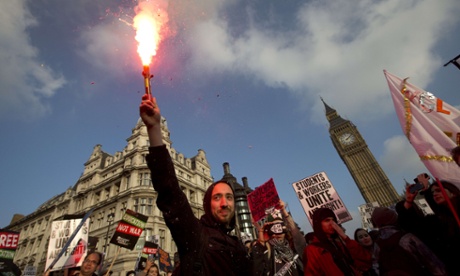
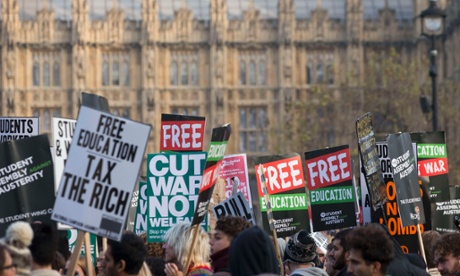
Today’s demo in support of free higher education has drawn to a close. Here are the key points:
- Organisers say 10,000 students joined the march calling for an end to university tuition fees, making it the the biggest mobilisation of students since 2010, when fees of up to £9,000-a-year were introduced.
- The Metropolitan police said four people were arrested at the demo, two for allegedly assaulting a police officer, and two for alleged affray. Three police officers suffered minor injuries.
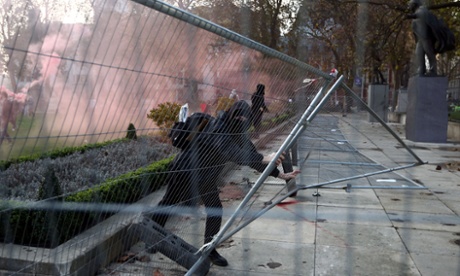
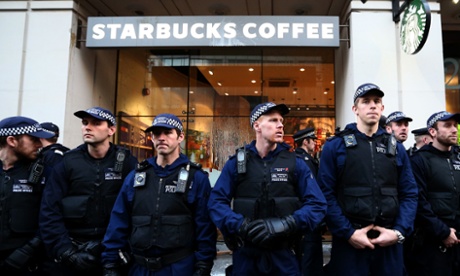
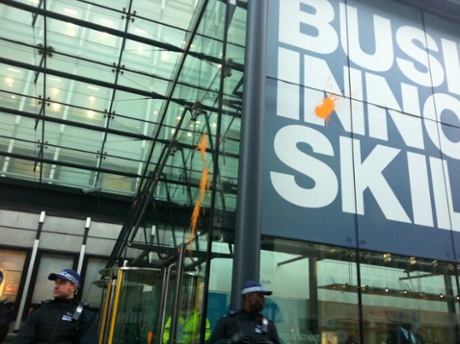
- There were scuffles as some protesters pushed down barriers in Parliament Square, while others threw paint at the Department of Business, Innovation and Skills and a nearby Starbucks.
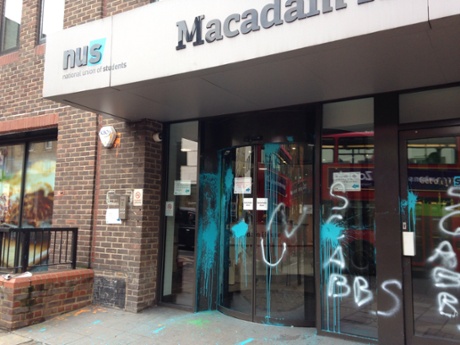
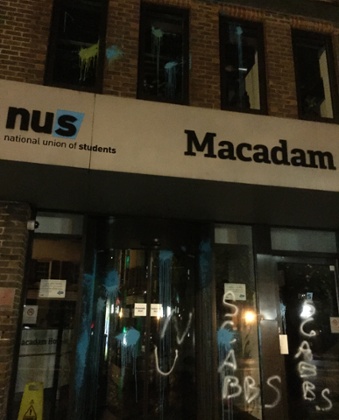
- The offices of NUS England were daubed in paint ahead of the march, after the union withdrew its support, citing safety fears.
- But the majority of the demo passed off peacefully, with protesters listening to speeches from Green party politicians Caroline Lucas and Natalie Bennett, and dancing to a samba band in front of the Palace of Westminster.
That’s it for the liveblog for today. Thanks for reading, and for all the comments and tweets.
Matthew Taylor, who was with protesters today as they marched through London, has filed his report. Here’s a snippet of it:
A student protest that attracted thousands of people onto the streets of London on Wednesday ended with a series of scuffles and accusations of police violence. Organisers said the demonstration against tuition fees and wider cuts to education was the biggest mobilisation of students since 2010 when demonstrators occupied Tory party offices at Millbank.
Today’s protest saw the National Union of Students headquarters in London daubed with paint after it decided not to back the protest due to ‘an unacceptable level of risk’ to its members. The move provoked widespread anger among those who took part in Wednesday’s march.
‘We did not organise what happened at the NUS but we do know students are very angry about being let down by the NUS,’ said Beth Redmond from the National Campaign Against Fees and Cuts, which was one of the groups that organised today’s demonstration. ‘When you see the numbers here today they are in danger of becoming an irrelevance.’
Organisers claimed that up to 10,000 protesters took part in today’s march with university students joining those from further education colleges and sixth forms.
The protest passed off peacefully until demonstrators arrived at Parliament Sqaure. A break away group of several hundred, including many who were wearing masks, pulled down fences blocking off the square, provoking minor scuffles with the police. They then occupied the area in front of parliament as the main body of the march continued to the final rally point.
For the next two hours smaller groups of a few hundred protesters played a game of cat and mouse with police, staging impromptu protests outside government departments, high street chains accused of not paying their tax and Conservative Party headquarters, where at least one arrest was made.
Police officers tried to keep up with the fluid groups of demonstrators as they wound their way through the back streets between Westminster and Victoria. Paint bombs were thrown at the department for Business Innovation and Skills and nearby Starbucks. Later police ‘snatch squads’ picked out people in the crowd and made several arrests provoking an angry reaction from the crowd.
At one point a protester was violently wrestled to the ground and dragged away. His friends told the Guardian he was a Turkish Kurdish student in his late 20s studying at London’s Birkbeck University.
The Metropolitan Police said three officers had suffered minor injuries. ‘Various missiles were thrown at the officers and protesters pulled down protective fencing around the grass area in Parliament Square,’ the force said in a statement.
Students from as far afield as Glasgow and Cornwall travelled to London for the demonstration, which organisers hope will kickstart a wider campaign in favour of free education.
You can read the full article here.
Updated
The slogan and hashtag for today’s demo – #FreeEducation – has prompted questions from some who have asked what the alternative is to fees. Richard Adams, the Guardian’s education editor, has been picking over the options:
One thing that the marchers in London don’t appear to be offering is an alternative way of funding higher education other than through direct government support via taxation. There are alternatives – such as a graduate tax, as in Australia – although as Nick Hillman, former special advisor to David Willetts as universities minister, argues: ‘We shouldn’t forget that the funding model we have could well prove better than many of the alternatives. It is not perfect, but it does deliver well-funded universities with lots of places.’
But the current model has unique problems of its own: that the student loan system for tuition fees will only pay back a fraction of the government’s financing. Even some conservative estimates expect that 40% of student loans will not be repaid for various reasons, and that many students will eventually see their student loans retired in 30 years time.
That figure may rise in the future when the impact of the government’s parallel plan to remove the cap on undergraduate student numbers takes effect. From 2015, universities will be able to recruit as many students as they see fit, without restraint or any level of minimum qualification. Even if the additional 60,000 students expected to take advantage of the new policy follow current estimates, that’s another 40% of loans likely not to be repaid. If, however, they drop out in greater numbers or fail to achieve well paid jobs, the proportion of unpaid debt will rise further. Eventually the shell game that the government is playing – lending money to students to pay universities, to repaid later – will be exposed.
A report published this week [pdf] by the centre-right thinktank Policy Connect raised these concerns, concluding that ‘the potential decline in quality for students, and the lack of control on public funding of student loans could prove problematic.... there is a serious issue with implementing a policy that dramatically increases the costs of student loan write-off for future governments, without being able to make a strong estimate of what that write-off will be’.
The report agrees with the Russell Group of universities that future governments may pay for the loan write-offs with cuts to research funding. The Russell Group remains ‘extremely concerned’ about unlimited student numbers for this reason.
As a result, higher education funding has all the symptoms of a political nightmare: a huge, expensive and complex problem that can be put off for future generations to deal with. For that reason student financing looks set to join the dismal club of climate change, pensions, healthcare and transport policy.
Press Association has filed this update on the march:
The demonstration began peacefully when student protesters gathered outside the University of London near Euston, before leaving to march through the capital shortly after noon.
But after it reached the Houses of Parliament the atmosphere grew more hostile, and hundreds of police and riot officers were deployed in the area.
Protesters tore down railings surrounding Parliament Square and took over the grass area, chanting in defiance over tuition fees and austerity cuts, while others wearing black bandanas let off flares as they marched through nearby streets.
Demonstrators hurled orange paint over the entrance to the Department of Business, Innovation and Skills before riot police formed a cordon.
Customers were also trapped inside a Starbucks coffee shop after eggs and white paint were thrown over the front window.
Riot police, some left covered in paint themselves, guarded the entrance as a group of demonstrators shouted abuse over the company’s alleged tax avoidance.
Flower pots were also thrown at police and bins were knocked over and paint thrown at a McDonald’s restaurant.
Tensions mounted when a man was arrested in Victoria Street, and angry crowds hurled abuse at officers and stormed after them as they led him away.
A large group then held a sit-down demonstration outside New Scotland Yard, where they chanted against the police and the Tory party.
Updated
It looks as if today’s demo has drawn to a close. I’ll post a summary of the day’s events shortly.
Police confirm four arrests
The Metropolitan police, however, is confirming just four arrests: two for allegedly assaulting a police officer, and two for alleged affray.
Four arrests at student march & rally in central London. 2 x assault on police. 2 x affray.
— Metropolitan Police (@metpoliceuk) November 19, 2014
Updated
The National Campaign Against Fees and Cuts, one of the organisers of today’s demo, has an update on the number of arrests today:
Heard reports that 12 people in total have been arrested. People are gathering outside Belgravia police station #freeeducation
— Against Fees & Cuts (@NCAFC_UK) November 19, 2014
Updated
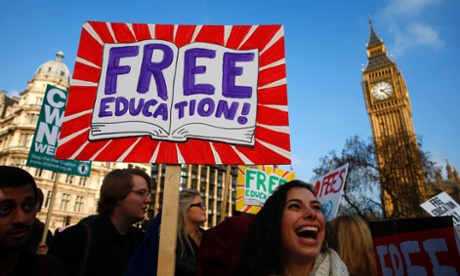
You can check out our gallery of photographs from today’s demo here:
Some students are already on the bus home:
Lots of happy #Brighton & #Sussex students on the #happybus following demo in London for #FreeEducation #Nov19 pic.twitter.com/hVl79d0wHl
— The Big Lemon (@thebiglemon) November 19, 2014
The National Campaign Against Fees and Cuts, one of the organisers of today’s demo, has been very quick to distance itself from the support offered by Ukip:
UKIP appear to have put out a statement in support of #freeeducation. To be clear: we don't want your support, or any racists' support.
— Against Fees & Cuts (@NCAFC_UK) November 19, 2014
Support for today’s protesters from a perhaps surprising quarter: Ukip.
The party’s education spokesperson, Paul Nuttall, has put out a statement backing students:
These students go off to university with no concept of the debt that they will rack up in the following three years and Ukip thinks it is wrong they should be saddled with such a millstone around their necks.
To end this great social injustice Ukip would remove the young people who have shown ability from having to pay tuition fees if they take a degree course in the sciences, technology, maths or medicine.
It does look as if things are drawing to a close.
From Victoria station area, which witnessed scuffles between protesters and police earlier:
#FreeEducation demo coming to end. Prob biggest since 2010. Lot of anger and wide range of groups. Interstg to see what happens next
— Matthew Taylor (@mrmatthewtaylor) November 19, 2014
And from Parliament Square, where, reports Abby Young-Powell, there is just a small group of protesters left, dancing to a samba band as the sun goes down.
It is getting dark now, and students are peeling away from the gathering in Parliament Square. Kirsty Haigh, a vice-president of NUS Scotland (which, unlike NUS England, supported today’s demo) tweets this picture from the scene:
Parliament square is still full of students #freeeducation pic.twitter.com/BzPmJyviUm
— Kirsty Haigh (@KirstyEHaigh) November 19, 2014
Matthew Taylor has some more information on the student who was seen being tackled to the ground by police officers (you can see the video here):
According to his friends, he is a Turkish Kurd studying history, politics and economics at Birkbeck University in London. ‘He was just walking outside John Lewis and they attacked him,’ said a fellow student who declined to be named. ‘He hadn’t done anything at all – we are all just here to protest. It was really violent: he looked like he was unconscious for a while.’
The man has been carrying a yellow flag and his friends said was part of a ‘UK community organisation’. They added: ‘The police said he is going to be charged with assaulting an officer but I just hope someone caught what happened on camera.’
Protesters scuffle with police – in pictures


This Vine, posted by independent journalist Vinnie O’Dowd, appears to show a protester being bundled to the ground by police officers.
Matthew Taylor, who was close to the scene, reports:
It happened in a pedestrianised area just near Victoria Station at about 3.30pm. A man in his 20s – who protesters told the Guardian was a Kurdish student – was forcibly bundled to the ground. He did not appear to be posing any great threat at the time of the arrest.
It was one of several violent arrests carried out by Territorial Support Group police officers as the breakaway demonstration snaked its way through the backstreets around Victoria station.
A crowd of around 100 protesters surrounded the police as the man was pinned to the floor, with some minor scuffles breaking out. The man has now been put in a police van and the crowd largely disbursed.
Paint was thrown at the Department for Business, Innovation and Skills (BIS), Natalie Gil reports, and the department has shut its front entrance:
Matthew Taylor reports that things are getting more heated away from Parliament Square:
Pretty violent. Police arrest squads going in and picking people out of crowd.
— Matthew Taylor (@mrmatthewtaylor) November 19, 2014
Reports of arrests
There are reports coming through of a few arrests – only a handful at this stage – and Matthew Taylor says a few hundred protesters are in a stand-off with police officers from the controversial Territorial Support Group (TSG) outside an All Bar One, where there have been “scuffles”, he reports.
The National Campaign Against Fees and Cuts, one of the organisers of today’s demo, also reports there have been a few arrests close to Conservative party campaign headquarters (CCHQ).
Another arrest near Scotland yard #freeeducation
— Against Fees & Cuts (@NCAFC_UK) November 19, 2014
Updated
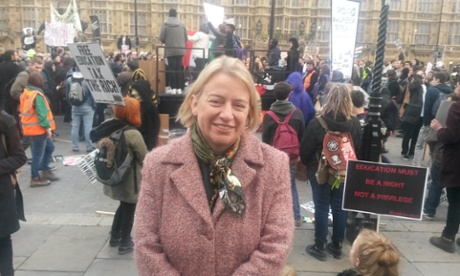
Green party leader Natalie Bennett joined the march half way at High Holborn and spoke to Frances Perraudin:
There’s a really great atmosphere, a real sense of purpose and direction and determination.
I was really pleased to see placards saying ‘no racist scapegoating’ and, in light of the Rochester by-election tomorrow, that’s a really important message.
But there are scuffles elsewhere, Matthew Taylor reports:
Breakaway from breakaway #FreeEducation demo now outside dept of Bis. Lots of police. pic.twitter.com/zjFkNm2yIX
— Matthew Taylor (@mrmatthewtaylor) November 19, 2014
Paintbombs (with stink bombs inside by the smell) thrown at Starbucks. Some minor scuffles with police. pic.twitter.com/Rn1jgw5J69
— Matthew Taylor (@mrmatthewtaylor) November 19, 2014
Police now trying (unsuccessfully) set up kettle. All bit chaotic.
— Matthew Taylor (@mrmatthewtaylor) November 19, 2014
The mood in Parliament Square is peaceful, Abby Young-Powell reports:
There doesn’t seen like too much of a police presence at the moment; helicopter above and police on the ground are keeping a distance.
It’s a contrast to a number of student protests this time last year, when students clashed with police. Last year a number of students were arrested at student protests, leading to ‘cops off campus’ protests.
Green party MP Caroline Lucas is addressing students in Parliament Square:
.@CarolineLucas MP addresses protestors outside parliament. 'Education is a good in itself and shouldn't be commodified' #FreeEducation
— Guardian Students (@gdnstudents) November 19, 2014
As is party leader Natalie Bennett:
Impassioned words from the Greens– leader @natalieben says students should vote next year – they can break politics wide open #FreeEducation
— Natalie Gil (@natalierosegil) November 19, 2014
Updated
But as this Vine from Frances Perraudin shows, the mood in Parliament Square itself is calm, with plenty of mooching about:
Updated
The marchers appear to be splintering into smaller groups, some of which are heading away from Parliament Square.
Some have reached Conservative Campaign Headquarters (CCHQ), behind Parliament Square, according to this tweet from Jonathan Simons, who works for the Policy Exchange (PX) think tank.
And now a load of students are pulling down scaffolding next to PX and trying to storm CCHQ. That'll definitely help yr case #FreeEducation
— Jonathan Simons (@PXEducation) November 19, 2014
Matthew Taylor reports that the group occupying Parliament Square is now moving off away from the rally point towards Victoria Station. There is minimal police presence, he adds.
Matthew Taylor reports from Parliament Square:
A few hundred protesters – many of them with faces covered as part of the so called black bloc grouping – pushed over the barriers around Parliament Square as the demonstration went past. A few police tried to stop them, while others looked on.
Several hundred protesters are now on the square while the main body of the protest has continued to the final rallying point.
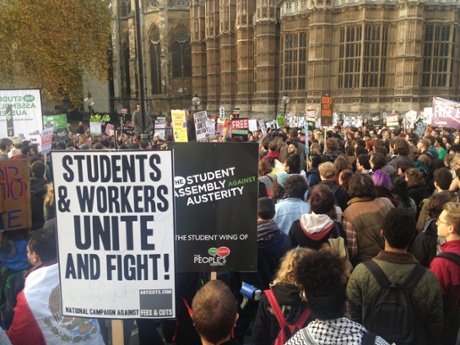
Abby Young-Powell reports that students are gathering to listen to speakers. “Education needs to be free to everyone,” they say, to cheers. There’s a friendly atmosphere, Abby adds, as someone next to her warns another protester that their bag is wide open. Other students are sat down eating packed lunches.
Lawrence Wakefield says students are moving in to Parliament Square en masse now, ignoring organisers’ calls to keep marching.
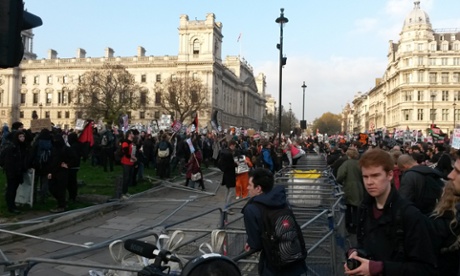
But it’s not a huge surge – most demonstrators are calm and simply milling about in the square, colleagues report. Police officers do not seem troubled.
#FreeEducation protesters have (predictably) occupied fenced off parliament square. Probably police plan all along.
— Matthew Taylor (@mrmatthewtaylor) November 19, 2014
Political journalists at Westminster are getting a good view as students take over Parliament Square:
Big protest in Westminster now moving onto Parliament Sq pic.twitter.com/2RliQy3ACJ
— Isabel Hardman (@IsabelHardman) November 19, 2014
The barriers around Parliament Square are toppling as students push forward – Lawrence Wakefield sends me this picture (spot the flying police hat):
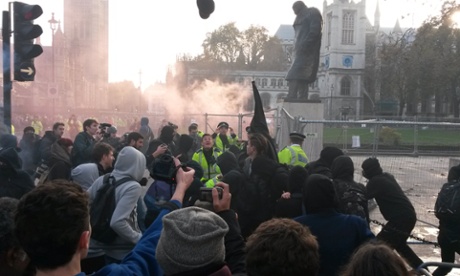
Frances Perraudin sends this Vine of students heading past Downing Street – and police officers – on their way to Parliament Square:
Marchers are now outside Downing Street.
David Cameron can you hear us? We're outside your door #FreeEducation pic.twitter.com/BEOSSDflty
— Sumaiya (@sumaiyav) November 19, 2014
Some of the crowd are shouting “Tory scum”. Some are taking selfies. I’d say the selfies might be winning out:
Downing Street Selfie #FreeEducation pic.twitter.com/WddYxwMWNl
— The Cheese Grater (@UCLCheeseGrater) November 19, 2014
Updated
Why is NUS England not taking part?
Education editor Richard Adams explains:
Today’s protest is taking place place without the involvement of the National Union of Students – unlike the previous one in 2011. While NUS Scotland is taking part, the NUS national executive decided not to back today’s effort on the grounds of what it described as unacceptable levels of risk during the march, as well as accessibility issues.
Toni Pearce, the NUS president, said the national body commissioned a risk assessment based on the information it was given by organisers – the National Campaign Against Fees and Cuts and the Student Assembly Against Austerity – and decided that ‘there are inadequate measures in place’ to avoid problems.
‘The reality we are confronted with is that this demonstration presents an unacceptable level of risk, is not accessible and does not meet the minimum expectations our members would expect for an action that carries NUS support,’ Pearce said in her statement earlier this month.
‘NUS has policy to support free education, and we will continue to lobby and campaign for this, but no action that we take should be put above the ability for all our members to be safe. We have gone to considerable lengths to help change that position, by working with the organisers, but that time has now run out,’ she said.
Some on the march have been noisily unimpressed with this attitude:
Not so keen on the NUS here today at the #FreeEducation march pic.twitter.com/naIW4AZmXd
— sally weale (@sweale) November 19, 2014
The march has now crossed Trafalgar Square and is pouring down Whitehall towards Parliament Square.
A bleak addition to the ranks of demonstrators – Mexican students have joined the march to protest the killing of 43 students in the southern Mexican city of Iguala. The 43 student teachers disappeared and are believed to have been murdered seven weeks ago, after they were attacked by police. You can read the Guardian report on that here.
Mexican students have joined the #FreeEducation march to protest against the murder of 43 students pic.twitter.com/xMLGqdCegf
— Luke James (@LEJ88) November 19, 2014
The front of the march is now approaching Trafalgar Square. There have been a few handy targets for demonstrators and their chants along the route:
Chants of "Pay your tax!" outside Topshop pic.twitter.com/d52vP1HgRh
— Guardian Students (@gdnstudents) November 19, 2014
Boos as the protest goes past the Savoy #freeeducation pic.twitter.com/ApqtYSVd2M
— Frances Perraudin (@fperraudin) November 19, 2014
The not-uncommon sight of students mobbing McDonald's... #FreeEducation pic.twitter.com/wUKwao8Wje
— Guardian Students (@gdnstudents) November 19, 2014
Lots of bystanders are watching the students go past. Abby Young-Powell spoke to a few of them.
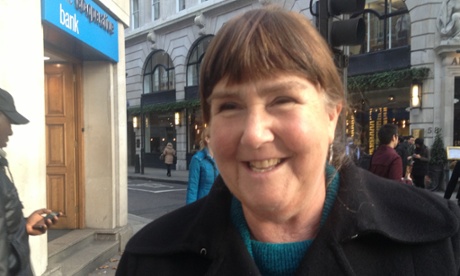
Elaine Griffiths, retired GP:
I think it’s a good thing they’re aware of things. I agree with them about tuition fees, tax and immigration. I don’t think it’s a bad thing to protest in this way when you’re young. I wasn’t expecting this, though – I wasn’t expecting anything. I was just trying to cross the road!
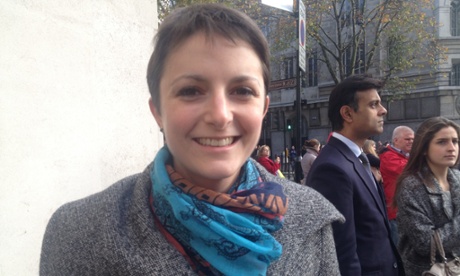
Lucy Hedges, works in media:
I’ve seen it in the news. I think it’s a really good idea. Uni is ridiculously expensive. I think it’s optimistic, but I think it’s good for students to come out and have their say. It’s incredible to see this many people – that’s why I came out to watch.
Guardian documentary maker Laurence Topham sends this film from the demo:
Updated
The Press Association has filed this lunchtime report on the demo so far:
Thousands of students from across the country have descended on central London to plead with politicians to end the ‘chain’ of high tuition fees and student debt.
The army of student activists, led by the Student Assembly Against Austerity, gathered outside the University of London near Euston before marching towards Whitehall and the House of Commons.
Hundreds carried placards and banners protesting against high fees, chanting ‘When they say cut back, we say fight back’, and ‘No ifs, no buts, no education cuts’.
A samba band created a carnival atmosphere, before leading them through the streets of the capital, shouting and whooping. As the march began, some of the protesters lit flares.
Organiser Aaron Kiely, from the Student Assembly Against Austerity and a member of the NUS national executive, said their message was very simple: a return to free education and an alternative to tuition fees.
He said: ‘We want to end the lifetime of debt which is a massive burden for students.
‘Students are really angry because we go to university and then at the end of it we get an average of £40,000-worth of debt. That puts you in a hell of a difficult position when you start to think about a mortgage and a family. We need an alternative.’
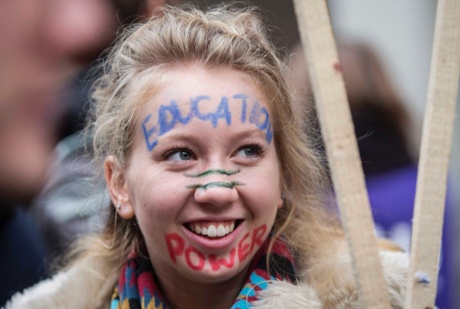
New entry into the nonexistent 'Best placard' competition. #FreeEducation #MeanGirls pic.twitter.com/q7WBP9nwdE
— Guardian Students (@gdnstudents) November 19, 2014
Bit of a miss by us on setting up a best placard competition. Apologies. Especially now we’ve seen “Cats not cuts”.
"Cats not cuts" #FreeEducation pic.twitter.com/ZL16HoaXgU
— George Bowden (@_georgebowden) November 19, 2014
Updated
The mood on the march is upbeat, Abby Young-Powell reports:
Now marching through the streets. Pedestrians are stopping to watch, looking confused, and some are taking pictures.
Students are chanting: ‘We’re here, we’re queer, we can’t afford nine grand a year!’
The National Union of Students (NUS) in England is not backing today’s march – see here for more on that – but has put out its own take on why student debt is unsustainable.
It claims the government’s own estimates indicate the size of outstanding student debt will increase to more than £330bn by 2044:
The proportion of graduates failing to pay back student loans is increasing at such a rate that the Treasury is approaching the point at which it will get zero financial reward from the government’s policy of tripling tuition fees to £9,000 a year.
Megan Dunn, NUS vice-president said:
Not only is a publicly funded education system achievable, it’s also necessary in the current economic and political climate. Our roadmap seriously challenges those who want to bury their heads in the sand and pretend that the current broken system can be fixed with tweaks and tinkering. The clear fact is that the current system we have is completely unsustainable.
The government’s own figures show that the prospect of a huge black hole looming over the budget is very real. It’s time the government started taking this issue seriously and committed to a new deal for students.
You can see the NUS “roadmap for free education” here.
My colleague Matthew Taylor, who’s at the demo, has been doing a rough headcount and estimates about 5,000 marchers are setting off from Malet Street. There’s a fair few police officers and a police helicopter on hand, too.
And the marchers are finally leaving the start point at Malet Street, flares flashing:
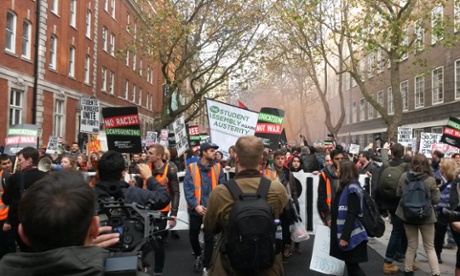
My colleague Natalie Gil has been investigating the vandalism attack on the offices of NUS England. An NUS spokesperson told her that union officials are unsure when it happened: “We’ve got no idea, we just came in and we saw it.”
Updated
And Caroline Lucas, the Green party’s sole MP, has tweeted her support:
Solidarity to everyone on #freeeducation #nov19 demo. pic.twitter.com/R0uLOOYSys - completely support you & will continue fight in parliament
— Caroline Lucas (@CarolineLucas) November 19, 2014
Green leader Natalie Bennett is on the demo; the Young Greens are among the organisers.
Dr Peter Noyes, former vice-chancellor of the University of Wales, Newport, has this to say on Nick Clegg’s insistence this morning that the current fees regime is working:
“@guardian:Nick Clegg: raising tuition fees has not deterred poor from going to university". But it has deterred anyone from voting for him.
— Dr Peter Noyes (@PeternoyesVC) November 19, 2014
Contrary to persistent rumours, it doesn’t look as if Russell Brand will be putting in an appearance at today’s demo. However, he has retweeted a photo of a placard bearing his image, which is almost the same:
“@bjacksonuk: Check this out, @rustyrockets #FreeEducation #Nov19 pic.twitter.com/J9Rz52vDuf” yes! No I can rest.
— Russell Brand (@rustyrockets) November 19, 2014
Education correspondent Sally Weale spots an imaginative protestor:
#FreeEducation march pic.twitter.com/J1v7af2nQ7
— sally weale (@sweale) November 19, 2014
Updated
The march is hoping to highlight issues beyond tuition fees – participants hope to raise awareness of the effects of austerity on young people. My colleague Natalie Gil put together this essay on young people who have found themselves hit particularly hard by cuts.
Today’s slogans and chants certainly have a fair few targets. So far, Guardian reporters on the scene have spotted:
- “Single mums on benefits did not cause the deficit. Bullshit, come off it, the enemy is profit.”
- “Tuition fees, no way, make the greedy bankers pay!”
- “Education should be free – not just for the bourgeoisie! Education for the masses, not just for the ruling classes!”
- A plethora of “tax the rich” banners.
- And – student demo veterans will be pleased to hear – “No ifs, no buts, no education cuts.”
Updated
My colleague Abby Young-Powell has been talking to students outside UCL.
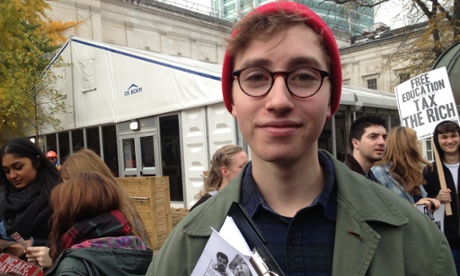
Jacob Furedi, UCL student:
We’re marching for free education. We think it’s unreasonable to pay for something which is a right. The atmosphere is buzzing. I’ve been speaking to people from Aberdeen and Stirling – it’s not just London students but students from all around the UK. Everyone realises it’s an important issue. The main aim is to create a platform for students.
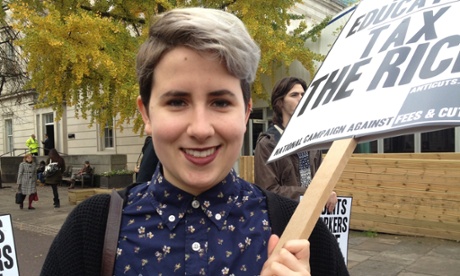
Marielle Cooper, UCL student:
I go to UCL. Given the demand for education it’s ridiculous to expect students to pay for it. I’m originally from the US and I know how bad having debt is. It’s my first demo: people think it’s extreme to protest but it’s not.
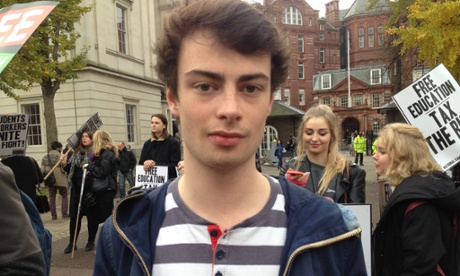
Jake Smithson, UCL student:
I’ve come to demand free education – the current system doesn’t work. It puts off students from disadvantaged backgrounds. Everyone’s excited to get going on the march. The NUS dropping out is absolute rubbish, they don’t stick up for students. It’s an excuse; I think it’s a shame.
Updated
Guardian reporter Matthew Taylor – who’s covered many a demo – says the numbers so far look lower than the 10,000 organisers had hoped for:
Couple of thousand students gathering for #freeeducation demo. Less than organisers had hoped for so far. pic.twitter.com/357E5VeWnx
— Matthew Taylor (@mrmatthewtaylor) November 19, 2014
Students as far as the eye can see pic.twitter.com/PfNkznNyre
— Abby Young-Powell (@abbyyoungpowell) November 19, 2014
Students begin to gather for today's demo against tuition fees on Malet Street #FreeEducation @Claire_Phipps pic.twitter.com/6GnyBd1bGU
— Laurence Topham (@loztopham) November 19, 2014
We found the @YoungGreenParty ! #FreeEducation pic.twitter.com/iZ6kHhS3TW
— Guardian Students (@gdnstudents) November 19, 2014
Updated
The march begins
Students are setting off from Malet Street now. Frances Perraudin sends this Vine:
You can see the route of the march here.
There are reports that the offices of NUS England have been vandalised by some protestors angry at the union’s withdrawal of support for the march:
Not great to see that the NUS UK offices have been targeted by vandals. Intimidate not educate? Yeah, well done, folks. #FreeEducation
— Lydia Crow (@lmtcrow) November 19, 2014
A group calling itself the “militant tendancy of Students Against Boredom and Banality” said it was responsible, adding that it “reject[s] the notion that the NUS works for student interests, or provides any means towards liberation”:
Is there an alternative to fees?
There is precedent for the abolition of university fees, Richard Adams reports:
Although it might seem the onward march of tuition fees is inevitable, today’s demonstrators in England can take heart from events in developed countries that have seen the tide of user-pays in higher education being reversed.
Most recently, the last German state abolished tuition fees for its students, making the country ‘s higher education fee-free for the first time in eight years. Just as Wales and Scotland have resisted fees, so some German lander had never imposed them. But it was mass protests and political pressure beginning in 2008 that saw first Hesse and then the others reverse course, including conservative Bavaria by 2013, even though the fees were only a modest €1,000 (about £800) a year.
The other example comes from Quebec’s so-called Printemps érable – or Maple Spring, a play on 2012’s Arab spring – that culminated in the political defeat of the state’s premier, Jean Charest, who had championed tuition fees in the face of tumultuous student opposition.
The Quebec election result in 2012 was culmination of a long campaign against both fees and Charest, as the Guardian reported: ‘This meant boycotting and picketing classes, and at their height the strikes achieved the support of 300,000 students. The structures of direct democracy built on campuses sustained the momentum behind the strikes, enabling students to meet, discuss and make decisions on a regular basis. Each month, the movement called a mass mobilisation, with tens of thousands of students gathering in the Place du Canada in Montreal.’
Marchers will be pleased to hear that rain doesn’t seem likely in central London this afternoon, although Parliament Square was looking a bit boggy yesterday:
Parliament Sq seems to be ready for us... #FreeEducation #nov19 pic.twitter.com/akSIRccEJK
— Against Fees & Cuts (@NCAFC_UK) November 18, 2014
Frances Perraudin is with students outside UCL as they make their final preparations:
Clegg: 'university is actually cheaper than it was'
Nick Clegg – the Liberal Democrat leader and deputy prime minister who has become the focus for student ire since he u-turned on his party’s commitment not to raise tuition fees – has been speaking about today’s demo on LBC this morning. As Patrick Wintour, the Guardian’s political editor, reports:
Nick Clegg defended the rise in tuition fees to a maximum of £9,000 a year as he prepared to become the villain of a large student demonstration in London against tuition fees.
Speaking on LBC, Clegg said he had learnt lessons from the episode of his broken pledge but added: ‘It is worth remembering the predictions were that people would not go to university, it would discourage kids from poorer backgrounds going to university, but actually what has happened is there are more people on full time courses than ever before, more youngsters from poorer backgrounds than ever before, and more kids from ethnic minorities than ever before.’
He nevertheless again expressed regret about this failure to deliver on the Liberal Democrat commitment to abolish tuition fees saying he had learnt the lesson that ‘you should only make commitments on which you are sure you can deliver’.
He came under pressure to explain why in Scotland students from Europe or Scotland did not have to pay tuition fees, but English students did. A caller to the Call Clegg phone-in claimed it was this kind of unfairness that was driving voters into the arms of Ukip.
Clegg said: ‘That is devolution: we have a different legal system, a different education system.’ He added that the former Scottish first minister Alex Salmond had surreptitiously taken away grants from Scottish students.
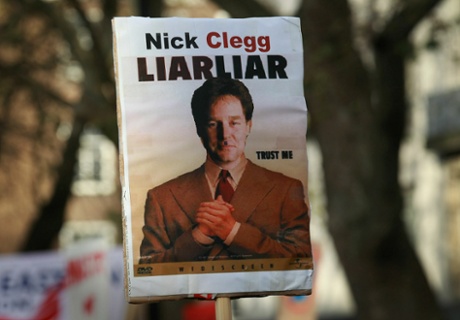
In defence of the current fees system in England, Clegg went on:
Despite all the headline controversies, people have got out their pocket calculator out and worked out for themselves that in terms of what they need to pay out, week in, week out, from their bank account for going to university in England, it is actually cheaper than it was under the old system.
Under the old system if you were on £25,000 on a graduate job you were paying about £67 per month. Under the new system if you are on £27,000 you will be paying about a third of that or £27 a month. What you have to pay out of your bank account has gone down, not up.
Half an hour till the start of the march and demonstrators are gathering in Malet Street, central London:
Lots of #students & anticuts activists gathering outside the Uni of London Union already for the demo #freeeducation pic.twitter.com/cpL8E3tfse
— Guardian Students (@gdnstudents) November 19, 2014
Why are students marching today?
The Guardian’s education editor Richard Adams offers this analysis:
So what do today’s marchers want? The short answer is the slogan: ‘No fees, no cuts, no debt’ – unchanged from the similar demonstration that took place three years ago, before the near-tripling in tuition fees was imposed by the coalition government.
Three years later and while the tuition fee of £9,000 may be a fact of life in England, its likely effects on the latest cohort of undergraduates are starting to be realised. And with a general election just six months away, the time is ripe to push tuition fees and wider questions of higher education funding into public debate.
Unfortunately none of the three major political parties – especially the Liberal Democrats, who campaigned in 2010 on a policy of no increases in tuition fees – are offering anything even close to free tertiary education. Labour’s vague offering includes plans for a reduction in the tuition fee to £6,000 a year, which is plausible in some circumstances.
Of the other parties in England, only the Greens have an unequivocal pledge to scrap tuition fees. But Ukip is the highest polling party to offer anything along the lines of today’s protest: one of Ukip’s few education policies is the scrapping of tuition fees for students taking science, technology, maths or medical degrees, so long as they ‘live, work and pay tax in the UK’ for five years after graduation. It would be interesting to see how many Ukip supporters take part in today’s march.
Updated
Advice for marchers
Colleagues at Guardian Students offer this advice for those travelling to the demo today:
- When you first turn up to the demo there will be lots of different sections for students from different areas, including a block near the front for students with disabilities.
- Make sure you know who you are marching with and have contact telephone numbers for people if you get split up. Have a fully charged mobile phone battery before the demonstration and have details written down.
- Stewards will be present on the march, in fluorescent yellow or pink bibs, and students are encouraged to talk to them if they have any questions.
- If you need to leave the march, there are three assisted leaving points where stewards will be on hand with water. These are at Holborn Tube Station, Kings’ College London and Trafalgar Square.
- For those not able to join the whole route, you can join the march at any of the three assisted leaving points.
- At the start of the demonstration there will be people handing out cards that provide information regarding your rights, and numbers that you can call in the unlikely event that you get arrested.
- There is a “find your friends” app, which you can download with your friends. This helps to track each other if you get lost.
NUS Scotland – unlike the NUS in England – is supporting today’s demo. But of course the situation is rather different in Scotland, where Scottish students in higher education do not pay fees. Yesterday, outgoing first minister Alex Salmond unveiled a memorial, literally setting in stone the Scottish National party’s commitment to no fees for Scottish students (English, Welsh and Northern Irish students in Scottish universities must pay fees as they do in their home countries).
Thrilled to see @ScotGov tuition fees commitment writ in stane at @HeriotWattUni http://t.co/cDH3sIArKn pic.twitter.com/QmBbOz5dA2
— Alex Salmond (@AlexSalmond) November 18, 2014
It’s always pretty hard to judge numbers of demonstrators, even during a march, but organisers say they’re expecting around 10,000 students to descend on central London today to take part.
Several student unions and other groups have tweeted to say they’re on their way:
200+ @SussexUni students w @USSU @USSU en route to #FreeEducation demo! Eucation is a social good- the costs shouldn't be individualised
— Lyndsay Burtonshaw (@LyndsayBurtonsh) November 19, 2014
On our way from portsmouth #nov19 #FreeEducation
— Emile (@Emile_Marchant) November 19, 2014
Let's go!!! #FreeEducation #freeeddemo #StirFreeEd @gordonmaloney @AUSAEducation @eusavps pic.twitter.com/rKVWzMyyT9
— Amy McDermott (@stir_president) November 19, 2014
Members of @StirlingUniCND say they set off from Scotland at 8pm last night! #FreeEducation pic.twitter.com/8LviESuZjG
— George Bowden (@_georgebowden) November 19, 2014
Updated
The Guardian reporting team
This liveblog will be scooping up news and interviews from Guardian reporters at the demo today; click on their names below to see their tweets.
Education editor Richard Adams is on hand for analysis of why students are marching and how likely they are to get what they want.
On the march are education correspondent Sally Weale, Matthew Taylor and Frances Perraudin, along with colleagues from Guardian Students: Abby Young-Powell, Lawrence Wakefield and Natalie Gil.
You can also follow me on Twitter @Claire_Phipps for updates and key developments, or just for questions or a chat.
Amelia Womack, from Young Greens, tells reporters:
Higher education is a mess. We’ve changed our educational institutions into businesses. Educational facilities are now practically in the private sector. We have the most expensive system in Europe.
It’s no wonder young people are taking to the streets today to say enough is enough. We need to bring back education so people can experience education for education’s sake. Young people are engaging in politics. Young people are passionate and engaging in politics.
Sixth former Reuben Williamson says more than 500 sixth formers will be joining the demo today. pic.twitter.com/vmCPVZYx0d
— Frances Perraudin (@fperraudin) November 19, 2014
The press conference by the organisers of the demo has begun.
Beth Redmond, of the National Campaign Against Fees and Cuts, tells reporters the march is in support of free higher education:
No one is marching for £6,000 fees, no one is marching for a graduate tax.
We should fund education through progressive taxation.
Beth Redmond speaking at the #FreeEducation press conference. Tuition fee system? "It's bullshit," she says. pic.twitter.com/5uy2y5gcDl
— Guardian Students (@gdnstudents) November 19, 2014
Updated
Supporters of today’s protest have issued an open letter to explain why they are taking this action:
Today we are stepping up our campaign against tuition fees and education cuts with the biggest student national demonstration for years. As student debt soars and staff working conditions deteriorate, it is clear that the marketisation of education is failing students and workers alike.
Last month Germany scrapped tuition fees – proving once again that free education is possible. If the government increased tax on the rich, scrapped Trident or reduced military spending, billions of pounds would be made available to fund education and other vital public services.
Free education is not just about the money. It’s about the working conditions of those who make our education possible, and about democratising and liberating our institutions and the curriculum; funding vocational and further education, living grants and childcare that allows women to freely access learning.
A new movement for free education is emerging on campuses across the country. Today’s national demonstration, organised by the Student Assembly Against Austerity, the National Campaign Against Fees and Cuts and the Young Greens, marks the the start of a major wave of action between now and the general election. We are determined to build a movement too big to ignore that puts free, accessible and public education back on the political agenda.
You can read the full list of signatories here.
And another colleague, Frances Perraudin, is on hand at the press conference held by the demo’s organisers:
Waiting for the a press conference to start ahead of the national anti-fees demo #FreeEducation pic.twitter.com/LazwAWs2bW
— Frances Perraudin (@fperraudin) November 19, 2014
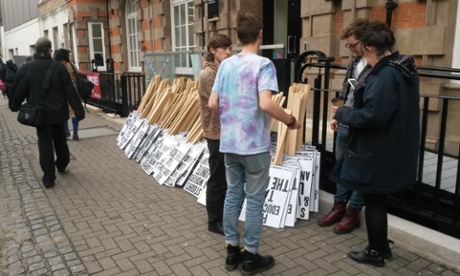
My colleague Lawrence Wakefield is already stationed by University College London (UCL), from where the march will start at noon. He sends this pic of this morning’s preparations:
The key players
My colleagues Abby Young-Powell and Natalie Gil, of Guardian Students, have prepared this handy guide to the groups behind today’s demo:
National Campaign Against Fees and Cuts
NCAFC is a network of student activists that was founded by University College London (UCL) students in February 2010. It was set up in response to the trebling of tuition fees and a perceived weakness at the time of the National Union of Students (NUS). NCAFC organisers have been behind many student protests over the past four years, including a national day of action against the role of police on campuses last year.
The Student Assembly Against Austerity
The Student Assembly campaigns for free education, and against tuition fees, debt, cuts to education and austerity more broadly. It’s the student wing of the People’s Assembly Against Austerity, which has been one the biggest anti-cuts movements since the government came to power in 2010.
The Young Greens
The Young Greens, the youth* and student branch of the Green party, are part of the coalition of groups involved in calling the demonstration. They have seen their membership rise 100% since March, and now have over 3,000 student members. They are asking Young Greens from around the country to attend. Clifford Fleming, co-chair of the Young Greens, says: “We are sick of being marginalised by Westminster. Years of tuition fees have lumbered millions with debt, and the system isn’t working. We need an open, accessible, free education system that supports those from all backgrounds.”
And here’s where it gets more complicated:
The National Union of Students
The NUS in England has been criticised by students, after it withdrew its support for the demonstration. Its president Toni Pearce said the march poses an “unacceptable level of risk to our members”, citing the lack of public liability insurance, along with concerns over inaccessibility for disabled students.
NUS Scotland is still involved and supportive, with its vice-president Kirsty Haigh (who is also an organiser for the National Campaign Against Fees and Cuts) saying students’ fightback against the government’s privatisation and attacks on living standards would be the biggest since 2010-11.
You can read the NUS statement on why it decided to withdraw support for the demo here.
[10.59GMT edit: I’ve tweaked the Young Greens description to clarify that it’s not just for students.]
Updated
Morning summary
Good morning and welcome to the liveblog as thousands of students prepare to march in London in protest at tuition fees and the debts faced by many young people when they leave university.
The demonstration, organised by the National Campaign Against Fees and Cuts (NCAFC) and the Student Assembly Against Austerity, is expected to be the biggest student protest for four years. Students will travel to London from cities around the UK, including Aberdeen, Glasgow, Newcastle, Leeds and Sheffield.
A number of coaches have been organised by students or their university unions and will arrive in London throughout this morning. Many in the capital, including school students, are also expected to join the march.
The march will begin at noon from Malet Street in central London, head around Russell Square to the Strand, on to Trafalgar Square and Whitehall, and end outside the Houses of Parliament at around 4pm. The map below – courtesy of the Young Greens, one of the groups organising the demo – shows the route.
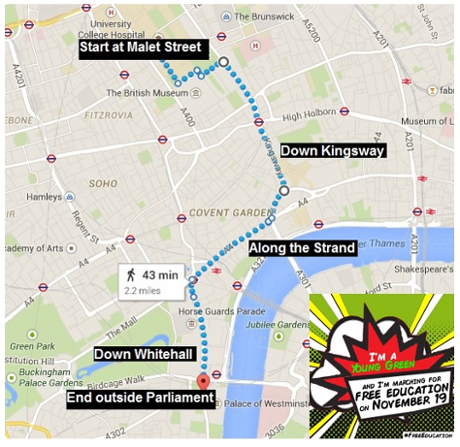
We’ll be covering the march throughout the day on this liveblog, with reporters on the scene, plus analysis of what students want and how likely they are to get it.
Whether you are on the march or not, do share your comments, videos and pictures – you can tweet us at @Claire_Phipps and @gdnstudents, or add your thoughts below.