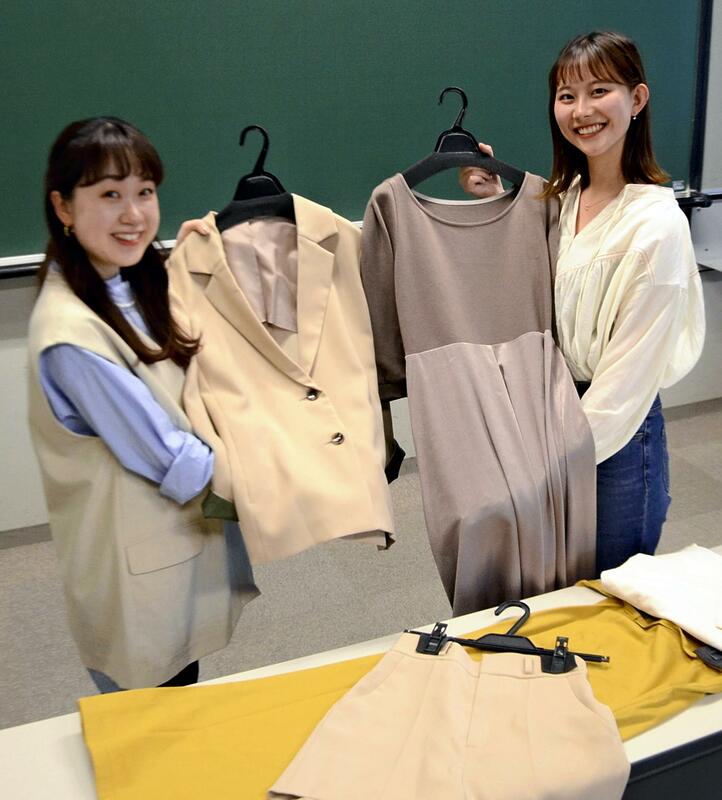
Home economics students at Otsuma Women's University in Chiyoda Ward, Tokyo, recently established their own fashion brand with an environmental focus.
The students participated in every aspect of creating the brand, which they named m_r tokyo (pronounced "maaru"). The name comes from the Japanese word "maru," meaning circle, and refers to a continuing cycle.
Various items, including jackets and jumpsuits, have been designed and advertised via social media. The young entrepreneurs voiced enthusiasm for the new business, saying they want to offer high-quality clothes that customers can wear for a long time.
"All of us proposed materials and design ideas. We opted for subdued colors like beige and brown, because those are ideal for the autumn and winter seasons," said 22-year-old senior Tamaki Kamimura.
Plans to establish the brand began in October last year with 14 students attending a seminar given by Ken Yoshii, an associate professor of fashion business studies. Originally, the students were divided into three groups and discussed what kinds of clothes they wanted to make.
They then narrowed down their marketing target to female university students and came up with designs after deciding on certain concepts, such as clothes they would want to wear to a cafe and to women-only parties.
The students visited wholesalers and selected textiles, taking into consideration the balance between design and cost.
Six kinds of jackets and jumpsuits for autumn and winter have been on sale online since June.
Kamimura said, "It's hard to widely convey the quality of our products via social media. I was so glad when they sold."
The students are now discussing designs for clothing that will go on sale next year.
They conducted a survey focusing mainly on female university students via Instagram and garnered replies from more than 1,000 respondents. Because people have had fewer opportunities to go out due to the coronavirus crisis, many respondents said they'd like clothes for picnicking or going to seaside resorts next year.
"For the spring and summer seasons, I want to make exciting clothes with bright colors that our customers will feel comfortable moving around in," said 21-year-old junior Rinoa Kawamura.
According to the Japan Textiles Importers Association based in Chuo Ward, Tokyo, 97.9% of clothes in Japan in 2020 were produced overseas.
Yoshii said: "As clothes are mass-produced in China and other Asian countries, prices can be kept low. However, this forces retailers to hold on to a wasteful amount of inventory, which isn't good for the environment."
Clothing under the m_r tokyo label, however, is made to order.
Two sewing factories in Tokyo sew the brand's products. One of them -- Tani Seni Co., based in Edogawa Ward -- made T-shirts with tube-shaped seamless sleeves to minimize fabric waste.
"During the coronavirus crisis, people have had fewer opportunities to go out in fashionable clothes," said company president Kazuya Tani. "At the same time, their values have shifted to wanting to wear high-quality clothing for longer."
The other sewing factory is AIPlanning Co., based in Koto Ward. Managing director Hitoshi Arai, 37, said: "Apparel makers who use the internet well have seen higher sales. From now on, the ability to get one's message out will be a decisive factor."
He expressed high hopes for the students' utilization of social media for promotion.
"We've received requests to participate in events at department stores and elsewhere," Yoshii said. "I want to raise the brand's name recognition in the future."
Prices range from 4,950 yen to 22,000 yen. All proceeds go to the sewing factories, as this project is meant to educate the students.
Read more from The Japan News at https://japannews.yomiuri.co.jp/