Student dormitories are attracting attention as a tool to counter the hollowing out of central city areas and are revitalizing communities.
The idea is to open student dormitories on unused land or in vacant buildings and trying to draw young people to live there. The hope is that students will feel attached to the community through exchanges with local residents and settle in the community even after they graduate from school.
In April this year, a new student dormitory was opened in central Yamagata.
The vacant third to fifth floors of a 32-year-old commercial building were renovated into the dormitory with 22 private rooms about 15 square meters each. The rent ranges from 28,000 yen to 32,000 yen per month, cheaper than the average rent in the area. Female students at Yamagata University and Tohoku University of Art and Design, both in Yamagata, live in the dormitory.
The idea of establishing a student dormitory was proposed at a meeting between the presidents of the two universities two years ago as a measure to revitalize the city center, which was hollowing out. The idea took shape as a government-subsidized project by the universities, the Yamagata prefectural and Yamagata city governments and other entities. The owner of the building agreed with it. Both universities introduce students to the dormitory.
In addition, a vacant 44-year-old wooden house in central Yamagata was renovated into a dormitory with three private rooms. The rent is 23,000 yen per month.
Locals place expectations on the students living in these dormitories. "As shop owners are getting older, they are not able to come up with new ideas for local shopping mall events. We hope those students will propose ideas and create a hustle and bustle in the city together with us," said an official of a local shopping mall association.
One of the female students living in the dormitory said she has conversations with a staffer at a shop where she is now a regular. She said: "I feel welcomed by neighbors. Since the dormitory is located in the city center, it's convenient for both shopping and working part-time."
Land believed to be unsuitable for housing are also being used.
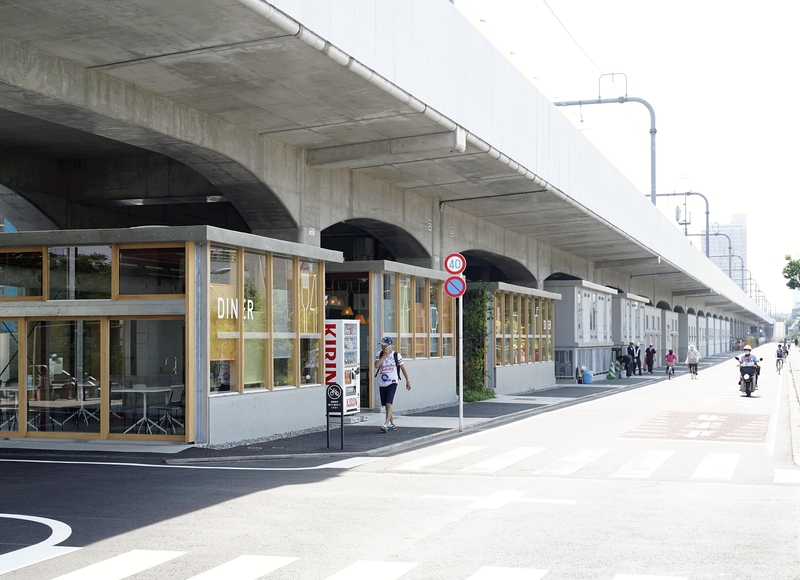
A student dormitory, "Chuo Line House Koganei," which was opened this spring in Koganei, Tokyo, is located underneath the elevated railway tracks of JR Chuo Line.
A total of 109 container-like residential units with a floor space of 10 to 16 square meters and a rent of 52,000 yen to 70,000 yen line up in an about 400-meter-long area. The rent is almost equal to the average rent in the area, with most of the units being occupied by students from 39 universities and vocational schools including Tokyo Gakugei University, Tokyo University of Agriculture and Technology and Hosei University.
JR Chuo Line Mall Co., affiliated with the East Japan Railway Company Group, is the operator of the dormitory. It said: "Many students don't care much about conditions such as sunlight. We could make effective use of land created as a result of elevating railway tracks." Trains run on the elevated railway tracks every few minutes, but the noise was not very annoying.
The company is considering creating a 45-square-meter hall in the dormitory to use it as a venue for local events. "We hope exchanges with local residents will encourage students to continue to live along the train line after they graduate school," an official at the company said.
In Kyoto, the prefectural government prepared a dormitory for international students in the city center.
Two buildings, including the former Kyoto Prefectural University of Medicine Nurses' Dormitory, were refurbished into student dormitories. For the past six years, they have been used as student dormitories called the Kyoto International Student Orientation Centers, which have a total of 89 units with about 13 square meters each and charge a monthly rent of 33,500 yen.
While some international students who were supposed to live in the dormitories could not enter Japan due to the coronavirus outbreak, a total of 36 international students from 13 countries and territories studying at four universities, including Kyoto University and Doshisha University, are currently living in the dormitories.
These international students participate in local sporting and school events, while local residents join parties held at the dormitories.
The Kyoto prefectural government set a goal of increasing the number of international students to 14,000 by fiscal 2023. "In order to accept more international students, we need cheap and comfortable residences. We hope they will like Kyoto and consider having a job in the city," a prefectural government official said.
Hidetaka Yoneyama, the housing and land analyst, said, "If new ideas and activities are created through exchanges between students and local residents, it will bring benefits to the whole community."
Read more from The Japan News at https://japannews.yomiuri.co.jp/