Afternoon summary
- Tom Watson, the deputy Labour leader, has rejected calls for him to apologise for comments he made about Lord Brittan after his death. David Cameron said earlier that Watson should “examine his conscience”. (See 1.22pm.) But, after Sir Nicholas Soames demanded an apology in the Commons, Watson defended his decision to write to the director of public prosecutions calling for a rape allegation involving Brittan to be re-investigated. Watson said in the Commons that victims had been ignored for too long, and that all MPs should examine their consciences over child abuse. (See 5.05pm.) He did not specifically defend an article he wrote just after Brittan’s death referring to the child abuse allegations and the rape allegation against Brittan (see 4.40pm), but Watson did say at the end of last week that he regretted some of what he had written in that article. (See 4.35pm.)
- David Lidington, the Europe minister, has told a committee of peers that it would not be “optimal” to hold the planned referendum on Britain’s membership of the EU during the UK’s six-month presidency of the 28-nation bloc in the second half of 2017. But, as the Press Association reports, Lidington insisted it was not “completely impossible” for the vote to be staged during the British presidency, which begins on July 1 2017. Here’s my colleague Nicholas Watt’s take.
Having #EURef in UK presidency not optimal @DLidington says. So has to be before 1/7/17 + obv before French elex so looking like 2016
— Nicholas Watt (@nicholaswatt) October 12, 2015
Feels like @DLidington thinks #EURef September 2016 - time for 10 week ref campaign after passage of bill, well before French elex + UK pres
— Nicholas Watt (@nicholaswatt) October 12, 2015
- Fugitives across Europe will flock to the UK as a safe haven if it leaves theEuropean Union because a series of laws and extradition agreements would be ripped up, the former head of the Association of Chief Police Officers (Acpo) has said. As Nicholas Watt reports, In one of the strongest warnings of the dangers of a UK exit, Sir Hugh Orde said criminals would know that it would take longer to extradite them if Britain were outside the EU.He said: “If I was a villain somewhere else in Europe and I’m escaping justice, I am going to be here because it is going to take a lot longer to get me back.” Orde was speaking at the launch of the Britain Stronger in Europe campaign.
- Vote Leave, the out campaign, has accused Britain Stronger in Europe of having nothing to offer “but the same clichés the Foreign Office has spouted since the Suez disaster”. In a response to the launch, Vote Leave’s Dominic Cummings said:
The EU-funded BSE campaign is led by people who told us Britain would be doomed unless we ditched the pound. They’ve learned nothing from the disasters of the euro project and the inability of the EU to cope with the economic and technological forces changing the world. The BSE campaign has nothing to offer but the same clichés the Foreign Office has spouted since the Suez disaster. We need a new UK-EU relationship based on free trade and global networked cooperation so we can adapt fast to the forces that are undermining the EU’s 1950s structure.
- John McDonnell, the shadow chancellor, has told Labour MPs that the party is now opposed to George Osborne’s fiscal charter committing the government to running a budget surplus in normal times. Before the Labour conference he told the Guardian Labour would back it.
- The UN’s most senior human rights official has condemned the UK government’s proposal to scrap the Human Rights Act. As Owen Bowcott reports, In an unusual intervention for a UN official, Prince Zeid Ra’ad Al Hussein said the Conservative party’s threat to leave the European court of human rights (ECHR) was “profoundly regrettable”. The Jordanian prince became the UN’s high commissioner for human rights last summer.
That’s all from me for today.
Thanks for the comments.
There is video of Tom Watson’s statement on the Guido Fawkes website.
Sir Nicholas Soames has criticised Tom Watson for not apologising.
Nicholas Soames on Watson: "It was not the apology that I sought or that any of us were looking for."
— Michael Crick (@MichaelLCrick) October 12, 2015
And this is the point of order that Sir Nicholas Soames raised.
Mr Speaker, I rise on a very serious matter indeed, to ask you whether you have had any request from [Tom Watson] to seek your permission for him to make a personal statement apologising for the way in which he has so vilely traduced the late Lord Brittan, and further for him to have a chance to apologise to Lord Brittan’s dignified and courageous widow.
Tom Watson's statement
Here is the full text of what Tom Watson said.
Mr Speaker, I understand that honourable and right honourable members feel aggrieved that Leon Brittan was interviewed by the police and that they are angry with my use of language. But I’m sure that they would also agree that when anyone is accused of multiple sexual crimes by numerous, completely unrelated sources, the police have a duty to investigate, no matter who it is.
My letter was prompted by concern that procedures were not followed. It is not for me to judge the validity of these claims, but I believe that I was right to demand that guidelines were adhered to.
I also believe that very many victims in this country have been too terrified to speak out for too long. And it is not all over just because a few famous people have gone to prison. And it has not all got out of hand just because people in high places are scared.
The survivors of child abuse have been belittled and ridiculed for too long. That’s the real scandal here.
Earlier the prime minister said that I should examine my conscience. Well I think we all need to examine our consciences in this House. We presided over a state of affairs where children have been abused, and then ignored, dismissed and then distained. If anyone deserves an apology, it’s them.
There were some cries of “”shame” and “disgraceful” when he finished.
Bob Neill, the Conservative, asks Bercow how they can raise legitimate matters, without interfering with police investigations.
Bercow says MPs have the same rights as citizens. And they have parliamentary privilege, he says. But they have responsibilities too, he says.
Bercow tries to move proceedings on. But an MP tries to intervene again.
Watson says all MPs need to examine their consciences over child abuse
Tom Watson says he understands why MPs are angry.
But when people make complaints, they should be investigated.
He says it was not for him to judge the allegations. But he wanted to ensure procedures were followed.
It is not all over because a few high profile people have been prosecuted.
He says David Cameron said Watson should examine his conscience. But we all need to examine our consciences, he says.
Soames demands apology from Tom Watson
Sir Nicholas Soames makes his point of order. He asks if Tom Watson has offered to make a personal statement apologising for the way he “vilely” abused Lord Brittan.
John Bercow, the Speaker, says he has not been notified of this. But Watson is here and can speak, he says.
And here is the article that Tom Watson wrote about Lord Brittan for the Daily Mirror just after his death. And here is an extract.
Hearing the painful memories of survivors is harrowing for anyone.
Then there’s having to deal with the righteous anger of those who have been ignored and dismissed by the authorities over many years.
But once you’re in, you’re in.
You can’t listen to a two-hour testimony of an abuse survivor and walk away when the going gets tough.
And any snorts of derision aimed at me from media commentators are nothing compared with the ruined lives of abuse victims.
Former Home Secretary Leon Brittan stands accused of multiple child rape.
Many others knew of these allegations and chose to remain silent. I will not.
The police must continue their investigations.
We’re expecting Tom Watson to speak in the Commons in the next 10 minutes or so.
Here is the article he wrote at the end of last week for Huffington Post about this. And here is an extract.
The lessons of the Jimmy Savile affair couldn’t be clearer. Theresa May has said that we have only seen “the tip of the iceberg” when it comes to child abuse. That’s why we can never return to the days when survivors of child abuse felt unable to speak out because they were ignored or even ridiculed. It does not matter who you are, what you do or how powerful you might be, when someone makes an allegation against you it has to be treated seriously.
I have heard many disturbing and harrowing accounts of child abuse since I asked that question in the House of Commons. It is impossible not to become deeply upset and angry when listening to them. When the death of Leon Brittan was announced, I worried that the justice system would no longer take its course and that the allegations would never be thoroughly investigated. As the tributes flowed in from his lifelong friends I felt for those people who claimed he abused them. I repeated a line used by one of the alleged survivors, who said: “He is close to evil as any human being could get”. I shouldn’t have repeated such an emotive phrase.
Like Laura Kuennsberg, I’m being told that Tom Watson’s view of David Cameron’s comments is not unlike Michael Dugher’s. (See 4.59pm.)
Labour's Michael Dugher dismisses Cameron's criticism of Watson
Michael Dugher, the Labour MP and shadow culture secretary, has dismissed David Cameron’s criticism of Tom Watson.
Would Cameron prefer to go back to the days when allegations about child abuse were ignored by the establishment and swept under the carpet?
— Michael Dugher MP (@MichaelDugher) October 12, 2015
If you chose to ignore serious allegations, rather than have them properly investigated, you would indeed need to examine your conscience.
— Michael Dugher MP (@MichaelDugher) October 12, 2015
The BBC’s Laura Kuenssberg suggests that this is the line Watson himself will take when the matter comes up during points of order.
don't be surprised if Watson's response is along lines of @MichaelDugher's tweets...
— Laura Kuenssberg (@bbclaurak) October 12, 2015


Boris Johnson, the mayor of London, is on a tour of Japan. According to the Press Association, he is pushing for British firms to get a share of the £10bn’s worth of contracts available in the run up to the Japanese Olympics and Japanese rugby world cup. Johnson said:
Tokyo has got the Olympics in just five years’ time, they have got the rugby world cup in four years’ time. This is a crucial moment for them in their procurement. They have got £10bn’s worth of contracts going out. We think that British companies ought to be trying to compete, ought to be offering their services there.

Updated
Back to Europe, and Lucy Thomas, director of communications at Britain Stronger in Europe, is celebrating the fact that Pimlico Plumbers has left Business for Britain, the Eurosceptic business group that has now morphed into Vote Leave.
This is fast becoming a trend. @PimlicoPlumbers is latest to resign from @forBritain saying Britain is #StrongerIN https://t.co/mjgyZZGlXH
— Lucy Thomas (@lucycthomas) October 12, 2015
And here’s a statement from Charlie Mullins, the Pimlico Plumbers managing director.
I find myself unable to support Business For Britain due to a direct conflict with my core belief that the UK is, on balance, better off inside Europe than out. For all its faults, it’s the biggest single market in the world and, for me, that’s the clincher and if I’m being honest a complete ‘no-brainer’.
In the Commons Home Office questions are over. But we’ve got two urgent questions now before points of order, and so the Tom Watson exchanges will not come up until after 4.30pm.
Yesterday the Sunday Times (paywall) said that Tom Watson could be questioned by the Commons home affairs committee about the Lord Brittan allegations. It quoted a Conservative member of the committee saying Watson should be summoned.
David Burrowes, Conservative MP for Enfield, Southgate and a member of the select committee, said that Mr Watson “needs to be held to account” for his actions.
“A tragedy of justice was committed in the way that Leon Brittan and his family were treated,” he said. “The rule of law was not applied.
“Tom Watson needs to be held to account... This raises broader questions about the way people [MPs] act in public life and how they use their [parliamentary] privilege.”
He added however: “I’m not going to be judge and jury as, some would say, he [Watson] has been. We need to be careful that we don’t make assumptions... and that it doesn’t become a witch-hunt.”
Keith Vaz, the Labour chair of the committee, told the paper that it was not “normal” for MPs to be summoned to give evidence, but that the committee would discuss this when it met on Tuesday.
The Labour MP John Mann is not impressed.
Home Affairs Committee that has failed to look at child abuse is to discuss whether to question @tom_watson. Uncomfortable priorities.
— John Mann (@JohnMannMP) October 12, 2015
My colleague Patrick Wintour says there are reports that the shadow cabinet has decided to come out against George Osborne’s budget surplus rule when MPs debate it on Wednesday. In an interview with the Guardian before the Labour conference, John McDonnell, the shadow chancellor, indicated that Labour would support the fiscal charter.
Reports Labour shadow cabinet has thought some more and decided to vote against Osborne Budget surplus rule on Weds.
— Patrick Wintour (@patrickwintour) October 12, 2015
Tom Watson plans to respond to criticism during points of order
Normally points of order in the Commons are taken at 3.30pm, after questions. Sir Nicholas Soames intends to use a point of order to demand an apology from Tom Watson. (See 2pm.)
But today there are two urgent questions. They come first, so we won’t get to points of order until about 4.30pm.
2 UQ's granted: 1. Financial performance of the NHS (Gummer/Alexander). 2. Extend Right to buy to housing associations. (Healey)
— Labour Whips (@labourwhips) October 12, 2015
The Labour supporter and prolific tweeter LabourEoin has posted this in Tom Watson’s defence.
31 Jul 2015, Daily Mail smear Corbyn for not reporting abuse 11 Oct 2015, Daily Mail smear Watson for reporting abuse pic.twitter.com/ydDg0CwdVB
— Éoin (@LabourEoin) October 12, 2015
My colleague Rajeev Syal has filed a story about David Cameron’s intervention in the Tom Watson case. Here’s how it starts.
Tom Watson should “examine his conscience” over pressure he put on police to reopen a rape investigation into the former Conservative home secretary Leon Brittan, David Cameron has said.
The prime minister’s remarks during a trip to Devon on Monday come as a number of Tory MPs are set to demand in the Commons that Labour’s deputy leader make a personal apology.
Watson has been caught up in the fallout from last Tuesday’s Panorama programme, which examined the claims of a paedophile ring involving VIPs in Westminster.
I’m back from the Britain Stronger in Europe launch.
Tom Watson has not responded to David Cameron’s comment yet (see 1.22pm), but we’re expecting exchanges about him in the House of Commons, and he could use that as an opportunity to say something. According to the Daily Telegraph, Sir Nicholas Soames and others intend to demand a full apology for what he said about the late Lord Brittan.
The pressure will intensify on Monday when Sir Nicholas Soames and other Tory MPs will ask a series of points of order in the Commons’ Chamber to attempt to force Mr Watson to apologise for telling “monstrous lies” about Lord Brittan ...
Sir Nicholas said Mr Watson “must now come and make his amends on the floor of the House of Commons by way of a personal statement apologising for what he has done and apologising most importantly to Lady Brittan and to Leon’s family for the monstrous lies and abuse that have been peddled about Lord Brittan.”
Watson, usually such a prolific social media user, hasn’t tweeted for a week now (his last dip into the Twittersphere on 5 October was actually to retweet a Guardian journalist).
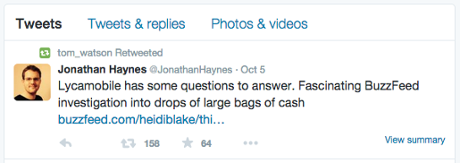
Watson accepted on Friday that he should not have repeated the comment of an alleged sex abuse survivor that the peer was “close to evil”. But he insisted it was his “duty” to pass on testimony from those claiming to have been abused to the director of public prosecutions (DPP).
Updated
Cameron says Tom Watson needs to 'examine his conscience' over Brittan accusation
The prime minister has added his voice to the growing Conservative pressure on the Labour deputy leader. While on a visit to Devon, Cameron told LBC:
It’s clear I think that he [Watson] has a lot of questions to answer and the house of Commons select committee is quite rightly going to ask him some questions … and so I’m sure he should answer those questions and examine his conscience about whether he has said enough so far.
Conservative benches are pushing for Watson to make a full public apology for the way he forced police to reopen an investigation into the former home secretary.
Updated
Leaving EU would hamper the fight against crime, former police chief claims
Britain Stronger in Europe launch - Summary: Lord Rose’s case making the patriotic case for remaining in the EU was briefed in advance, but that is not the only reason it sounded familiar; it failed to stir the audience at the Truman Brewery because it was a solid but pedestrian reheat of the case that pro-Europeans have been making since at least 1975.
Instead it was Sir Hugh Orde, the former Association of Chief Police Officers president and former chief constable of the Police Service of Northern Ireland who will grab the headlines. In his panel contribution, he said that withdrawing from the EU’s justice arrangements would hamper the fight against crime in the UK. It would even put people at risk, he suggested.
He said the European arrest warrant was “utterly essential” for the police in the UK.
We have the European arrest warrant, which everyone agrees is the most effective way of catching bad guys who commit crimes in this country, but equally sending criminals back to the countries from which they have come when they try and evade justice by travelling across borders .... We would see that as utterly essential in the modern world.
But he also suggested that British citizens would be at risk if Britain opted out of the information sharing and extradition arrangements embodied in the EU.
Not only can we [get information about what suspects have done abroad] through what is known as the Association of Chief Police Officers’ criminal records office, we get that information in hours or day, not months and years, so it fits into the judicial process and these people are convicted in the proper way.
Equally important in the modern world, with children going missing, traffickers, all that information is on the system. And it strikes me that, if you are not a member, you are not entitled. Therefore we would have to renegotiate an incredibly complex system, back to probably the 1957 extradition treaty, which is completely out of date and irrelevant. Every country would require a bilateral agreement. And many countries in the old world would not export their citizens to face justice in the country where the crime had been committed. So citizens in this country would not face justice. They would not see their people convicted unless we could export, for example, the whole trial to Germany or Poland or France because in the old world they would not let their citizens be tried in other countries.
If one compares that to the difficulties we still have with [countries like America] - in America it takes years to go through an extradition process, to export people or to import people wanted for crimes. My sense is we would go back to that sort of complex, bureaucratic, massively expensive model. And citizens in this country would be put at risk as a consequence. That is not scaremongering. It is simply fact.
In 2012, when I was researching this for Acpo when I was president, the numbers 50, 20 and 90 came to mind. That’s the number of murderers, 50, the Metropolitan police was asked to find and arrest under warrants to export, it was 20 rapists the Metropolitan police were searching for, and 90 robbers. And my experience tells me if you are a robber in another country, you are a robber in this country. If you are a rapist, you are a rapist, and if you are a murderer, you are by definition extremely dangerous ...
If I was a villain somewhere else in Europe and I was escaping justice, I would be coming here because it’s going to take a lot longer to get you back.
This message did clash somewhat with the later claim from Will Straw, the campaign’s executive director, that it will be focusing on making the positive case for remaining in the EU. (See 12.16pm.)
I’m heading back to the Commons now. I will post again after 1.30pm.

Updated
Q: What lesson have you learnt from how Better Together campaigned in Scotland.
Straw says the campaign is clear that it wants to start making a positive case. The circumstances in Scotland were different. He accepts that the EU is not perfect. The campaign wants to make a pragmatic case. And it wants to ensure that pro-Europeans turn out.
Utlimately people have to make a choice, he says.
Q: Your panel looked like the metropolitan elite, not the nation.
Straw says Richard Reed and Stuart Rose are both self-made men.
There is a wide mix on the board, he says.
We will be reaching out to the whole country, he says.
Q: Do you think people who want to leave the EU are unpatriotic?
Straw says he is making a positive and patriotic case today. The patriotic case is to stay in, he says.
Q: Are you suggesting all maternity and paternity rights would go if we left the EU?
Straw says some of these rights come from the social chapter. If the UK left, it would have to decide what rights to keep. That would tie parliament up for years.
Q: Will Jeremy Corbyn get involved?
Straw says the campaign has been talking to Labour. Many Labour MPs were here, he says.
Q: What EU reform do you want?
Straw says the campaign thinks the benefits of being in the EU outweigh the costs. But the renegotiation can achieve improvements.
Q: Why did none of the panellists take questions from journalists?
Rose did broadcast interviews earlier, Straw says.
Q: Why are you having the launch here at hipster central?
Straw says they wanted somewhere that was a bit different.
Q: Who wrote Lord Rose’s speech?
Straw says there was an original draft. It was written by people at the campaign. Rose edited it, and delivered it in his own words.
Q: Do you hope David Cameron will become your main figurehead?
Straw says he hopes Cameron will campaign to remain in the EU. The campaign supports his reorganisation, he says.
Q: Were panellists discouraged from talking about the EU? They spoke about Europe instead.
Thomas says the panellists spoke in their own words. They were not told to avoid the term EU.
Q: Why did Lord Rose not use the line about the out camp being quitters?
Straw says Rose spoke in his own words. But, if you favour leaving, we think you are a quitter.
(As Paul Waugh reveals, there is an alternative theory around.)
If this is true, the words piss up and Truman's Brewery really do go together. #StrongerIn https://t.co/k3KNY34h65
— Paul Waugh (@paulwaugh) October 12, 2015
Will Straw's briefing
Will Straw, the executive director of Britain Stronger in Europe, is now holding a Q&A with journalists. He is with Lucy Thomas, the campaign’s director of communications.
Q: Who are your top three backers?
David Sainsbury has given some seed funding, Straw says. The campaign is now raising funds. The names of donors will be released in due course.
Q: Why are you still using the 3m jobs at risk figure? It is 10 years out of date, and is discredited.
Straw says the campaign is not saying 3m jobs would be lost if we left the EU. It is saying 3m jobs are linked to our being in the EU. The challenge is for the other side to explain what the impact on jobs would be.
Q: But 3m jobs are not at risk.
Straw says that there are different estimates out there. It is for the other side to explain if they think no jobs are at risk.
Updated
The verdict on the launch from journalists is pretty negative, so far.
From the Mirror’s Kevin Maguire
If I was an Outer I'd be encouraged by the launch of Britain #Strongerin Europe. Dangerously uninspiring, complacent
— Kevin Maguire (@Kevin_Maguire) October 12, 2015
#Strongerin launch panel: 2 business bods(1 a Con peer), 1 banker, a retired cop(knighted) & "our official young person"
— Kevin Maguire (@Kevin_Maguire) October 12, 2015
Launch felt and looked metropolitan elite. Probably because it was #Strongerin
— Kevin Maguire (@Kevin_Maguire) October 12, 2015
From the BBC’s James Landale
Think the Stronger in EU campaign might regret not allowing media to ask questions at their launch. Campaigns need confidence #EURef
— James Landale (@BBCJLandale) October 12, 2015
From the Times’s Patrick Kidd
I feel I'd be more persuaded about voting to stay in Europe if I spent half an hour listening to John Redwood froth
— Patrick Kidd (@patrick_kidd) October 12, 2015
Lord Rose did not sully the launch with anything as cheap as a Q&A. After the panel discussion all the board members lined up on the platform for a photograph. But none of them took questions.
Instead reporters are now getting a press briefing from Will Straw, the campaign’s executive director.
This is from ITV’s Carl Dinnen. It probably sums up the mood in the press section.
With everyone agreeing this In campaign event now feels like a really dull Question Time.
— Carl Dinnen (@carldinnen) October 12, 2015
Richard Reed says voting in is the pragmatic choice as well as the patriotic choice. He says he emailed 50 of his entrepreneur friends. Some 47 of them said they were for in. These were figures involved in well-known brands that have made Britain a better place, like Pret a Manger, and Dominos Pizzas.
Nigel Farage, the Ukip leader, is heckling the event on Twitter.
Lord Rose has got it wrong. This referendum isn't about Europe. It's about whether we stay locked in the failed EU project.
— Nigel Farage (@Nigel_Farage) October 12, 2015
Lord Rose supports the European Arrest Warrant. He clearly doesn't believe in habeas corpus.
— Nigel Farage (@Nigel_Farage) October 12, 2015
Rose says Blair successful renegotiated our EU membership. Laughable. Blair gave away £7 billion for nothing.
— Nigel Farage (@Nigel_Farage) October 12, 2015
Like Nick Clegg, Lord Rose says we have "clout" in the EU. In fact we don't even have our own seat on the World Trade Organisation.
— Nigel Farage (@Nigel_Farage) October 12, 2015
Darcy Levison says she used to be involved in the European youth parliament. That taught her the importance of engaging with Europe over changing laws.
Richard Reed, the Innocent smoothies boss, puts the business case for the EU. He says his business sells more than half it its drinks to the EU. But 80% of the jobs are in the UK, he says.
If Britain comes out of the Europe, we will be hold hostage by Europe. We will have to follow their regulations, without having any impact over them.
Sarpong asks Sir Hugh Orde, the former Association of Chief Police Officers president, about the security implications of leaving the EU. Orde says police officers agree the European arrest warrant is essential. Before that was introduced, it took far, far longer to arrest people in other EU countries, he says.
Information is shared across the EU much more quickly, he says.
If you were not a member of the EU, you would not be entitled to this information. The UK would have to negotiate new information-sharing mechanisms with EU countries.
And citizens would not get justice, because EU countries would not easily surrender their people for trial in the UK.
He is not scare-mongering, he says. He is simply stating the facts.
Sarpong turns to Stephanie Flanders, the former BBC economics editor, and asks what would happen if we left.
Flanders says no one knows what would happen if the UK left.
But supporters of in and out agree on one thing; you cannot have all the advantages of being in the single market without having some of the disadvantages. Norway has to accept EU regulations as the price of trading with the EU. You cannot have a single market without regulations, she says.
She says at some point in the future the eurozone countries might have to take a different path. But now is not the time to diverge, she says.
Sarpong asks Darcy Levison if her generation feels European. I think they do, says Levison. The government has put a lot of money into languages. And many students have taken part in exchange schemes.
Updated
June Sarpong says it is now time for “the panel”.
She says she is introducing “some of the best brains in this country”: Richard Reed, Stephanie Flanders, Karen Brady, Darcy Levison (a Cambridge student) and Sir Hugh Orde. They take their seats on the platform.
Updated
Rose says he is not saying Britain could not survive outside the EU. But he is asking: Would we thrive?
Our economy would be weaker outside, he says. We would be weaker outside in total. Why take the risk? Let’s reform Europe by leading within it, he says.
And that’s it. His opening speech is over.
UPDATE: Here is Lord Rose talking about his campaign.
Updated
Rose says he does not want Britain to say ‘We can’t hack it’.
If other countries can make it work by being inside the EU, why can’t we?
Rose says the EU does need reform. He says he supports the prime minister’s renegotiation strategy.
But he says you can only reform the EU from within.
Rose says leaving would risk our prosperity, threaten our security and undermine our standing in the world.
The out campaigners have no idea whether the UK would still be able to access EU markets on a free trade basis, he says. And they have no idea what new relationships might take the EU’s place.
Leaving would be a leap in the dark, he says.
Rose says Britain gets a better deal in trade deals by negotiating them as part of the EU.
And there is strength in numbers on security matters too, he says.
We would never dream of leaving the UN. We would never dream of leaving Nato. So why would you consider leaving the EU?
Lord Rose open the "Britain Stronger In Europe" by acknowledging he signed Business for Britain (out cmpn) letter pic.twitter.com/pAIlaluUEB
— Sam Coates Times (@SamCoatesTimes) October 12, 2015
Rose says being in the EU has benefited consumers, because it has driven down the cost of goods and services.
The CBI estimates that being in the EU is worth £3,000 a year to every household, he says. That is 10 times as much as they pay to be in the EU.
This is not about choosing between Britain and Europe, he says.
Some says you have to choose between the two, he argues.
(Like Nigel Farage? See 9.03am.)
But that is nonsense, says Rose. Britain is stronger as part of Europe.
Rose says the EU is not perfect. Being part of it involves compromise. But the question is: do the benefits outweigh the costs?
He says the in campaign will reach out across the whole of the UK.
We believe that Britain is stronger in Europe for everyone, but particularly for the young.
Lord Rose's speech
Lord Rose is speaking now.
He is not an uncritical fan of the EU, he says. Some years ago he signed a Business for Britain letter calling for reform. (Business for Britain has morphed into Vote Leave, an umbrella out campaign.)
Rose says Britain Stronger in Europe has the support of a wide cross-section of people.
Britain has been a leader in Europe for centuries, he says.
The choice facing the UK is the biggest choice it has had for a generation: do we remain part of the largest single market in the world, or do we walk away?
Do we protect the ability to tackle cross-border crime, or do we walk away from them?
June Sarpong is opening the event. She will chair the morning session, she says.
She hopes this will be about a sensible conversation, a sensible conversation based on truth.
Europe needs the efficiency of the Germans, the pragmatism of the Finns, the creativity of the Italians and the Frenchness of the French, she says.
(She leaves out the British. Do they need us?)
JUNE SARPONG IS HERE AND I CAN SEE THE BACK OF HER HEAD. Photographers swarming pic.twitter.com/BrKi5IVLlq
— Michael Deacon (@MichaelPDeacon) October 12, 2015
A crowd of June Sarpong fans - ie young people - launch the EU "In" campaign pic.twitter.com/iERFIXDWw4
— Michael Deacon (@MichaelPDeacon) October 12, 2015
The event is starting now. They are showing the Britain Stronger in Europe video which I posted at 9.45am.
I’m at the Britain Stronger in Europe launch event. We’re in the Truman Brewery off Brick Lane in east London.
Set at the Britain Stronger in Europe launch pic.twitter.com/7yUYefhGz4
— AndrewSparrow (@AndrewSparrow) October 12, 2015
As press launches go, it is at the very swish end of the market. At the door there were more invite checks than you’d get at an upmarket club, and there is a small army of assistants hanging around in I’m In t-shirts. There must be about 300 people here, and reporters are very much in the minority.
If you can’t watch the Britain Stronger in Europe promo video where you are (or perhaps you just don’t want to), here’s some of the things said by the campaign’s biggest-hitters, referencing business, sport and crime.
Sir Richard Branson:
Being part of Europe means we are part of one of the biggest trading blocs in the world. So the bottom line is that we are much stronger being a part of Europe than being an island to ourselves.
Lady (Karren) Brady, West Ham’s vice-charman:
Whether on the pitch or in the boardroom, people are stronger when they work together.
Sir Hugh Orde, former president of the Association of Chief Police Officers:
Crime crosses boundaries. It does not respect individual countries. We will keep citizens in our countries far safer by remaining within Europe
Updated
Not a word is put to paper. There are negotiators, countless meetings but not one specific demand. Asking for what you want is definitely banned. And a wishlist can only emerge once everyone agrees to fulfil the wishes. Welcome to the surreal phase of Britain’s EU renegotiation ...
Behind the British tactics is a cold calculation about the campaign for the country’s forthcoming referendum on EU membership. Should formal UK demands leak, the Out campaign will brand them worthless. Even worse, David Cameron, prime minister, may not secure all the “worthless” changes he sought. By this measure, Europe would remain unreformed.
This has convinced Downing Street that the traditional Brussels approach — to aim high and haggle — is not open to them. “We cannot ask for five cakes and come back with three,” said one senior British government figure.
When Denmark faced a similar pre-referendum dilemma in the 1990s, it opted to drown critics in detail, with a doorstopper of a position paper on EU reform. Britain is instead attempting the EU equivalent of immaculate conception: a deal without formal demands or leaks.
I’m now off to the Britain Stronger in Europe launch, which is in a brewery in East London. I won’t be posting until about 10.45am, but if anything big happens in the meantime, a colleague will step in.
The Financial Times (subscription) says Number 10 has changed its stance on businesses speaking out in favour of Europe. Here’s an extract from its story.
The launch [of Britain Stronger in Europe] comes amid claims Downing Street has changed its advice to business leaders, urging them to speak out in favour of Britain remaining “in a reformed EU”. A few months ago, No 10 was encouraging business to remain silent while David Cameron attempted to renegotiate the terms of Britain’s membership of the bloc.
Mr Cameron’s allies deny he ever tried to deter business leaders from speaking out in favour of EU membership. “It’s a matter for businesses to decide where their interests lie,” said one. “They don’t need us to tell them what to do.”
But pro-EU business leaders said there had been a definite relaxation of the government’s position since Sajid Javid, business secretary, lectured a CBI audience against speaking out while the negotiation was still going on.
But Vote Leave, one of the two main out campaigns, is flagging up this video on Twitter, highlighting the point Douglas Carswell made (see 9.43am) about many pro-Europeans being in favour of Britain joining the euro 15 years ago.
The In campaign are lining up today to warn leaving the EU would be a disaster. Sound familiar? #wrongthenwrongnow https://t.co/F7S3qkg7J5
— Robert Oxley (@roxley) October 12, 2015
Here’s the Britain Stronger in Europe campaign video.
Looking forward to the @Stronger_In campaign launch today great video on why EU is great for Britons https://t.co/ubKhl6vtti #StrongerIn
— Mary Honeyball (@maryhoneyball) October 12, 2015
Douglas Carswell, the Ukip MP, says Britain Stronger in Europe is reminiscent of the campaign for Britain to join the euro launched when Tony Blair was prime minister.
A decade and a half later, the Reunion takes place today: Blair, Brown, Clarke, Mandeldon, Rudd pic.twitter.com/JYdT61WyOK
— Douglas Carswell MP (@DouglasCarswell) October 12, 2015
How many of those at the launch of the Remain campaign still want Britain to join the Euro?
— Douglas Carswell MP (@DouglasCarswell) October 12, 2015
Caroline Lucas, the Green MP, has released a statement explaining why she is on the board of Britain Stronger in Europe.
I’ve joined the board of the ‘In’ campaign because I believe we are stronger when we work across borders on the challenges we face ...
Though I don’t see eye to eye with every member on the board on every issue we all share a commitment to Britain remaining in the EU. I will make a truly progressive case for a more democratic and accountable European Union.
A different kind of EU is possible: one where power is held locally whenever it can be, where citizens have a real say in decisions made in Brussels and where corporate lobbyists are banished from the halls of power.
This referendum campaign is a chance to reimagine what democracy looks like, reshape what having a say really means and reinvigorate our politics.

Will Straw, the executive director of the Britain Stronger in Europe campaign, was on Sky News this morning. He said there were three arguments at the heart of the case for staying in the EU.
The importance of our membership of the European Union is three-fold. First it makes a strong economy, the benefit we get from trade and investment, the jobs that are created in the UK because of our free trade with Europe and the consumer benefits, the lower prices, whether it’s foreign holidays with low air fares, or the cheaper roaming charges when you’re abroad.
Secondly, the stronger security that we get in a very uncertain world, the aggression in Russia, the rising threat of terrorism, climate change, cross-border crime, all issues best dealt with in cooperation with our European neighbours. And then finally the strength that we get from our leadership in the world. Britain is a country that’s always been outward looking, it doesn’t turn in on itself and we can project our leadership through our strong membership of the European Union leading at the table.

Britain Stronger in Europe - Full list of its board members
Yesterday Britain Stronger in Europe released a full list of the members of its 16-strong board. I can’t find it online, so here is the full list, with biographical notes taken from the news release.
Stuart Rose (Chair) was chief executive of Marks & Spencer from 2004-11, and chairman from 2008-11. After starting his career with M&S in 1971, Stuart was chief executive of Argos, Booker and Arcadia. He is currently chairman of Ocado, FatFace and Oasis Dental Care. In 2008 he was knighted for services to the retail industry and corporate social responsibility. In 2014 he became a Conservative member of the House of Lords, and wrote a report on the management of the National Health Service.
Danny Alexander was Liberal Democrat MP for Inverness, Badenoch and Strathspey from 2005-15. In the Coalition government, he served as Scottish Secretary and Chief Secretary to the Treasury. Before becoming an MP, Danny worked for the Cairngorms National Park Authority.
Brendan Barber was general secretary of the Trades Union Congress from 2003-12. Since leaving the TUC he has become Chairman of the Advisory Conciliation and Arbitration Service (Acas ) the organisation that supports employers and employees develop positive employment relations and helps resolve disputes.
Janet Beer is the Vice-Chancellor of the University of Liverpool and the Vice-President of Universities UK. She is a leading authority on North American literature and is widely respected in the higher education sector for the national leadership roles she has undertaken.
Karren Brady spent her business career in sport. She was managing director of Birmingham City and is now vice-chair of West Ham United. She is a passionate advocate of women in business, and is one of Lord Alan Sugar’s advisers on The Apprentice. In 2014, she became a Conservative member of the House of Lords, and became the government’s ambassador for small business.
Megan Dunn is a leading youth campaigner, she has been president of the National Union of Students since April 2015. Before this, she served as the vice-president for education, and the president, of Aberdeen University Students’ Association.
Damian Green has been Conservative MP for Ashford since 1997. He was a minister in the Coalition government, with responsibility for immigration and policing. In opposition, he served in key positions, including Shadow Education and Shadow Transport Secretary. Before entering parliament, he worked as an adviser to Sir John Major and he is chairman of the Conservative European Mainstream group of MPs.
Jenny Halpern Prince is the founder and chief executive of Halpern, a PR and communications agency. She is the founder and co-chair of Access Inspiration, a charity which has secured over 800 aspirational work placements for children from state and Academy schools. She created a charity called Save the Day for Great Ormond Street children’s’ hospital having been on the Corporate board for 6 years. Gynaecoligical Cancer Fund was also co set up by Jenny to raise funds into research into ovarian cancer. She sits on the Corporate board of the Tate and mentors people having set up their own businesses through Expert Impact.
Jude Kelly is the artistic director of the Southbank Centre in London, Britain’s largest cultural institution. She founded Metal, artistic laboratory spaces in Liverpool and Southend. Before this, Jude spent 12 years in charge of the West Yorkshire Playhouse and was artistic director of the Battersea Arts Centre.
Caroline Lucas has been the Green MP for Brighton Pavilion since 2010, and was the Green Party’s leader from 2008-12. Caroline is a leading voice on sustainable economies, climate change and human rights.
Peter Mandelson was Labour MP for Hartlepool 1992-2004, serving in the Blair government as Secretary of State for Trade and Industry and Northern Ireland Secretary. He then served for four years as the European Commissioner for trade. In 2008, he entered the House of Lords and became Business Secretary and First Secretary of State in the Brown government. Peter is now the chairman of Global Counsel, a strategic advisory company. Before entering politics, he worked as a television producer. He lives in London with his partner.
Trevor Phillips is a writer and broadcaster, a leading campaigner on international migration and diversity, and the elected President of the John Lewis Partnership Council. He was the first Chairman of the Equalities and Human Rights Commission, and was previously Chair of the London Assembly and head of current affairs for London Weekend Television.
Richard Reed is the co-founder and co-CEO of Innocent Drinks, the smoothie and drinks brand. The company, set up in 1999 from a market stall now sells in over 17 countries across Europe and is valued at over $500m. Richard also helped set up the Innocent Foundation, which gives money to charities around the world. He is co-founder of Jam Jar, an investment company supporting start-up businesses in the UK.
Roland Rudd founded Finsbury, a global leader in strategic communications, in 1994. He is also the founding chair of the pro-European business campaign Business for New Europe, and of Legacy10, which aims to increase charitable giving. Roland is a trustee of the Speakers for Schools programme and a member of the advisory board of the Centre for European Reform.
June Sarpong is a television presenter on ITV’s Loose Women. She was previously the presenter of T4, Channel 4’s programme aimed at young people. June is also the founder of the women’s summit, WIE (Women: Inspiration & Enterprise). Her latest venture is Ldny.com, a fashion social enterprise that partners with the UN. June is a director of the Lunchbox Fund, which provides meals to schoolchildren in poor areas of South Africa.
Peter Wall retired as Chief of the British Army in 2014 after a 40-year career. Commissioned into the Royal Engineers in 1974 he has served all over the globe, and on operations in Rhodesia, the Balkans, Afghanistan and Iraq. He is President of Combat Stress and Chairman of the Gurkha Welfare Trust.
Sir Mike Rake, the BT chairman and former president of the CBI, will be the co-treasurer of Britain Stronger in Europe, according to the BBC’s Today. This morning he told the programme why he was confident that David Cameron’s EU renegotiation would succeed.
If you look at all the CBIs across Europe, we all practically have the same agenda for reform of the European Union: in other words, complete the single market, deal with services, introduce the digital single market, deal with regulation that does not help, adopt the European principle of subsidiarity, only deal with those things at a European level that are necessary and leave national states to get on. That’s a view held right across Europe.

Nigel Farage, the Ukip leader, has now taken to Twitter to respond to Lord Rose.
I know which flag represents my patriotism. pic.twitter.com/DFUlYPigtD
— Nigel Farage (@Nigel_Farage) October 12, 2015
Britain Stronger in Europe, the campaign for Britain to remain in the EU, is officially launching this morning. As Patrick Wintour reports, Lord Rose, the campaign’s chairman, “will try to defuse the claim that pro-Europeans are unpatriotic by launching the campaign to keep Britain inside the EU with the claim that true patriots do not withdraw, retreat and become inward-looking.” Rose will say:
Those of you who know me will know that I am not an uncritical fan of the European Union. Far from it. That’s why I signed a letter arranged by Business for Britain calling for reform of the EU. Wanting reform, however, is not the same as wanting to leave.
To claim that the patriotic course for Britain is to retreat, withdraw and become inward-looking is to misunderstand who we are as a nation. In this ever-changing and very uncertain world we need to engage with strength.
I will not allow anyone to tell me I’m any less British because I believe in the strongest possible Britain for business, for our security and our society.
Nigel Farage, the Ukip leader, has responded this morning. He issued a statement saying:
It is not patriotic to give away control of our country to overseas bureaucrats, it is a surrender.
I will be covering the launch in detail, and the reaction to it.
Here is the agenda for the day.
11am: Lord Rose launches the Britain Stronger in Europe campaign.
2.30pm: Theresa May, the home secretary, takes questions in the Commons.
4.05pm: David Lidington, the Europe minister, is questioned by the Lords EU committee.
As usual, I will also be covering breaking political news as it happens, as well as bringing you the best reaction, comment and analysis from the web. I will post a summary at lunchtime and another in the afternoon.
If you want to follow me or contact me on Twitter, I’m on@AndrewSparrow.