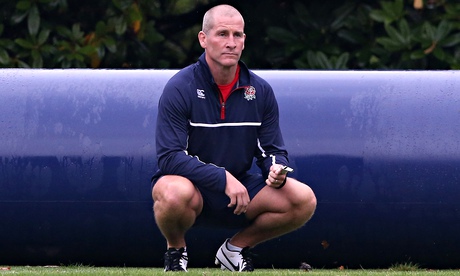
It does not seem long ago that Stuart Lancaster was naming his first England team to face Scotland in 2012. If the side to play Uruguay on Saturday turn out to be his last as head coach his spell in charge will have spanned 46 Tests. It seems somehow appropriate he finds himself experimenting to the bitter end, still looking for the ideal midfield combination that has eluded him from the beginning.
Given England are out of the World Cup, it does not theoretically matter who plays in his side’s final pool game in Manchester. Barring the biggest shock in World Cup history by a team of South American part-timers the game will definitely be won, leaving Lancaster with a final tally of 28 wins, 17 defeats and one draw. By omitting Sam Burgess altogether, starting Owen Farrell and Henry Slade in midfield and retaining Chris Robshaw as his captain, however, Lancaster has ensured his final fling in Pool A is not the irrelevant postscript it might have been.
Suddenly, from having barely any playmakers against Wales, England have four in the same backline. There may well be a subliminal V-sign in there somewhere, a here-you-go retort to those who have queried his selections.
Yet again, though, the balance is questionable – either Slade and Jonathan Joseph or Burgess and Slade would have made more immediate sense than shifting Farrell into a position he has publicly said is not his forte. Slade, similarly, is being asked to create openings without the relieving option of a fast, strong ball carrier to fix defenders.
Given the game is also being staged on the same weekend – and in the same city – as rugby league’s Grand Final, this was surely a perfect occasion, too, for a Burgess cameo.
His absence from the 23 would suggest that experiment has been mothballed, making the logic of his original selection even more questionable. Courtney Lawes and Brad Barritt are injured and, as for Robshaw, who has endured a hellish couple of weeks, the thinking seems to be that resting his captain would have been crueller still.
In all there are eight personnel changes from the ill-fated Australia game for a fixture which Lancaster has clearly started to view differently as the fog of despair starts to clear. He spoke more than once about the importance of leaving “a good last impression” and departing the tournament with head held high.
“If there is one thing I’m determined to do this week, it’s to finish with everything intact,” he said, referencing the whispers of discord at Burgess’s squad inclusion, among other noises off.
“I think you guys are looking for conspiracy theories which just aren’t there. My relationship with the players has always been strong and will remain so. From the feedback they’ve given me they believe the team is in a good place. And I do too.”
To some that will be construed as a public plea for clemency from his employers, the Rugby Football Union, to others simply an attempt to use his final days at the tournament to highlight the positives of the past four years. There have been several of those but not, crucially, where it mattered most.
While Lancaster is conscious of that reality, he is not convinced anyone else would have done better given the post-2011 situation he inherited.
“It’s a brilliant job but it’s a tough job. I think people underestimate the complexity of how injuries, form, fitness, the EPS agreement with the clubs, having so many players and the must-win game nature of England rugby affect the decisions you make. But having not nailed a Six Nations or a grand slam and certainly not this World Cup, I understand there is no room for error. Obviously that’ll all be taken into consideration over the next few weeks.”
Had he known at the outset what he knows now, someone asked, what advice would he have given the fresh-faced Lancaster? “Good luck, get a tin hat and a flak jacket,” he replied instantly. As far as the future goes, he picked out Ford, Farrell, Joseph and Slade as players around whom something spectacular could yet be built. “They are the most talented in my opinion. But it [has been] very hard, with injuries and everything else, to get to that type of combination under the pressure of must-win games.”
There will always be some luck involved but, equally, too few of Lancaster’s big punts, particularly in the last 18 months, have come off. Add to that the untimely decline in England’s scrum potency – “That’s been a disappointing area” – and a tendency to give away “dumb penalties” at crucial junctures and the host nation can hardly claim to have been robbed blind.
This match will at least offer Alex Goode, Jack Nowell, Danny Care and Slade a first tournament start and it was the last of those who neatly summed up the general mood. “For it to be over before I’ve had a chance to do anything was slightly disappointing,” he said. The 22-year-old will not be alone in seeking some belated redemption against Uruguay.