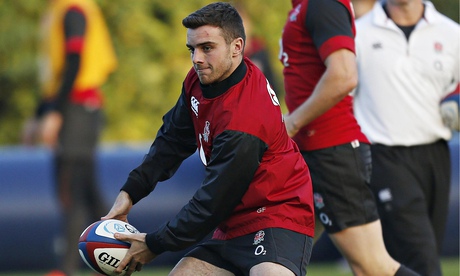
The middle of a busy month is not a natural moment to start a new era but Stuart Lancaster has just made the most significant choice of his tenure as the England coach. Moving Owen Farrell from No10 is a big deal but taking the goalkicking away from him as well sends the clearest of signals. The selection of George Ford at fly-half is the shape of things to come.
That is certainly the thrust of the message Lancaster relayed to the 21-year-old Ford when he gave him the news. He has made six changes in total for the Samoa game but in terms of running the game, Ford is now first among equals. “I told him: ‘You’re the boss, let’s get bossy,’” said Lancaster, making clear the Bath player will be England’s principal boy. The flip side, of course, is that Farrell no longer is.
When England are awarded their first kickable penalty against Samoa on Saturday that changing reality will become even more obvious. It is not just a question of whether Ford will kick it but how Farrell will respond to his altered circumstances. Lancaster can only hope, for the good of the team, that both young men rise to their respective challenges and give him a pleasant selection problem for Saturday week’s final Test of 2014, against Australia.
The downside is Farrell has never pretended to be a specialist 12. He and Barritt play together in the centre for Saracens – normally with their numbers switched around – but they are neither the biggest nor quickest midfield pairing seen at Test level in recent times. It is all very well having an extra distributor and kicker but centres capable of breaking the defensive line and out-sprinting the cover are also required. When they last played together in midfield, right at the start of Lancaster’s reign in 2012, England’s main source of tries were charged-down kicks by Charlie Hodgson.
Farrell has 27 caps-worth of experience, however, and Lancaster has to discover at some stage if he can fill a role which has caused England problems for years. Kyle Eastmond, whose bang to the head at the end of the South Africa game did not help his cause, has yet to stake an unanswerable claim and Billy Twelvetrees, despite his reappearance on the bench, still seems to be trying to win back the trust of certain elements of the management team after throwing a costly loose pass against New Zealand in Dunedin in June.
There is a collective sense of genuine opportunity, however, running through the heart of this England selection. Tom Wood, such a strong lineout presence, has hitherto been a constant pick under Lancaster but, suddenly, James Haskell has the World Cup audition he has waited for. The coach made little attempt to soften the pill, making clear England need “to make a step up” with ball in hand as well as around the breakdown and in defence.
With Dylan Hartley missing out partly because of his avoidable second-half sin-binning against South Africa, there is also a significant run for Rob Webber at hooker. He is one of three Bath men in the front five, all of whom have spent long enough on training fields and benches to recognise a golden chance when they see one.
The choice of Richard Wigglesworth on the bench is also an indicator of the management’s desire to see England’s kicking game improve.
Among the forwards, the key word will be discipline. Too many penalties were given away against South Africa and too few yards were covered with ball in hand. If Ben Morgan can add some dynamism and bring a touch more control than Billy Vunipola it will make life appreciably easier for Leicester’s Ben Youngs, back again as the starting scrum-half. That all-important 8-9-10 axis is precisely where England have struggled most this month to date.
Samoa, who will confirm their lineup on Thursday, are not in the class of the All Blacks or the Springboks but Lancaster will be seeking a far more clinical showing. “We need to improve the quality of the performance,” he warned bluntly. “The players have been told that and we’ve made changes to create that.”England Brown (Harlequins); Watson (Bath), Barritt, Farrell (both Saracens), May (Gloucester); Ford (Bath), Youngs (Leicester); Marler (Harlequins), Webber (Bath), Wilson (Bath), Attwood (Bath), Lawes (Northampton), Haskell (Wasps), Robshaw (Harlequins, capt), Morgan (Gloucester).
Replacements Hartley (Northampton), Mullan (Wasps), K Brookes (Newcastle), G Kruis (Saracens), T Wood (Northampton), R Wigglesworth (Saracens), B Twelvetrees (Gloucester), M Yarde (Harlequins).