There are, they say, seven basic plots. That’s according to the theory coined by Christopher Booker in his famous book of the same name. He can never have seen England play the All Blacks, a fixture growing to be tediously predictable, and which seems, of late, to always be the same old story. England have lost their last five games against New Zealand and only once, in the third Test at Hamilton last summer, has there ever been more than eight points in it. The gaps are so narrow, and yet the gulf between the two teams seems as wide as ever. Well, you may say, England can join the club, along with every other rugby-playing country in the world. New Zealand have been beaten 12 times in their last 100 matches, five times in the past five years, and twice in the last three years. Lunar eclipses are more common than All Blacks defeats.
A result like this one, 24-21, can be cut two ways. You could take it as a sign that England are developing along the right lines. You could argue that this time around they were handicapped by all those injuries, to four certain starters in Dan Cole, Alex Corbisiero, Joe Launchbury and Manu Tuilagi, and four certain subs, Tom Youngs, Tom Croft, Luther Burrell and Mako Vunipola. You could howl, as the crowd did, in protest against Nigel Owens’s decisions, and boo Richie McCaw for his mastery of the dark arts, as though England themselves didn’t, wouldn’t, look to grab every single advantage, legal or otherwise, that they could find. Ah, the injustice of it all.
Cut this result the other way, and you’ll find that for all the improvements they’ve made they’ve won two of the 12 games against Australia, South Africa and New Zealand since Stuart Lancaster took charge. Add to that fact that they haven’t once won the Six Nations in the same span of time. The thing is, with all the changes they’ve made to the team culture, the bonds they’ve built with the fans, the sense of pride and responsibility they’ve fostered in the players, England are starting to look like they’re all pomp and extenuating circumstance.
Which side do you fall on? That depends how generous you are feeling. Stuart Lancaster said that he felt happy that there were “enough positives to draw from that performance”. It was true that England played superbly well in the first half, against the world’s No1 side, who, as Lancaster pointed out, had the benefit “of two and a half months together”, whereas his England side has been training for “a week and a half” and included three players making their international debuts.
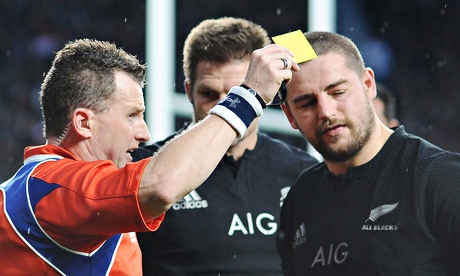
Then the All Blacks’ kickers, Aaron Cruden and Beauden Barrett, missed four kicks, spurning 10 points between them and, in the crucial spell of the match, they were a man down for 10 minutes at the end of the third quarter after Dane Coles was given a yellow card for kicking out at Dylan Hartley after the Englishman yanked his jersey.
At that point the score was 16-14 to New Zealand. This, then, was England’s opportunity. They blew it and by the time the All Blacks were back to full strength their lead had grown to 19-14. That even after Barrett let England off when he missed a kick from in front of the posts. A penalty for offside gave him a simpler opportunity from even closer moments later. Add it all up and you could conclude this was a match England should have won. To put it another way, by their own extraordinary standards New Zealand didn’t play all that well. Certainly, they don’t make a habit of cutting their opponents as much slack as they did England.
That the All Blacks were able to do such a good job of controlling the match when they were a man down, and as the rain started to fall, could be put down to their match experience, something England undoubtedly lack. Lancaster had 359 caps in his starting XV. New Zealand had almost twice as many. Conrad Smith had as many as England did in the entirety of their backline behind Danny Care. When he took charge, Lancaster said he planned to have a side that had a combined total of 663 caps by the time the World Cup came around, a figure based on the average aggregate of the last four world champions. England are a long way short of that, and still will be this time next year. They always seem to be perpetually stuck, six months behind where they want to be.
The worrying thing was, though, that it wasn’t the rookies who struggled. England lost control of the game because of a series of sloppy errors from the few senior players they do have in the squad. Whether it was Care, who twice kicked possession away when Coles was off the field, or Owen Farrell, who missed touch with a kick from hand in the lead-up to McCaw’s wonderful try, or Mike Brown, who fumbled a pass from Kyle Eastmond when he was within reach of the try-line in the first few minutes.
The game ended, fittingly enough, when Chris Robshaw knocked the ball on, killing the game before his team had the chance to make one last attack. The very men Lancaster has built his team around are the ones who let the side down. They will need to be sharper, and smarter, against South Africa next Saturday.