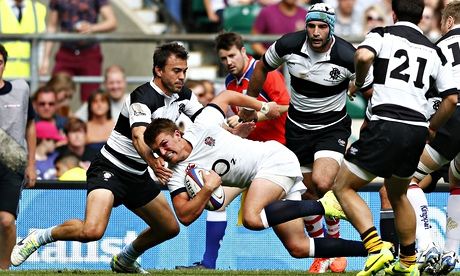
Stuart Lancaster says he already knows 80% of his squad for next year’s Rugby World Cup. As he is well aware, though, it is the remaining 20% which will probably make or break England’s 2015 campaign. He needs at least two – and ideally three – quality players in every position if the hosts are really going to prosper.
Hence the importance of this autumn’s international series in terms of polishing the enamel and filling any holes ahead of the once-in-a-lifetime glare of public interest next year. It scarcely helps that so many forward candidates – Dan Cole, Alex Corbisiero, Mako Vunipola, Tom Youngs, Geoff Parling, Louis Deacon, Tom Croft, Ed Slater, Tom Johnson and Carl Fearns – are injured but such is life in a brutally tough professional sport. England will just have to whistle up their fittest available pack and view the task of beating New Zealand a fortnight on Saturday as a timely opportunity rather than a headache.
To complicate matters further, Lancaster is having to cope with the slightly arcane small print of the elite player agreement. It means he is initially required to unveil a 33-man squad, including some currently-injured players such as Manu Tuilagi and Kyle Eastmond, on Wednesday and than wait until Sunday to bring in further reinforcements. It makes for a potentially bitty announcement, with the realities of England’s selection not now due to become fully evident until next week once they gather for training in Bagshot.
There will, therefore, be several players apparently surplus to requirements in midweek who will subsequently be whistled up in a few days’ time. Two of the form players in this season’s Premiership, Jonathan Joseph and Henry Slade, are set to be among this second wave. Stick everything together and there is no shortage of talent around; when Danny Cipriani, Freddie Burns, Christian Wade, Ben Foden and Chris Pennell are all struggling to feature in the elite player squad there is clearly some decent depth.
When all the previously mentioned forwards are back fit and Lancaster has to reduce his squad to 31 for next year’s World Cup certain pips really will begin to squeak. In some positions – hooker, lock, scrum-half, full-back – there is not a great deal of argument. The main debates, as ever, hang over the back row, the midfield balance and which brace of wings to pick.
With Croft, Slater, Johnson and Fearns injured and Steffon Armitage still in Toulon, there is certainly a lively argument to be had around England’s flanker options. Exeter’s Dave Ewers – big, strong, willing and improving all the time – must be getting very close, along with Saracens’ Will Fraser, now back fit again. With James Haskell enjoying a highly productive season and both Chris Robshaw and Tom Wood determined to retain their starting shirts, there is healthy competition all over the place.
It is the same on the wings. Jack Nowell and Jonny May finished the Six Nations as England’s starting wide men; Chris Ashton and Marland Yarde were in position by the time England wound up their season against New Zealand in Hamilton. When the Six Nations comes around again it could easily be Semesa Rokoduguni and Anthony Watson, with Christian Wade on their heels. Ultimately England require players with a rounded game, not just try-scorers.
The midfield? Lancaster could do worse than study last week’s excellent documentary on the greatest centre Ireland has ever produced. BT Sport’s film about Brian O’Driscoll was an absorbing study in emerald genius, enhanced by the frequent contributions of his parents. Mrs O’Driscoll turned out to have a low opinion of New Zealand newspaper cartoonists, while her husband’s main regret was that Brian never played a Test at flanker. It was not hard to work out where their son’s legendary competitive edge came from.
Two other contributors also made timely points: Gordon D’Arcy and Warren Gatland. D’Arcy, O’Driscoll’s long-time midfield partner, said he felt as if he had had the best seat in the house throughout his career, suggesting class will always drag others along behind it. Gatland rightly observed that, while Roberts won the man-of-the-series award for the Lions in South Africa in 2009, it was O’Driscoll who often fashioned the space which allowed his partner to flourish.
If Tuilagi is not fit to face the All Blacks, England will probably opt for the unselfish Brad Barritt and AN Other. That seems most likely to be Luther Burrell, unless Joseph really rips it up in training. It promises to be a revealing few weeks, either way, with Watson, Slade and Ewers all on a sharply-rising trajectory.
The EPS system can be confusing but there is a silver lining this time around: had Lancaster been forced to play it strictly by the book and name his elite squad back in July he would have been guessing far more than he is now. While inevitably dogged by fitness issues, he at least has some form to base marginal decisions on. Historically England have had too many people from which to choose and fallen into the trap of trying them all. By the time he names his next EPS squad in January, Lancaster needs to have identified his best men for the long haul.
Possible 33-man squad
Forwards J Marler, M Mullan, D Hartley, R Webber, D Wilson, K Brookes, D Attwood, J Launchbury, C Lawes, J Haskell, T Wood, C Robshaw, M Kvesic, W Fraser, B Vunipola, B Morgan.
Backs D Care, B Youngs, L Dickson, O Farrell, G Ford, S Myler, B Barritt, L Burrell, K Eastmond, B Twelvetrees, M Tuilagi, S Rokoduguni, M Yarde, J May, J Nowell, M Brown, A Goode.
GOING FOR GOLD
The departure of Ewen McKenzie as Wallaby coach merely heightens Australian rugby’s image as the most dysfunctional family in the international game. It was only last year that Robbie Deans was ushered out of the job and it would appear player power has again played a part in McKenzie’s exit. For two such experienced coaches to fall by the wayside in such quick succession has to reflect poorly on the Australian Rugby Union.
As the Rugby Football Union – and the English and Wales Cricket Board – has found in recent years, lasting on-field success is almost impossible if there is a lack of faith in those at the very top.
ONE TO WATCH THIS WEEK...
Bath v Toulouse. A fortnight ago Bath were looking at this fixture as potentially riotous fun against out-of-sorts opposition. Suddenly, after their comprehensive drubbing in Glasgow and Toulouse’s victory over Montpellier, the game has taken on a very different complexion. Injuries have struck Bath at an awkward moment and they need their England forwards to front up against a powerful Toulouse pack. The good news is that home advantage seems to be more priceless than ever in Europe; the only away win in round one was at Sale where Munster squeezed home 27-26 with a last-gasp drop-goal.