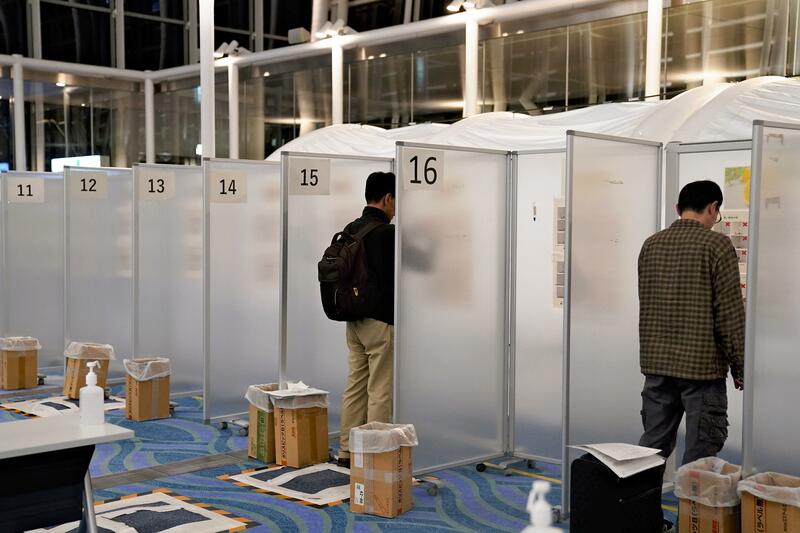
Various problems have arisen due to border control measures that were bolstered in April. In some cases, returnees have not been allowed to board planes because airline officials said the document certifying negative coronavirus test results was not the form designated by the Japanese government, although different versions are allowed as exceptions.
A company employee in his 40s was returning from South Africa to Japan in late April, but was told by an airline official that he could not board the airplane because his test result certificate was invalid.
The man had prepared a document that stated everything required by the government, but he was told that the government-specified form was not used.
The man insisted that returnees are allowed to enter Japan as long as all the necessary items are included in the document, but airport staff were not convinced until a Japanese embassy official provided an explanation over the phone.
Standardized coronavirus test result certificates are not common around the world.
"I understand how important border control is, but I wonder if there isn't a smarter way [to do things]," the man said.
Cases of returnees being denied boarding have occurred in Britain, China, Israel, Italy, Thailand and the United States, according to a tally by The Yomiuri Shimbun. There was also a case in which an airliner did not allow a person affiliated with the Japanese government to board a plane.
According to preliminary statistics by the Immigration Services Agency, about 30,000 people returned to Japan from overseas in April. Strengthening border control measures is an urgent task as coronavirus variants continue to spread.
The Health, Labor and Welfare Ministry said that a specific certificate was designated to ensure the government-specified test method is used. However, the fact that the government has allowed exceptions is not widely known among airline companies.
At Kansai Airport in Osaka Prefecture, a man in his 30s returning to Japan from the Netherlands was denied entry under the Quarantine Law and sent back to the European country in April. The reason was that the coronavirus test method described in his predeparture result certificate was different from the technique specified by the Japanese government.
The test the man had taken was conducted by mixing multiple samples taken from different places including the nose and throat, a common method in the Netherlands. However, Japan specifies that mucus from the back of the nose or saliva be used for a test.
Some experts question the decision to send people back to the country of departure.
"Doubts remain regarding the legitimacy of sending Japanese nationals to a foreign country," said Yukio Tomii, a professor at Tokyo Metropolitan University and an expert on public law. "The government needs to provide a clear explanation about the decision."
Read more from The Japan News at https://japannews.yomiuri.co.jp/