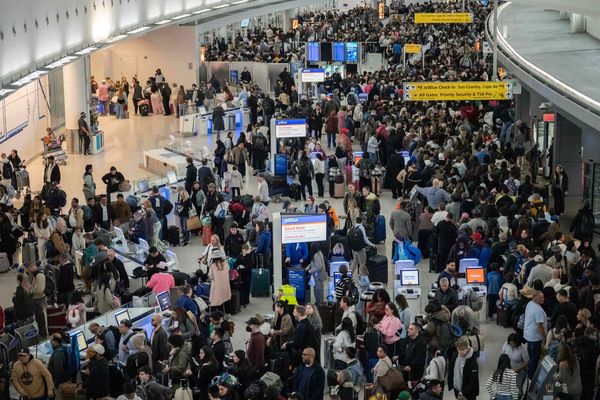
How many Australians would vote if voting wasn’t compulsory? Across Europe voter turnout has collapsed from an average of 84% between 1979 and 1984 to 62% between 2009-2014. The last time turnout in the UK exceeded 80% was back in 1951.
Are Australians, famous for our distrust of the ruling class and authority, somehow more enamoured with politics and politicians than other western countries? It’s doubtful. Compulsory voting masks significant disaffection with the political system. While over 90% of Australians continue to diligently turn up to polling booths and cast a vote, a 2014 poll found that only 60% of Australians, and just 42% of Australians aged 18-29, believed that “democracy is preferable to any other kind of government”. Of the 28 prime ministers, premiers and chief ministers Australia has had since 2007, only three have been elected more than once. Clearly something is going wrong.
In the UK, comedian and actor Russell Brand has tapped into the feeling of distrust and frustration permeating the populace following economic decline and the imposition of harsh budget cuts by the Conservative government. Brand called for a “revolution” of the political system and argued that since the major political parties had coalesced around the ideology of free market supremacy, elections weren’t worth voting in.
While Brand was criticised for advocating electoral boycotts, with many pointing out parties such as the UK Greens did in fact stand for the kind of change he was espousing, his political treatise sold tens of thousands of copies within two weeks, demonstrating the resonance of his ideas.
Back home in Australia it appears that the stage is set for a Brandian revolution. The Abbott government’s first budget served as a significant turning point for progressive politics in Australia. After trundling along, fulfilling the only responsibility voters had placed in it – not being the divided and inward looking Labor party – the Coalition turned on those who had elected it. Without any pre-election foreshadowing, the government took a sledgehammer to social services, Medicare and higher education.
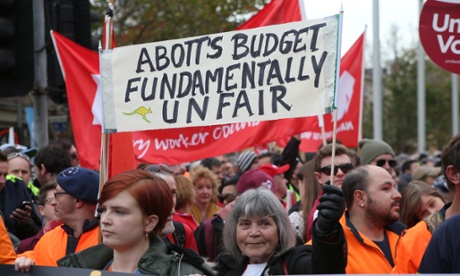
These attacks, on what most Australians consider core responsibilities of the state, prompted “Bust the Budget” rallies. While the rallies were energising and a much needed boost for a demoralised Australian left, they, along with the March in March protests that preceded them, have been criticised for focusing almost exclusively on anti-Abbottism rather than building up an alternative agenda.
Luke Mansillo’s call in Guardian Australia for progressives to fight Abbott and his agenda by joining the Labor party sparked furious debate. Mansillo – attempting to portray Labor as a kind of Australian Syriza, committed to the wilful destruction of capitalism and a kinder, fairer society – was criticised for skating over the Labor party’s recent history of slashing funding to higher education and pushing single mothers into poverty by slashing welfare.
In many ways Mansillo’s arguments represent the opposite end of the spectrum to Brand’s view of abstention and revolution. Upset with the state of politics? Grab a membership form, attend branch meetings, and argue ferociously on social media about how Labor simply has to slash funding to welfare because if they didn’t, the Tories would get in and do it anyway! It’s not surprising Australians look at politics with despair.
So if neither Brand nor Mansillo, then where? Politics is a battle of social forces. Political parties act as representatives of those forces. The weaker the social movements underpinning them are, the more likely we are to see politicians of all persuasions push through agendas entirely disconnected from the views of the community. That’s why even if every well-meaning progressive angry about Abbott’s cuts joined the Labor party tomorrow, it probably would have still voted to support billions of dollars of cuts to welfare.
It’s also why Stephanie Peatling’s call for more “compromise” between our major political parties to fix the malaise afflicting politics is off the mark. Both Peatling and Mansillo are calling for us, the disaffected, to throw our lot in with those who turned us off politics in the first place – the parties that run the show.
The fastest growing political movements in Europe at the moment are those who have risen out of disenchantment with the current economic and political order and are committed to building newer, fairer societies. They include Syriza in Greece, Podemos in Spain and the Greens in the UK.
I chose to involve myself politically with the Greens here in Australia because they too grew out of frustration with the existing political order, in particular disenchantment with a conservatising Labor party. The Greens are committed to rewriting the rules, not just being absorbed into the bland melange of mainstream Australian politics. But the Greens, just like the new parties of Europe, won’t be able to change politics on their own. New and invigorated social movements are needed to provide the basis for change.
If you want to fight Abbott and the right-wing agenda he and the Coalition stand for, sure you can join a party and campaign in elections, but also join your union, join your local environment group, attend rallies, help organise protests and debate politics with your workmates and friends. These are the social movements that will drive a new kind of politics, one that puts power in the hands of people not politicians.