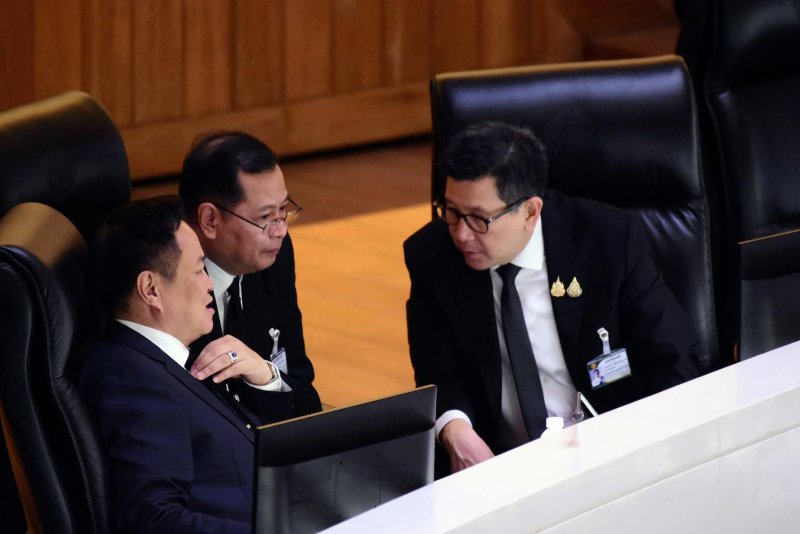
Listening attentively for 52 minutes to Deputy Prime Minister and Finance Minister Ekniti Nitithanprapas' diagnosis of Thailand's deep economic malaise, one could easily have suffered a heart seizure. Fortunately, he used the analogy of a patient with cancer who must determine what treatments are required to cure the disease in both the short and long term.
"Today we must accept that we have cancer. Painkillers relieve the symptoms, vitamins can keep us going, but chemotherapy -- are we going to wait five months, six months, or another year before making the energy transition?" he opined.
"If we do not hurry to transform, to make ourselves strong, to treat the disease at the root, the country will only get worse." He clearly wanted to make a broad public appeal that the threat is real and affects everybody, and will for a long time. "We need to change, otherwise we will get worse."
At the National Press Council of Thailand over the weekend, Mr Ekniti was in his element. He spoke with passion and laid bare the country's economic health without a prepared speech. Obviously, as the country's financial czar -- not to mention a seasoned Finance Ministry mandarin -- Mr Ekniti must have repeatedly highlighted, in domestic and international forums, the structural economic challenges Thailand is navigating. Under his watch, his legacy now rests on the recovery of the Thai economy.
He was candid in saying that amid rising energy costs, a higher cost of living and huge short-term deficits driven by oil and gas imports, the fiscal budget will not be sufficient. Truth be told, in front of a roomful of reporters, he was asking the country to trust the Anutin government with a 400-billion-baht emergency fund when its honesty is in question. His comments came ahead of a Constitutional Court ruling on the fund's legality later this week. Given the current situation, Thailand needs strong medicine now to restore economic health.
Mr Ekniti disclosed that in May and June alone, the country suffered a 500-billion-baht current account deficit -- the most serious challenge facing the government. Prior to the Feb 28 Middle East crisis, Thailand had run a healthy current account surplus for two decades. But with the energy crunch, the government is borrowing funds to finance the energy transition. The opposition parties were not happy, viewing the massive borrowing as non-emergency and calling it unconstitutional.
According to Mr Ekniti, the Anutin administration has set three priorities for how the money will be spent. First, the country needs investment in the energy transition to upgrade the power grid, which will cut electricity bills through renewable energy, including solar power, and let households sell electricity back through the net metering system.
Second, the country will promote the use of electric vehicles (EVs) and the so-called "fuel from the land", which includes biodiesel and ethanol. From now on, Thailand must lessen its energy imports and turn to locally produced sources. Finally, the workforce needs new skill sets related to EV industries to earn higher wages in the new economy.
Today, Thailand's energy imports account for more than 10% of GDP, the highest proportion in Asean. "This transition isn't just short-term relief -- it's an investment in the future that will boost the country's long-term competitiveness," Mr Ekniti stressed.
Towards the end of his speech, he also proposed a "5T Strategy" to strengthen Thailand's economic resilience: target, transition, transform, transparency and teamwork.
"Target" means ensuring that budget spending and policy measures reach the right groups affected by the economic shocks. "Transition" focuses on accelerating Thailand's shift to a green economy through greater investment in clean energy and related infrastructure.
Then came "transform", which calls for long-term reforms through investment in infrastructure, people and AI-related skills, as well as regulatory changes to make investment easier, including expanding the Fast Pass system for Board of Investment projects and promoting investment in data centres, semiconductor manufacturing and AI industries.
The remaining two pillars are "transparency" and "teamwork".
Transparency is the most important element of all, as the government must make budget data publicly available in AI-readable formats to strengthen accountability and public scrutiny. Teamwork emphasises closer cooperation among the government, private sector and economic agencies, including the Joint Public and Private Sector Consultative Committee, to advance investment, regulatory reform, workforce development and fiscal stability.
The Anutin government is also opening the way for AI to help small and medium-sized entrepreneurs through an app known as Nok Krasip, which will help small traders understand and analyse sales and prepare financial statements. At the upcoming World Bank and IMF meetings here in October, Mr Ekniti proudly said the government will showcase Nok Krasip to global participants. The locally made AI is touted as a model for using the technology to lift local economies and small businesses.
Wrapping up, Mr Ekniti urged Thailand to act and adapt to rapid changes in investment, infrastructure and human capital development to maintain its competitive edge. On the evidence of this speech, the Anutin government has the right diagnosis of Thailand's urgent challenges.
The speech was well paced, the delivery confident, the content clear and even inspiring. Yet, as with all promises, the real test is whether the government is sufficiently transparent to warrant the strong medicine. Otherwise, it could quickly morph into a government of alphabet-soup policymakers.