"Nihonbashi," the name of a fashionable commercial area of Tokyo, means "Japan Bridge," and indeed there is a bridge at the center of it. The first Nihonbashi bridge, made of wood, was built in 1603, around the time Tokugawa Ieyasu took power as shogun and relocated Japan's capital from Kyoto to Edo, as Tokyo was then called.
The bridge, crossing the Nihonbashi River east of Edo Castle (a precursor of today's Imperial Palace), became the official starting point of Japan's road system. Over the past 416 years, a series of 20 bridges have stood on the site, and the nation's official zero-kilometer marker still exists at the center of the current one, which was built in 1911.
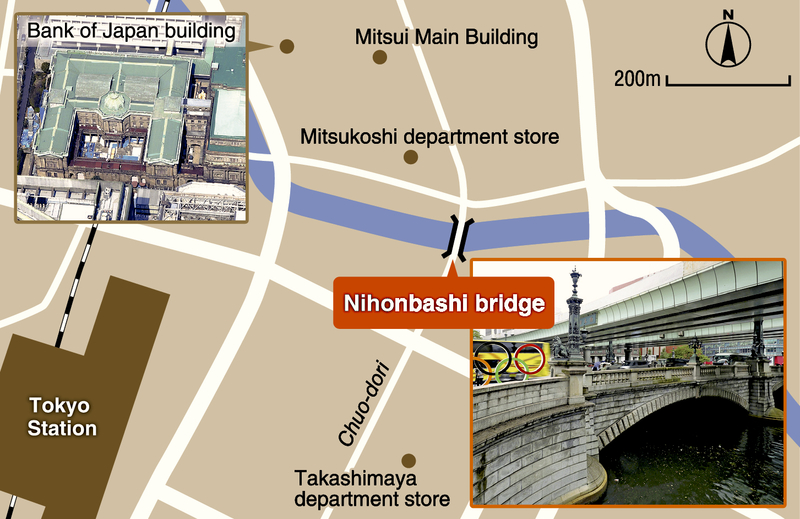
On a rainy October afternoon, I joined a group of Japanese and foreign visitors for the Nihonbashi Cultural Heritage Tour, a nearly two-hour stroll taking in architectural and historic points of interest mostly along Chuo-dori, the avenue that runs over the bridge.
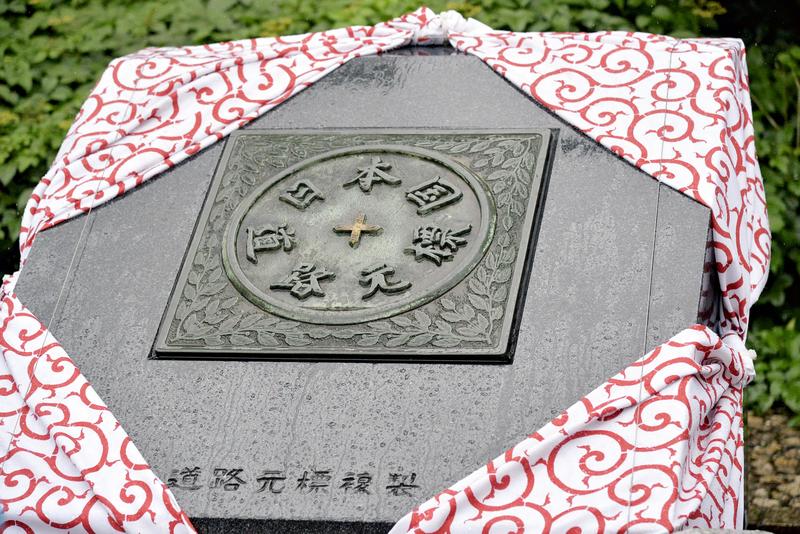
Tour guide Eleonora Bianchi warned us not to run out into traffic to look at the zero-kilometer marker, although it might be possible to get a peek during an annual bridge cleaning event in July. The rest of the year, visitors must content themselves with looking at a replica on display in a tiny park on the west side of the bridge's northern end.
On the east side of that end stands a sign explaining that a bustling fish market arose here early in the Edo period (1603-1867) "as a sales point for fish left over from the supplies sent to the shogun and daimyos [who] lived in Edo Castle." Business continued until the Great Kanto Earthquake of 1923, after which the market was relocated to the Tsukiji district.
At the south end of the bridge, there are two metal plaques bearing the name "Nihonbashi," one in kanji and the other in hiragana, on opposite sides of the road. The calligraphy was done by Ieyasu's descendant Yoshinobu, the last Tokugawa shogun. Adornments on the span also include sculptures of kirin, dragonlike mythical creatures. These kirin are unusual in that they have wings, which is said to make them a symbol of prosperity.
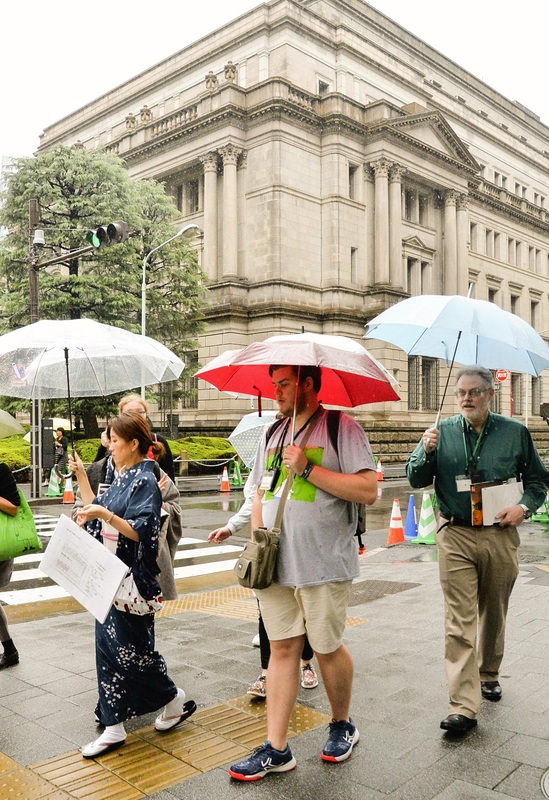
North of the bridge, we peered out from under our umbrellas at the Mitsui Main Building, built in 1929 as a base for the Mitsui Conglomeration. Our eyes traveled up the tall Corinthian columns of the about 30-meter-tall building -- a giant edifice for its day -- to where Bianchi pointed out relief sculptures on the facade. These included a spinning wheel to represent the silk business and a beehive to symbolize industriousness. The basement contains a bank safe so heavy that it couldn't be carried across the bridge and had to be delivered by boat, Bianchi said.
Next door is the Nihombashi Mitsukoshi Main Store. Although the department store was built in 1935, parts of it are millions of years older. The marble on the walls of the atrium and surrounding stairways includes numerous fossils of spiral-shelled creatures called ammonites.
The atrium also features a Wurlitzer organ with 852 pipes, imported from the United States in 1930. A sign in the store said it is played at 10 a.m., noon and 3 p.m. on Friday through Sunday, so I returned later to hear a 15-minute performance of several short tunes including "Ave Maria" and "Deck the Halls."
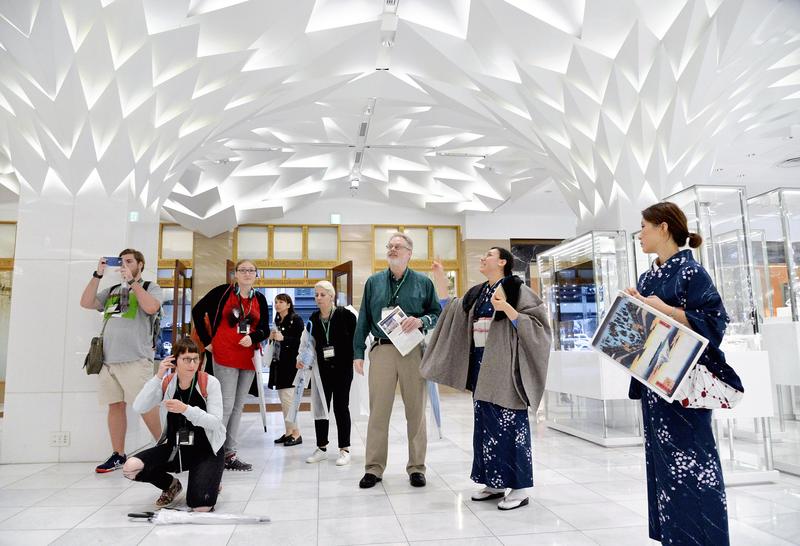
But not everything is old. The first floor has an interior design by Kengo Kuma and Associates, the architecture firm behind the New National Stadium. An array of aluminum panels and LEDs spreads from support columns and across the ceiling to create a sense of being inside a shiny white forest.
South of Nihonbashi bridge, but also on Chuo-dori, is another department store, the Nihombashi Takashimaya S.C. Main Building. Built in 1933, it is a rare place that still employs old-fashioned elevator operators. Down a side street, you can look up to the fifth floor of the building to see a ledge that holds a large abstract sculpture resembling a white snake. This may allude to a traditional symbol of commerce, but the artist's intentions are unknown.
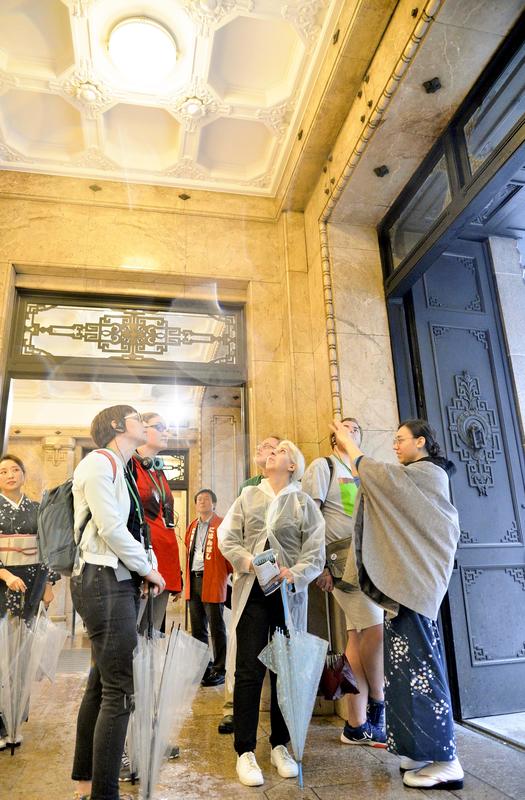
As we looked at sculpted decorations on the store's massive iron doors, which combine Western floral and Eastern geometric designs, Bianchi taught me a new word: "raimon." This is the name of the Greek-key-like design seen on the doors -- and also around the rim of a typical ramen bowl.
Along Chuo-dori avenue on both sides of the bridge there are many smaller merchants, including "antenna shops" selling craft items, local delicacies and other specialties from various parts of Japan.
Just off Chuo-dori, near the Mitsukoshi store, is the 1896 Bank of Japan building, designed by prolific Meiji-era architect Kingo Tatsuno (1854-1919), who also designed Tokyo Station. Bianchi pointed out that when seen from above, the building appears to be shaped like a very familiar kanji character: the one for "yen."
However, a different kanji for yen was officially in use back then, so no one is sure if Tatsuno did this intentionally.
One thing is certain -- Nihonbashi includes a lot of nice places to spend your yen.
* * * * * *
For more information, visit the Nihonbashi Information Center at nihonbashi-tokyo.jp/en/. No schedule for a future Nihonbashi Cultural Heritage Tour has been announced, but the stores on the tour are open to the public.
--The tour was held as part of the Japan Cultural Expo, or Nihonhaku, a goverment-sponsored arts and culture festival coinciding with the period around the 2020 Tokyo Olympics and Paralympics.
Read more from The Japan News at https://japannews.yomiuri.co.jp/