The 1950-53 Korean War ended in an armistice rather than a peace treaty, and hopes have been raised that this week's second US-North Korea summit may begin a process towards formally resolving the conflict.
On the surface these sentiments are admirable -- who can argue against peace? But prematurely declaring "peace" could have unintended negative consequences for denuclearisation, US alliances, and existing security institutions. Declaring peace, in other words, could actually threaten peace.
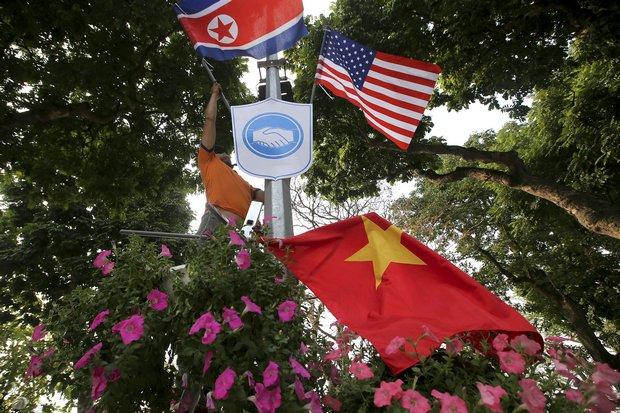
In the Trump-Kim summit planned for Wednesday and Thursday in Hanoi, Vietnam aims to produce dual roadmaps: one elaborating steps toward denuclearisation, the other specifying elements of a peace regime. It would be a substantial achievement if the meeting produced a timetable integrating the two. Freezing the production of fissile material, nuclear weapons and delivery systems could be rewarded with sanctions exemptions for inter-Korean projects. Having the US and North Korea open liaison offices in each other's capitals would be diplomatically meaningful and could facilitate humanitarian assistance.
But declaring peace, without achieving more substantive steps toward denuclearisation first, risks accepting North Korea as a de facto nuclear state. While North Korea's suspension of nuclear and missile tests may resemble stability, the freeze is easily reversible and likely temporary. The regime continues to produce fissile material, advance its missile and nuclear technologies, and engage in cyber attacks. Even if Pyongyang agrees to disclose its nuclear assets, it is likely to make an incomplete declaration, offer up known and nonessential sites, and then drag out piecemeal concessions using so-called "salami-slicing tactics". Policy inertia in that direction -- after a declaration of peace -- would risk allowing North Korea to go the way of Pakistan, with the Kim regime keeping its nuclear weapons while enjoying international recognition and economic benefits.
While some strategists place faith in the transformative power of economics to peacefully change North Korea from the inside out, economic cooperation is already butting up against sanctions restrictions. Moreover, North Korea shows a lack of willingness to open to international trade and capital beyond what the regime can control. With a record of exporting slave labour, engaging in illicit trade, and breaking business contracts, there is no possibility of an overnight success story for economic engagement.
Furthermore, North Korea would almost certainly use "peace" to drive wedges between the US and its allies. After an end-of-war declaration, North Korea and voices sympathetic to Pyongyang would begin to question the purpose of Terminal High Altitude Area Defence (THAAD) missile defences, US-South Korea joint military exercises, and even US troops stationed in South Korea.
If South Koreans see the costs of US cooperation rising while the perceived threat of North Korea declines, domestic support for the alliance may be at risk.
North Korea continues to increase its conventional military capabilities without noticeably reducing its deployments, training, or readiness. If peace were simply declared, Pyongyang would likely aim to push the United Nations Command and Neutral Nations Supervisory Commission out of the DMZ and call for an end to the US-South Korea Combined Forces Command. A hastily made end-of-war declaration could damage the legal basis for these authorities that maintain the existing armistice, which is still needed until the parties negotiate and implement a full peace treaty.
In contrast to the early 2000s -- when Six Party Talks aimed for multilateral responsibility among the two Koreas, Russia, China, Japan and the United States -- the old narrative of the US and North Korea failing to make progress has made a comeback since the first Trump-Kim summit in Singapore. This bilateral blaming distracts from the actual problem, which is North Korea's failure to denuclearise. A false moral equivalency between Washington and Pyongyang lets China off easy in terms of its commitments to nonproliferation and implementing UN sanctions, while any degrading of American alliances opens space for Beijing to advance its own vision of regional order.
The final barrier to ending the Korean War is Pyongyang's record on an integral component of peace: human rights. There have been recent improvements in terms of accountability, as the US added sanctions for violations of freedom of speech and individual rights. The UN Commission of Inquiry report advanced an ongoing movement to collect testimony, and the next UN Universal Periodic Review of North Korea is upcoming in May.
But for many survivors of the oppressive North Korean regime, high-level engagement of Pyongyang produces self-censorship on the part of US and South Korean political leaders. Talks on denuclearisation and peacebuilding have overlooked the Kim regime's massive political prisoner camps, brutal loyalty campaigns, and pervasive exploitation of women. While Mr Trump's 2018 State of the Union address highlighted rights issues, his 2019 speech did not mention them. Without improvement of human rights, it is inconceivable that the United States would normalise diplomatic relations or that North Korea could shed its pariah status to attract aid, trade and investment.
Whatever agreements come out of the Hanoi summit, the US and its allies are still far from peace with North Korea. Peace is a worthy goal that should be contingent on North Korea's denuclearisation. The temporary lack of North Korean kinetic provocations should not be confused with real peace. Nor should a peace declaration be the Kim regime's reward for developing what it claims is an operational nuclear deterrent, as this would set a dangerous precedent for Iran and the international nonproliferation regime.
Denuclearisation of North Korea and peace on the Korean Peninsula require that Washington coordinate with Seoul and Tokyo, and to the extent possible with Beijing. That calls for prioritising policy substance over political theatre so North Korea only receives benefits for substantive progress on denuclearisation, conventional threat reduction, and implementing the rule of law. - Zocalo Public Square
Leif-Eric Easley is an associate professor at Ewha Womans University in Seoul. His research focuses on trilateral coordination among South Korea, Japan and the US.