The baseball unicorn lives in Corona, California. His house sits at the end of a cul-de-sac, one among thousands forming the Inland Empire’s ocean of suburbia. The Big Bus is parked out front, gassed up for another tournament. The fruit—bananas, loquats, Granny Smith and golden apples, peaches, apricots, figs, guava and mulberries—grows out back.
This is home to the Pence family: two parents, five children (ages 10 to 18), three dogs and one unicorn. He sleeps upstairs, hogs the cereal, quotes Napoleon Dynamite and prefers his chocolate milk by the barrel.
On a random Tuesday in mid-April, the 90-inch television is paused on 90 Day Fiancé. The house fills. The hubbub amplifies. Spring means baseball games and water polo practices and doctor visits and school days and No, you can’t go to Coachella … vroom-vroom-vroom.
On this day, as on most days, everyone spills outside. Years ago, Allison Pence surprised her husband, Howie, a retired professional pitcher, with a backyard baseball wonderland. He had taken their oldest son, Striker, to a tournament. She had the batting cage constructed in their absence. With these boys—and their friends—Howie is already on his fifth net.
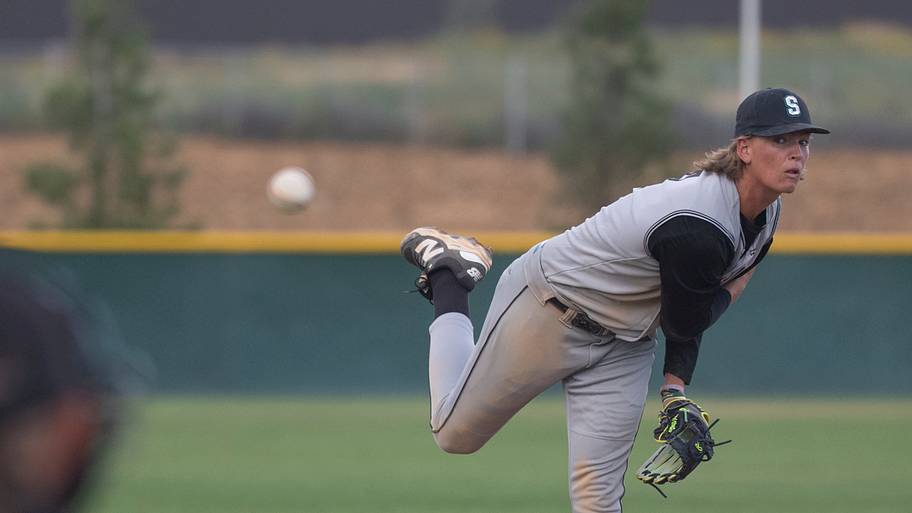
He guesses that the creaky pitching machine delivers its hardest throws at 95 mph. Striker can handle those. He’s an ace pitcher and slugger. Still a sophomore. Turned 17 on March 23. And he already throws harder than that machine.
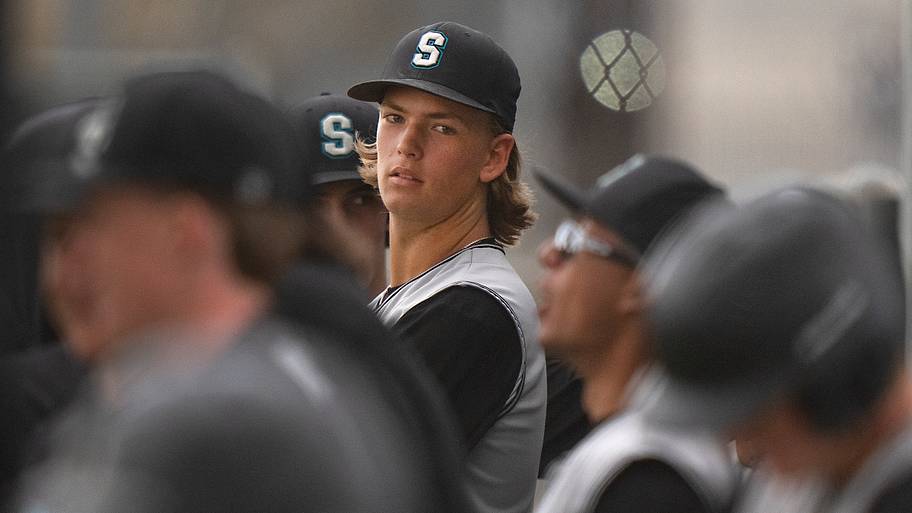
Meet Striker Pence, the unicorn.
Hurlers envy his name, not to mention his arm. Striker clocked 92 mph at age 14. After another birthday, he hit 97—in his first high school appearance. At 16, he registered 100 mph on eight straight pitches and triple digits 10 times in that one inning. And, last October, Striker joined the 101-mph club.
He is, his father says, “still learning how to pitch.”
These throws went viral, each spreading wider, farther, lighting social media ablaze. This morphed the kid into a real-life Sidd Finch. The secret cannot be kept much longer.
That Striker throws harder than just about any 17-year-old, ever. That’s not his secret.
This is: Throwing hard is part of the job description. Throwing harder has never been the point.
Before the Pences raised pro ballplayers, they didn’t follow the sport at all. Striker’s grandfather grew up in southern Minnesota, performing odd jobs on nearby farms. Howie Pence would move to Texas, join the cattle industry and create his distinct brand of livestock. He met his second wife, Gail, there. Each had a daughter from a previous marriage, and Gail soon gave birth again. Another girl in a house full of women.
Two boys, Howie Jr. and Hunter, changed their family’s dynamic. A neighbor asked one question: Did they want to try this sport he loved called baseball? Soon the HP brothers decided on the only plan either ever had. Their father started watching every Rangers game. He chauffeured the boys to private coaching, elite teams and tournaments. Howie played third base or right field. Hunter always said Howie hit better early on. But coaches sized up the hard thrower and decided that how well Howie slugged no longer mattered. “Been that way forever,” he says.
Howie earned his coaches’ respect with availability as much as ability. But no one counted pitches. Sometimes, Howie appeared three times, in different games, in one day. In college, at Sam Houston State, he tore his right UCL, forcing Tommy John surgery. One doctor told Howie that his elbow was already 90% scar tissue. He’d likely torn it years earlier.
Howie spent 2003 to ’06 in the Padres’ organization but never advanced beyond High A. He bounced around the minors and independent ball, the team names as striking as those of his future children. Fort Wayne Wizards! Lake Elsinore Storm! Winnipeg Goldeyes!
The scar snakes across Howie’s right elbow, presenting painful, daily proof of the exact calculus he wants Striker to avoid—pitching too much, throwing too hard, too often. “They didn’t know better then,” Howie says. “It was reckless. Reckless.”
Howie says this as he, Striker and Striker’s agent, Matt Hannaford, drive to a recovery session with the Padres’ former longtime trainer, Paul Navarro. Howie pauses, face pointed out the window for 15 seconds, then resumes. “I’m happy how my life turned out,” he says.
“Sure, everything happens for a reason,” Howie continues. “I’ll probably”—he gestures at Striker in the seat behind him—“save this guy from getting hurt.”
The baseball lab basks in South Florida sunshine, anonymity intact. No address. No signs. It does have branding. But its branding is ... no branding. Some of baseball’s best players decamp there every offseason; some 30 pitchers, lifting weights, fortifying arms, increasing pliability, testing out new ideas, assessing their sleep positions, diagnosing allergies, exploring cognitive issues and tweaking their routines in advance of another season. “It’s a secret society of pitchers lab,” founder Derek Groomer says. “We’re not trying to blow up.”
Groomer’s path to non-villainous keeper of a baseball lair began in medical school—until he decided to play pro tennis. Then the Mets hired him to create a sports science department in 2019. The last one stuck. Groomer would bolster similar departments for the baseball programs at Georgia and LSU. In ’23, the Tigers won a College World Series title behind Paul Skenes, now the reigning NL Cy Young winner and Pirates ace. The lab is their creation, and it owes to trust (between them), health (Skenes) and biometric expertise (Groomer).
Striker joined their secret society last fall. He threw from atop a NewtForce mound, which analyzed his ground force in 3-D. TrackMan measured velocity, spin rate, ball movement and release metrics. “He’s super, super raw,” Groomer says.
That’s expected but also in contrast with another assessment of Striker’s mechanics overall. “Super-efficient and super-safe,” Groomer says. Striker exhibited MLB-level force outputs and timing without the harmful movements typical in young aces. “I don’t know how you got it right at this age,” Groomer told Striker. “But you’ve organized your body to throw hard.”
Asked how rare that is, Groomer pauses briefly, then says, “I haven’t seen it before.”
He trains professionals with “four or five years” of experience who are just reaching the same level of mechanical efficiency. “We’ve worked on this for three years with one guy,” he told Striker. “And you’re doing [the same thing] naturally. And you don’t even realize it’s natural!”
Striker is cut from the classic max-intent pitcher cloth. The aim is to throw as hard as possible, with a fully developed body and refined mechanics. Dialing back can mean loss of command. This does not, however, mean that Striker cannot develop craftiness and technique at the same time.
For now, comparisons center on hurlers like San Diego’s Mason Miller (max velocity 104.2 mph) and Boston’s Aroldis Chapman (max velocity 105.8 mph, the highest speed ever recorded). And yet … speak with baseball’s developers, evaluators steeped in the modern pitching landscape. They’ve never seen an arm at 15 or 16 or 17 like Striker’s. What’s possible is staggering. Striker throws that hard without trying to throw that hard. Asked if he could one day surpass Chapman’s mark, Groomer doesn’t say yes. But he doesn’t say no, either.
“I would very comfortably say [it’s possible],” he says.
The first time Howie asked out Allison, she pretended she didn’t speak English. He played for Lake Elsinore, and she had no interest in dating a baseball player.
This is where Tom Anderson enters the unicorn’s origin story. If you’re old enough, you remember: Tom from Myspace. Howie found Allison there. She soon made his top eight. And when Hunter, who would go on to win two World Series with the Giants, switched agents to the Beverly Hills Sports Council in 2007, he flew Howie to Los Angeles for the signing—but only so Howie could ferry Allison on their first date. Nine months later they were married.
Before the birth of their first son, he sometimes teased her. “If he’s not a first-rounder, you only have yourself to blame.”
There wasn’t much time for teasing then. The three oldest siblings—the Big 3, in Pence parlance—were all born in a 22-month span.
They desired a large family, ended up with five kids and absolutely crushed the names. Dad wanted their oldest to share his initials. Hence HayleyJane, who will play water polo at powerhouse Fresno State next year. Striker came from Mom—she loved the way it sounded—as did Ace, inspired by Jim Carrey, followed by Maverick and Paisleykaye. Striker stands 6' 6" and weighs 210 pounds; Ace, 16, is 6' 5", 230; Maverick turned 14 on May 9, and he’s already 6-foot, 144. Grocery bills average around $8,000 per month.
Howie and Hunter grew up with baseball on the brain, their shared goal singular. Howie wished for two boys close in age who could play together, like he and Hunter did. They didn’t have to choose baseball. Didn’t have to choose sports. The Pence children write down their preferred ambitions. Striker has consistently scribbled the same thing: Make the Baseball Hall of Fame.
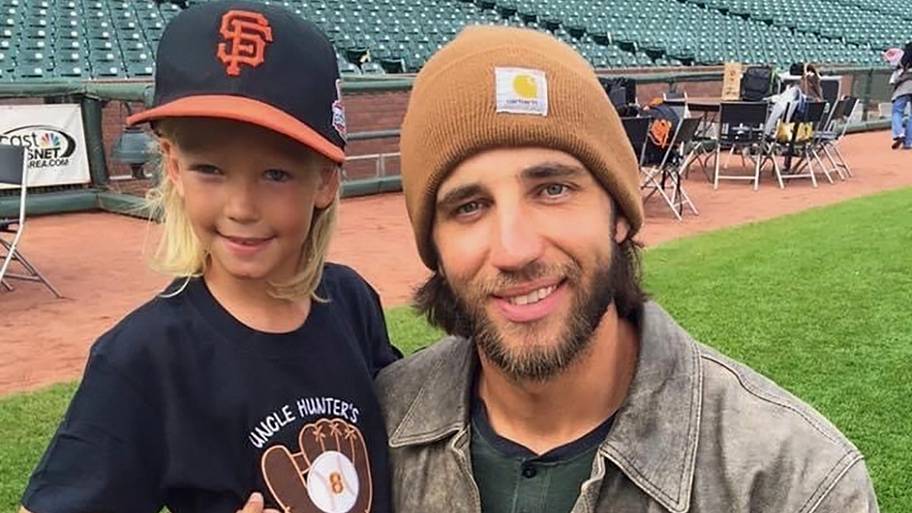
Regardless of team, age or skill level, Striker always drew attention. That was Hunter Pence’s nephew on the diamond. Striker loved baseball for every reason except fame. He loved afternoons spent on fields at major league parks. Or his bond with Madison Bumgarner, the three-time World Series champion. There’s a poster hanging in Striker’s bedroom, inscribed by Bumgarner, who describes himself, a four-time All-Star and World Series MVP, as Striker’s “No. 1 fan.”
Even in grade school, Striker devoured baseball history. One inspiration, in all seriousness: Charles “Old Hoss” Radbourn. In 1883, Old Hoss started 68 of his team’s 98 games. The next year, he won 59 times in a single season, including victories in 18 straight starts (or 19, or 20, depending on the source).
Howie wasn’t surprised when his boys arrived at the exact same place, ambition, sport. But he also noticed an important difference. His boys don’t realize how hard it is to make The Show. Their family is 2-for-2 in its attempts to play professionally. The kids think they’ll go 5-for-5.
When Striker flashed prowess, Howie made a promise. “We don’t want him blowing out on our watch.” He spoke with coaches, helping set pitch count limits. He sought outside expertise. He didn’t coax Striker into the backyard batting cage. He followed the boy inside. Striker, meanwhile, never stopped growing: an inch a month, it seemed like, and for years. And every time some anonymous know-it-all aims their keyboard right at him, surmising that Howie must want Striker to achieve what he could not, he thinks about the boy who, when tasked with naming as many Hall of Famers as he could in 10 minutes, got 80% right.
The point, always, per Howie: “Keeping it fun.”
The Big Bus isn’t a bus at all. It’s a Chevy Explorer conversion van, complete with Wi-Fi, a flatscreen, six bucket seats and a bench in back that folds down into a bed. The Big Bus has taken Pences to New York, Nebraska, Nevada and Texas, to the Louisville Slugger factory and spring training ballparks. Its odometer recently tipped over 70,000 miles, each traveled since they got it in 2020. And when Striker and his core friend group climb aboard, the Knuckleheads all stick to their assigned seats.
As far as pitching prospects go, Striker is one of one. At home, and in this friend group, he’s one of five; a unicorn, in other words, who’s still a teen. The Knuckleheads are Striker and his oldest friends, Thomas Padilla and Jonathan Thornton. They became the Core Four, along with Troy Randall, when Striker was 6 and the others were 7. They played 11 seasons together, adding a fifth member, Joshua Angulo, at age 12.
Striker was always different, and they knew that but didn’t mind. Because he never set himself apart. Striker was them—always there for the faraway tournaments, backyard hacks, swing coaches, bats stacked on top of bats, AXE body spray bombs, movies, jokes, sleepovers, sparring sessions complete with boxing gloves, Fortnite marathons and something called Extreme Hide-and-Seek.
The best summer? Easy. Cooperstown. 12U. The Knuckleheads+ played 12 times. The fields were spread out, so they’d finish one game, then start jogging to the next. They played after the concession stands ran out of food, in front of empty bleachers, when plumbing issues shut down bathrooms. They played six games on the final day alone, losing only in the championship, after a brief pause during the semifinals for a fireworks extravaganza.
Five years later, Tommy says, “Best time in my whole life.”
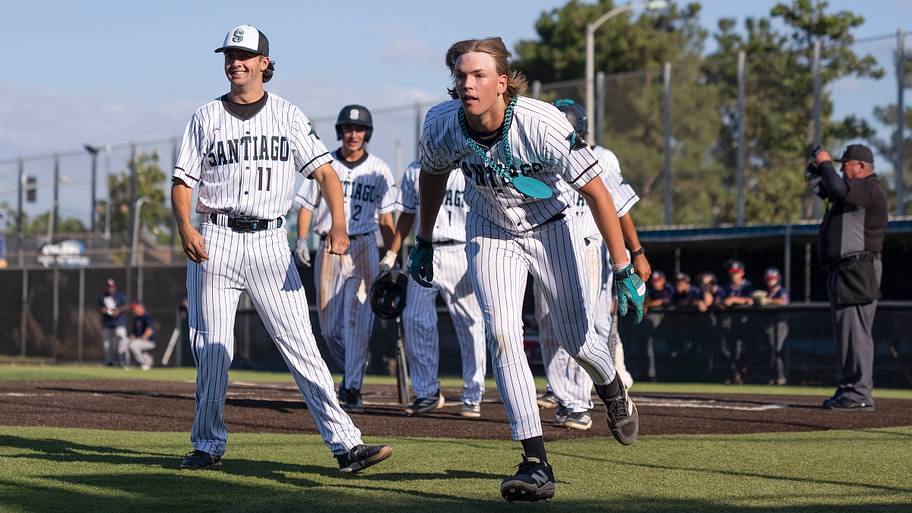
They’re still together, playing baseball at Santiago High. Tommy transferred in last season. Striker refused to transfer out, despite close proximity to Corona High, which placed three players in the first round of the 2025 draft, an MLB first.
These friends know Striker like his siblings know Striker. He’s trying to grow a mustache but cannot yet. He’s, ahem, thrifty. Last big-money purchase: $50, on a box of Cadbury Eggs. He could go pro in hacky sack, if such a thing were viable. He tries to avoid reading, because he saw somewhere that Lenny Dykstra famously avoided books to protect his eyes. He argues with H.J. over whether water polo or baseball is more difficult. Loves Minecraft. Needs help with laundry. Struggles to tie shoes. “Dude can throw 100,” Ace says, “but can’t put something in the microwave.”
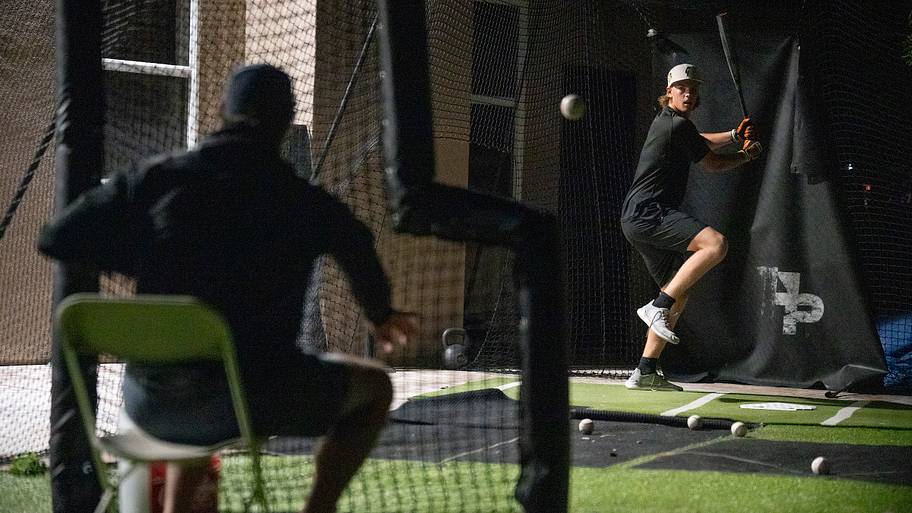
In recent years, Striker has apprenticed under Groomer, Doug Latta (who enhanced Cal Raleigh’s swing before a historic 2025), and Navarro, among others. Striker began working with Lotta at age 9. His first big league instructor was his uncle. Striker wants to bat in the majors, too; become an American Ohtani. Striker throws right-handed but bats from the left side. He kicks his front leg up, high, almost like a pitcher. Striker says he never dreams about fanning hitters; only about hitting walk-off home runs. And he says these things, and he works with these people, and he oozes this talent, and he wants to pursue these accomplishments that are unfathomable to most. But celebrity is not what he’s chasing.
Sometimes, he’ll joke about the movie Jerry Maguire, where the presumed No. 1 draft pick, young quarterback Frank Cushman, says the suffocating attention gave him Cushlash over his own hype, warranted though it was. Striker experiences Strikelash. Same as those 16-year-old batters staring at the giant teenager who throws triple digits.
Young pitchers often throw more often and as hard as possible and for too long. Same as they did when Howie whipped his own blazing fastballs. And, yes, the vast majority of top pitching prospects, if their careers go well and even if they don’t, will damage the very arms that hold baseballs and livelihoods, simultaneously.
This means that Striker may require Tommy John surgery, like Howie did. This does not mean that Striker will require Tommy John.
Sometimes, well-meaning baseball types ask Howie if the family will elect to have that procedure early, as is fairly common now for young pitchers. Never, Howie says. “I wouldn’t rush that on anybody, not my worst enemy. It’s not something that you wish on a kid, like, take that [idea] out of your brain. Don’t say that.”
Striker’s not chucking as hard as he possibly can. He’s on a progression, and it’s no different than most progressions for pitching prospects; he simply threw harder than everyone else earlier.
Groomer hammers the same emphases to Striker that he imprinted in Skenes. Focus on controllables. Do not stress the arm for no reason. Adjust based on genetics. Ground all decisions in science and performance data. Do scans that reveal factors like fat infiltration.
Even then, in Striker’s case, some evaluating isn’t possible, not yet. At 17, what Groomer calls “growth points” aren’t in secure positions yet. Groomer suggests a simpler approach that aligns with how these Pences have raised their children. “Fall in love with the game and love the game every day,” he says. “Things happen. You never really know. No matter what happens, Striker’s in a great place.”
The goal: Build a chain, through arm care, leg strength, making the physical body a priority—all while the body itself fills out.
To become an MLB ace, like Skenes, Striker must develop at least two pitches that are antithetical to his greatest gift. Neither can start with “fast.” He needs a repeatable delivery. Needs a repertoire. Needs control. His greatest gift isn’t velocity; it’s time. Harder is, essentially, guaranteed.
In terms of future 108 mph fastballs, Howie scoffs. He’d prefer that Striker threw most pitches between 97 and 99 mph, albeit with pinpoint precision and variety. Add a cutter or a sinker. Tinker with grips. Learn a changeup. Master the sneaky split-fingered fastball that’s already in development. “He’s gonna have years to develop this stuff,” Groomer says. “Honestly, he’s good enough now to get guys out at the big league level. For him, 99 [mph] is less of a strain than it would be for 99 percent of pitchers.”
At Perfect Game, the amateur baseball scouting service and tournament platform, Hunter is part of the ownership group. Striker takes part in what the organization calls “gateways,” or tournament-style showcases with additional prospect development. Jered Goodwin, the organization’s VP of scouting operations, says Striker does things on baseball fields that lifers “have never seen at his age.”
Striker is not without options in this new paradigm. Most right-handed prospects, even elite ones, even those who throw baseballs faster than eyes can track, go to college. Such is the bounty of right-handed arms in the MLB. Like Skenes, who dominated with Groomer at LSU, spent one season in the minors and made his Pirates debut in 2024. But Striker all but showed his hand recently by deciding to reclassify, or skip a grade, so he'll graduate high school and be eligible to be drafted in 2027.
His wider team gives Striker a head start on these processes, earlier in critical areas that project a healthier body—and arm—for his career. Groomer taught Striker the warmup routine Skenes uses before each of his starts. It involves a football, a stick and a bag filled with water.
He’s building professional habits, and he’s still a teenager, with a synthetic friend created on ChatGPT that he calls Bernard.
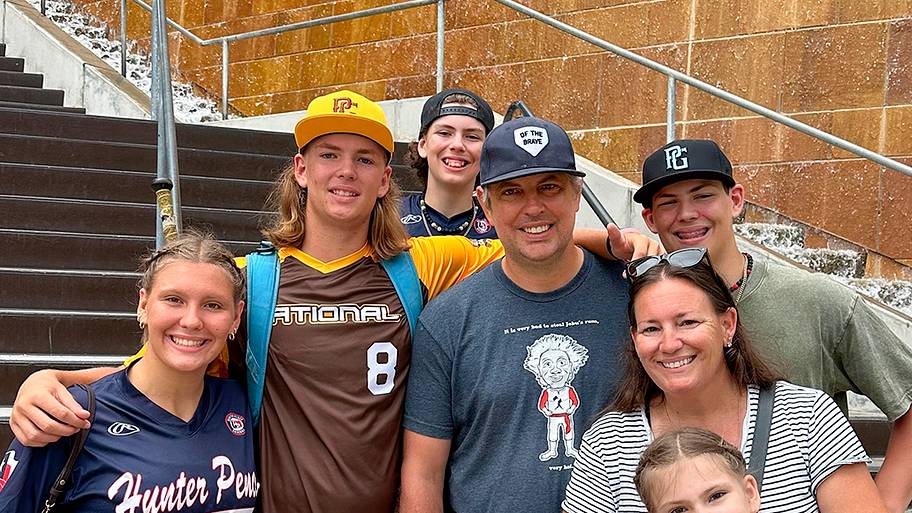
Striker Pence makes far less of all this than everyone around him. He likes attending public school, where sometimes it feels like, “No one knows anything about me,” he says. “Sometimes, I walk around school, and I’m like, These guys don’t even know!”
He says his father did everything possible to support Striker’s long-held, Old Hoss-inspired dream. That other coaches or teammates or strangers push him to hit triple digits. That he doesn’t care if he throws harder ever again. That he once rode in Hunter Strickland’s green Lamborghini but peppered the former Giant with pitching questions. That he believes Fred McGriff should be in the Hall of Fame.
Sometimes, Striker will scroll through his Instagram feed and watch videos of him, at 8 or 9, smacking pitches into Net 1 or Net 2. That’s still him. He doesn’t necessarily want to throw a baseball faster than any pitcher ever. If it happens, he says, “It’d be really cool.”
He doesn’t have a backup plan. He doesn’t need one. He’d like to follow Howie’s retirement blueprint—trading stocks by day and coaching youth baseball teams at night. “Yeah,” Striker says, “Be a good dad.”
His parenting model doesn’t hear Striker say this. But an hour earlier, right around when Striker’s grand slam and six RBIs powered the Santiago Knuckleheads to another victory, Howie looked out over that same ballpark and said, of his half-teen, half-pro, all-unicorn, “The best thing we ever did for Striker was just … let him be.”