The curtain came down Sunday on the Tokyo Olympics that had to overcome an unprecedented postponement. The organizing committee had its hands full having to prevent a coronavirus outbreak, deal with the sweltering heat and handle other issues. Still, it saw a record 339 events across 33 sports completed without major disruption.
"I believe that we appropriately dealt with those who tested positive and carried out the coronavirus countermeasures we had prepared," Toshiro Muto, director-general of the organizing committee, told members of the International Olympic Committee at its general meeting in Tokyo on Sunday.
IOC President Thomas Bach praised the organizing committee for doing a tremendous job, comments that brought thunderous applause from the IOC members.
The coronavirus countermeasures marked the biggest challenge facing the organizing committee.
From July 1, when the Playbook -- detailed guidelines on preventing infections -- was put in place, through Aug. 6, the organizing committee conducted about 624,000 PCR tests on those involved in the Olympics. The tests produced 138 positive results, a rate of 0.02%.
While roughly 43,000 people involved with the Games came from abroad, tests at the airports yielded just 37 positive results, or 0.09% of the total. Three of those infected were hospitalized, but none were considered serious.
The number of athletes infected totaled 29. That included a cluster of six among the Greek artistic swimming team, but the organizing committee had measures in place to keep infections from spreading by moving anyone suspected of having been close contact with team out of the Athletes' Village.
A total of 19 athletes were unable to compete for reasons related to the coronavirus, including testing positive after arriving in Japan. But it did not disrupt any events, all of which were completed as scheduled.
There were 32 people involved with the Olympics who were sanctioned for Playbook violations. Eight had their credentials, needed for taking part in the Games, taken away, while eight others were dealt a temporary suspension. Sixteen others received strong warnings.
The Playbook proved to have permeated among many athletes who had longed for the opening of the Games. Ian Chesterman, head of the Australian Olympic delegation, said that the Games were conducted very smoothly.
-- Trouble beating the heat
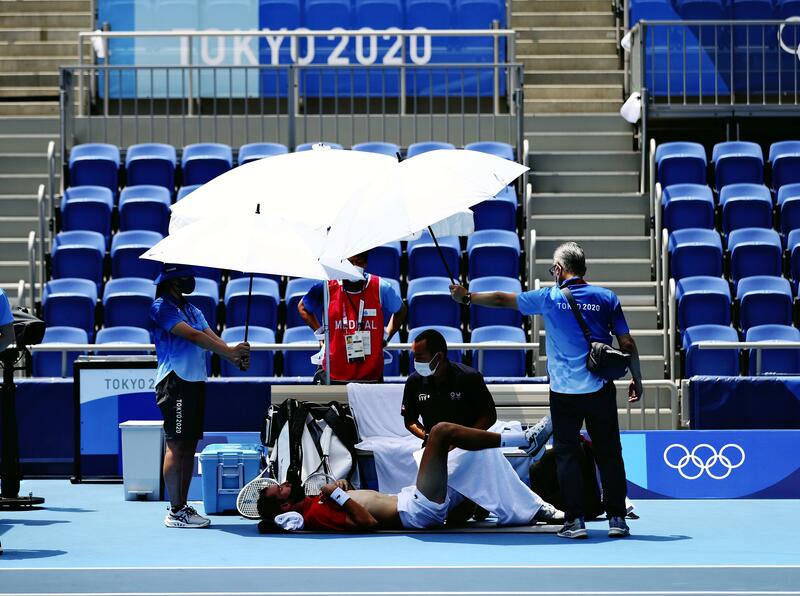
Before the world became swept up in a pandemic, the biggest issue that the Olympics was expected to face was coming up with measures to deal with the summer heat. Those proved to be insufficient, and changes had to be made on the fly.
In tennis, top players successively spoke out in anger with having to play matches in sweltering heat over 30 C. In response, matches scheduled to start at 11 a.m. were changed to 3 p.m., and a special rule was adopted giving players an optional 10-minute break between the second and third sets.
The start time of women's soccer final between Canada and Sweden was changed from 11 a.m. to 9 p.m. upon request from both teams. For the marathons, which were moved to Sapporo specifically to avoid the Tokyo heat, the start of the women's race was pushed up to 6 a.m., one hour earlier than scheduled.
The schedule changes in soccer and the marathon were only made the night before the events. The banning of spectators enabled the switches to be made, but had fans been allowed into venues, such sudden changes would have caused massive chaos.
A number of athletes and volunteers suffered heatstroke, making measures against the summer heat also a big challenge for the Paralympic Games, which are slated to open on Aug. 24.
Read more from The Japan News at https://japannews.yomiuri.co.jp/