Sammy Lee did not want to talk about the next round of the Champions League. If it's happening at the end of February why discuss it now, especially when top-of-the-table Liverpool have the small matter of a visit to Arsenal this afternoon?
Yes, but hang on Sam, an optimistic television presenter ventured on Friday afternoon at Melwood, Real Madrid is going to be a pretty big game for Rafa Benítez. "Of course it is," Lee gamely countered. "That's because he's the Liverpool manager."
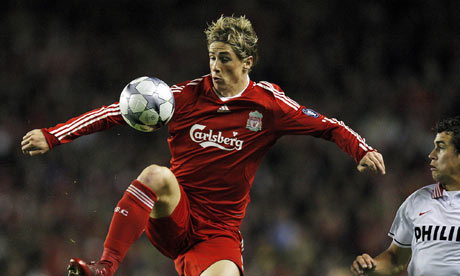
Try as you might though, and Liverpool's assistant coach certainly tried, it is impossible to invest today's game at the Emirates with the glamour or the global significance of those four plum ties waiting in the New Year. Fernando Torres isn't even playing, whereas when Real Madrid are in town the former darling of Atletico will be even keener than his manager to do well against the Spanish giants. Real Madrid in the Champions League is an enormous fixture for a player made captain of Atletico at the age of 19.
No one is quite taking Liverpool seriously as league leaders yet. They keep throwing away points at Anfield and even if they win for the first time at Arsenal's new ground, an achievement to put alongside ending Chelsea's mammoth unbeaten home record earlier in the season, they will probably squander their advantage by tripping up against Bolton or Stoke in the near future. Arsenal appear to have forgotten how to defend, have started arguing among themselves and are not even certain to finish in the top four this season. But for the poor form of so-called contenders such as Manchester City and Spurs, Arsenal might be further down than fifth.
Yet come February, with Torres and Theo Walcott hopefully restored to full fitness, not to mention Benítez, these same two teams will be part of England v The Rest of Europe in what is becoming an annual exercise in proving that the Premier League rules. After the sensational events of last season, when it was an all-English final and no English club was knocked out by continental opponents, the world is waiting to see whether the cream of Europe - only Barcelona would improve the quartet that lie in wait - can do anything to stop us this time.
Please do not write in, by the way, to say that Premier League clubs are no longer English in any meaningful sense. They have English postcodes, and it's not as if all the other clubs in Europe are full of homegrown players, even if the Italians tend to do better than most. Look at the players Manchester United sold to Real Madrid: David Beckham, Ruud van Nistelrooy, Gabriel Heinze. Not a Spaniard among them. And now Fergie is saying he wouldn't even sell them a virus.
But I digress. The trouble with categorically stating that the four English clubs are favourites to get past their illustrious Champions League opponents is that the more you look at it, the more you fear it might not be the case. Liverpool could be the best bet. Not just because they are top of the domestic pile, but because their record in Europe demands respect. They might be up against arguably the most difficult opponents, but Liverpool can defend to save their lives and they know how to strangle the life out of a two-legged tie. The other three have been struggling for form of late. Chelsea peaked in mid-October and have been barely recognisable since. Arsenal have already lost five times in the League, and anyone who witnessed Manchester United at full stretch in narrowly beating Hull and Sunderland at home in recent weeks will not be totally confident of their ability to break down a team managed by José Mourinho.
So while we may be delighted to discover we are still the powerhouse of Europe in a couple of months, anyone expecting a whitewash should prepare to be disappointed. Italian football might not be as dominant as it used to be, and Real Madrid might now be under the guidance of a Spurs reject, but Inter, Juventus, Roma and Real are still great clubs with proud histories. And if there's one thing guaranteed to get up anyone's nose, it is arrogant English supporters going around telling anyone who will listen that this year we are aiming for all four semi-finalists.
While Italian teams may be able to cope with being favourites for everything, one instinctively feels we English are better at being underdogs. That's how Liverpool won in 2005, still one of only two English Champions League successes this century. Spain has had three winners and Italy two in the same time-frame. Though our record is improving we are not invincible yet, and not even Manchester United dare enter the European Cup and assume, as Real Madrid and AC Milan have in the recent past, that it is their trophy to lose. Domestic obligations alone make that a tricky proposition.
But that is how it should be. Europe is only the icing on the cake, after all, and if the Premier League really is the world's strongest then a match such as today's at the Emirates should be every bit as titanic as anything on the road to Rome. Does it feel that way? No. It has 0-0 or a single late goal written all over it. Proper English football.
Stiff lesson for Megson and Villa fans
Why, a Bolton supporter of my acquaintance wishes to know, does "St" Martin O'Neill get congratulated for experimenting with his reserves in the Uefa Cup, when last season Gary Megson was pilloried for doing the same thing?
Because Villa had already qualified for the next stage, that's why. When Megson sent the stiffs to Sporting Lisbon last season he was turning his back on a possible quarter-final, and as that tie would have brought Rangers it is even possible to argue Bolton might have made it all the way to, er, Manchester.
It is true that Villa fans did not sign up to go all the way to Hamburg to watch the reserves and some comedy finishing, though at least they saw one of the goals of the season. Well, perhaps not quite that, but if you ever see a better pass from a centre-half than the 70-yard one from Joris Mathijsen that set up Ivica Olic's second goal, please let me know. Some time in the new year, perhaps. Have a jolly Christmas first.
Would you risk a drink with Lawro?
I hate to name-drop, but the last time I saw Mark Lawrenson he was pushing his way to the front of the queue for an easyJet flight home from Barcelona to Liverpool, hoping the familiarity of his face and the small band of fellow travellers he had gathered behind him would persuade the gate stewardess to overlook the fact that his boarding rank had not yet been called.
It didn't work. The girl on the door was a doughty Scouser straight from central casting. "Are you deaf or can't you read?" she barked. "I've just asked for As and then Bs and your ticket says C."
So the master of the lugubrious expression had no choice but to stand and wait, doing his best to look insouciant with shirt collar raised and pullover casually draped around his shoulders, as practically the whole flight said hello on the way past. He missed the first two buses, and could not even raise a smile when many of the football fans on mine gave him a cheery wave as the driver pulled away.
Perhaps I have no business relating this inconsequential and only mildly amusing anecdote to a wider audience, though at least it will not embarrass Lawrenson professionally or damage his personal standing. When he name-dropped Steven Gerrard on Irish radio, and subsequently in print all around the world, the Match of the Day pundit showed scant respect for the Liverpool captain, the allegedly outbound Robbie Keane, or sensible journalism. It is debatable which of these Lawrenson holds most important, just as it is debatable whether players turned pundits regard themselves as journalists and even need to be aware of anything so mundane as training or ethics.
Yet it is clear in most walks of life that you cannot share a drink with someone one minute then dob him in it the next. The first rule of journalism - unwritten, naturally - is never to let down a contact. The more frequently quoted one about never revealing your source is merely a distillation of the same principle. If the BBC is wondering why Lawrenson never blabs anything half as interesting to viewers and listeners in this country, in the long run they know there is no future in it. What Lawrenson may find in coming months is that sharing drinks is the easy part. It's the shared confidences that could dry up.