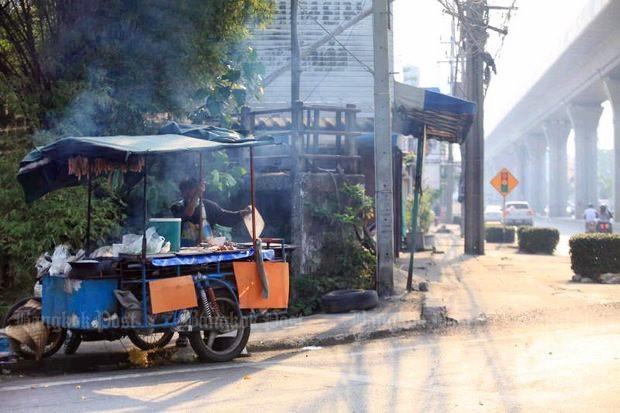
During general election season, anything is possible. All of a sudden, the city's street food vendors, who were considered as "nobodies" -- if not, a nuisance -- in the eyes of state authorities, have now become the darlings of politicians vying for state office, with each promising to allow them to return to where they once hawked their products.
We are engaged in a love-hate relationship with those who belong to the lower end of the social spectrum. Under governor Aswin Kwanmuang, the Bangkok Metropolitan Administration began booting vendors from the city's pavements in 2015.

Sirinya Wattanasukchai is a columnist, Bangkok Post.
However, just last week, several political parties who participated in a forum to discuss the future of Bangkok's street food vendors at Chulanglongkorn University, seemed keen to revive the remnants of Bangkok's famed culinary culture, in the hope of boosting the urban poor's income.
Among them was the pro-regime Palang Pracharath Party, which vowed to help this group of people make ends meet. Isn't this ironic?
We must not forget that it was the military regime that initiated the clean-up project and banned street food vendors from operating in several areas of inner Bangkok.
In defence, the PPRP insisted that it had no ill intentions, and that the move was intended to reclaim the city's pavements for public use, before saying that it was the BMA who took things "too far" by implementing a blanket ban. What a lame excuse!
How could the regime sit back and watch the BMA misinterpreting its order, while ignoring the street vendors' pleas for help?
We have to concede that the clean-up campaign bore some fruit -- several main roads look relatively cleaner in the absence of leaky refuse and discarded waste, and pedestrians are less likely to accidentally bump into a wok filled to the brim with hot cooking oil.
However, if you were to take a stroll along the back streets of your neighbourhoods, the same old mess can still be seen. Street food vendors are still around. It seems all the BMA did was to sweep the issue under the carpet.
I'm curious -- did any of these political parties discuss the matter with the BMA before announcing their poll promises? The Bangkok governor adamantly insisted in November last year that the ban would remain in place and evicted vendors will not be allowed to return.
How exactly do these politicians work with the city's administrators to tackle the issue? More importantly, have they managed to agree on the role street food vendors will play once they are allowed to return -- will they be promoted as a tourist attraction, or as a part of daily life in Thailand?
The Democrats made it quite clear that street vendors should be allowed to return to designated areas because street food is a way of life. The Samanchon Party, which portrays itself as the champion of the city's underprivileged, promises to include the opinions of street vendors in the city's management.
The Paradonraphab Party said that the ban discriminates against street vendors, because pavements in other areas are being used as parking spots. Separately, Future Forward Party leader Thanathorn Juangroongruangkit also voiced his support for the vendors.
Meanwhile, the Bhumjaithai and Pheu Thai parties want to see street food promoted as a tourist attraction.
In line with its "Tourism for All" strategy, Pheu Thai said that Thailand's street food scene is an attraction that can draw up to 50 million tourists and generate about three billion baht in income for the country. It promised to transform street vendors into small investors in order to lift the city's grassroots economy, by using a model similar to the One Tambon One Product project, which it said has boosted the local economy.
If street vendors were to make a comeback, they need to better managed and regulated. The vendors should be also equipped with business training and knowledge of sanitary practices. Needless to say, decision makers must not only listen to the vendor's opinions, but also input from local communities that will be affected by the vendors' return.
If street vendors were given the all-clear to return, they should not be treated as a mere tourist attraction. No tourist wants to see "staged authenticity" -- after all, why would they be interested in eating only with other fellow tourists?
Of course, I want to see Bangkok's streets clean and safe for pedestrians. But I also want Bangkok to be an inclusive city. Bringing street food back won't hurt the city's charm. But measures must be taken to ensure vendors can coexist with local communities.
If we give the space back to vendors without equipping them with knowledge about sanitation, access to funding, and have an agreement between City Hall and other stakeholders, we will quickly plunge into the same old mess.