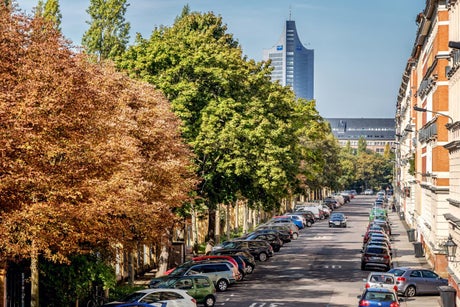
Having street trees closer to your home may reduce the risk of depression and the need for antidepressants, research has shown.
Multiple studies already show that mental health can be strongly impacted by environment so a German research team tried to assess if everyday objects people engage with – such as trees dotted along the pavement – could have a positive impact.
They analysed data from 10,000 residents of Leipzig, Germany, and found a correlation between the amount of street trees and antidepressants prescribed to a patient.
A larger amount of trees less than 100 metres from someone’s home was associated with a lower risk of having antidepressants, the researchers said.
The correlation was especially strong for more deprived groups who are more likely to be prescribed medication for depression in Germany.
Lead author of the study Dr Melissa Marselles said: "Our finding suggests that street trees – a small scale, publicly accessible form of urban greenspace – can help close the gap in health inequalities between economically different social groups.
"This is good news because street trees are relatively easy to achieve and their number can be increased without much planning effort."
As well as having a mental health benefit, planting more trees may also contribute to climate change mitigation, the researchers said.
Dr Diana Bowler, data analyst in the team, added: "Our study shows that everyday nature close to home – the biodiversity you see out of the window or when walking or driving to work, school or shopping – is important for mental health."
The group of academics hope the research will encourage more councils to plant street trees in urban areas.
The project was conducted by theHelmholtz Centre for Environmental Research (UFZ), the German Centre for Integrative Biodiversity Research (iDiv), Leipzig University (UL) and the Friedrich Schiller University Jena.