MASUDA, Shimane -- Nestled deep in the Chugoku mountain range in the Hikimi district of Masuda, Shimane Prefecture, is a wasabi field that looks as if it was an ancient ruin. Stones are piled up on both sides of a 4-meter-wide stream that flows down the mountainside and lush green wasabi leaves carpet the surface of the water.
In all my time writing stories about food, I have never had such an arduous time reaching the location I was reporting on. From central Masuda, I traveled along a national highway and main local roads before reaching a path through the forest. When I got to the end of the path, I changed my footwear to boots. As wasabi farmer Mitoshi Otani led the way, I pushed on into the mountains, crossing streams from time to time. After about 20 minutes, as I struggled to catch my breath, a wasabi field stretched out before me.
Junpei Miyakawa, head of a wasabi producers association in Hikimi, accompanied us. "This is actually one of the closer fields [to where people live]," said Miyakawa, 38.
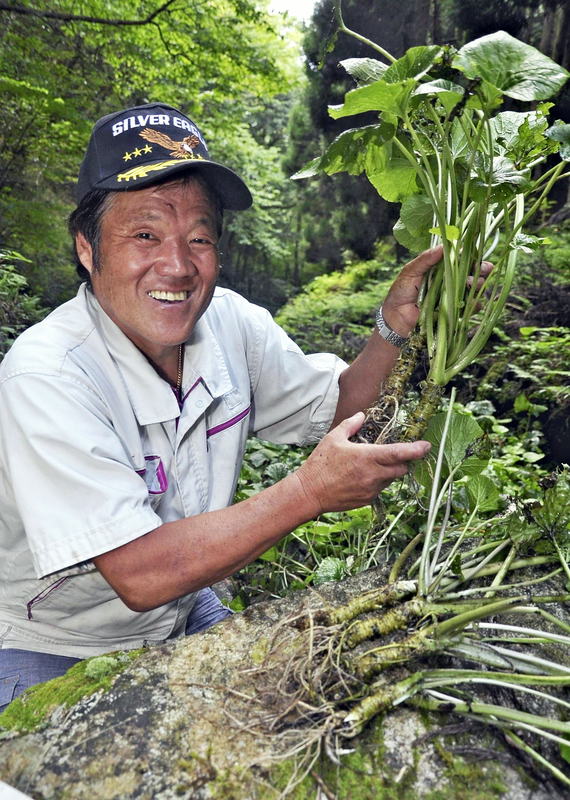
Otani, 67, wandered down to the field and began pulling up wasabi plants one after another. He washed the dirt from the wasabi in the stream and scraped the roots, revealing the bright green rhizomes. Each one was a bit thicker than my fingers and takes about 1-1/2 years to grow.
Insect pests or the wasabi being washed away during heavy rain are always a concern here.
"So I'm always excited about how much wasabi I can harvest," Otani said.

Wasabi can be cultivated in water or in fields. Most other wasabi farms in Shimane Prefecture opt for the latter method because preparing land for the crop is easier and apparently less likely to be afflicted by disasters. In contrast, wasabi fields like the one Otani uses -- which require a mountain stream and harness the natural terrain -- are labor-intensive since most of the work cannot be done by machines. While wasabi harvested in this method tends to be smaller, it is also very sticky and has wowed connoisseurs with a sweet flavor that follows the initial spicy burst.
"I mustn't pollute the stream, so I don't use agrochemicals or fertilizers," Otani said. "This wasabi is a blessing of nature."
Hidden specialty
I learned there is a delicious way to eat this wasabi, so I visited Shigeko Minari, who runs a lodging facility in the Hikimi district.
Minari served me what seemed to be an ordinary bowl of plain white rice.
"There's nothing else here," the 81-year-old said tongue-in-cheek as she laughed mischievously.
What was before me was uzumemeshi, a local specialty in which the ingredients are hidden under the rice. The dish literally means "buried in rice."
At the bottom of the bowl beneath the rice are ingredients such as finely sliced carrots, burdock roots, shiitake mushrooms and chicken breast in a broth. Grated wasabi also lurks underneath. I mixed everything together before eating a mouthful. A fresh scent filled the air, before the sharp zing of wasabi spread throughout my mouth.
I asked Minari to show me how she grates the wasabi. She used a brush to remove the dirt, then cut out any blackened bits with a knife. Minari left most of the wasabi's skin on. "After all, it was grown in a beautiful place," she explained.
Minari then demonstrated the secret to grating wasabi.
"You can get this wonderful smell," she said. "Slowly grating the wasabi in a circular motion will give the paste its stickiness."
I added a few drops of soy sauce to the grated wasabi, dipped my chopsticks in and took a taste. I could appreciate the delicate aroma and sweetness that seemed to bring the gurgling stream and the clean mountain air right to my palate.
Read more from The Japan News at https://japannews.yomiuri.co.jp/