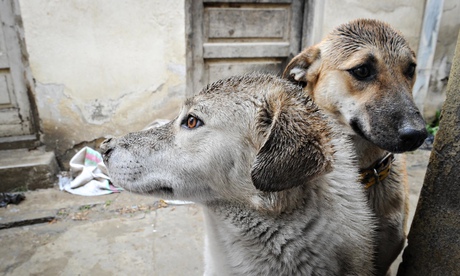
Last week, Lumpi and Eidi were still in Afghanistan. Now, they sniff the south London air, suspiciously. Their new environment is full of weird smells and unfamiliar noises. A squirrel sets them off on a frenzy of barking and seemingly pointless running around. No wonder the foxes who drag plastic litter into my garden have vanished. They were no match for the canine mujahideen, my new dogs of war. And no, not Afghan hounds, as everyone is asking. Afghan hounds are surprisingly rare in Afghanistan. My new dogs are pure-breed Heinz 57, opportunists with that hungry look of animals that have been forced to live on their wits.
Lumpi and Eidi began life on a rubbish tip in Kabul, two of several thousand stray dogs that roam that city, living in sewers and on the streets. Eidi was rescued on Eid, hence the name, on Street 3 (better known to locals as Rubbish Street) by a journalist friend of mine, and given a cut-out Heineken box as a makeshift kennel. Lumpi was originally rescued by a German diplomat who was re-assigned to Africa and who passed her on to British journalists, and from them to me.
By western standards, most Afghans are pretty unfriendly towards dogs. Many consider contact with them to be haraam or forbidden – though the only specific prohibition in the Qur’an is that dogs not be kept inside the house. The hadith literature is generally more negative. Which is why many Afghans refuse to touch dogs, believing that contact makes them unclean and thus in need of re-doing their ablutions.
While it is increasingly common for western dog-walkers to have stones thrown at them, this may reflect a more widespread antipathy to the continuing presence of westerners as much as to the dogs. Even so, dogs get a pretty raw deal, scavenging for food among refuse and surviving on their wits. Dog fighting is widespread, though this is haraam; even the Taliban, who disapprove of this sort of thing, have failed to stamp it out.
Now, lying in my garden, the dogs seem fairly relaxed. They used to live under the flight path to the US military airport at Bagram and are apparently terrified of the sound of low-flying Black Hawk helicopters. Yet they were quite uninterested in the Chinook, Apache and Sea King helicopters that passed directly over the vicarage garden towards St Paul’s Cathedral at Friday lunchtime, marking the end of combat operations in Afghanistan.
It was relatively easy to get the dogs over here. No quarantine. Rudimentary papers. Lumpi managed to escape her crate at Istanbul airport and spend 24 hours on the runway, dodging jumbo jets. But that stressful episode aside, immigration was simply a matter of a couple of flights and the Eurotunnel. For people, however, the situation is so different. For instance, it is nigh-on impossible for Afghan interpreters who have worked for British forces to be allowed to come to the UK, though they remain at continual risk of reprisals by the Taliban. Dogs can be saved but people are abandoned.
But the instinct to save is a tricky one, especially if people don’t themselves want saving in the way we want to save them. Saving Afghanistan from the Taliban was a major part of the justification used for our military presence. Years later, and with much blood and gold wasted, it is hard to see that we have succeeded in anything like that. The Taliban are far from defeated. Much of Afghanistan’s infrastructure will collapse again when the money stops coming in from abroad. And the rubbish will pile up again in Rubbish Street. How is this salvation?
My friend who brought the dogs over from Kabul gave me a word of advice. They find it hard to distinguish between fear and aggression, he told me. Which means that the more afraid I get of them, the more likely they are to snarl at me, and the more afraid I get – a vicious circle indeed. Which is not a bad analysis of the whole Afghanistan mess: a confusing mélange of fear and aggression that has led us nowhere.