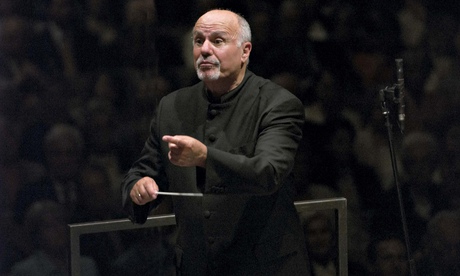
David Zinman studied with Pierre Monteux, who conducted The Rite of Spring at its notorious premiere in Paris in 1913; and he was Monteux’s assistant for the conductor’s performances with the London Symphony Orchestra to mark the work’s 50th anniversary. It was then that Zinman became aware of the considerable differences between the different versions of the score that Stravinsky had prepared over the course of more than half a century. For the centenary of the Rite, two years ago, Zinman went back to the original 1913 manuscript, now in the archive of the Paul Sacher Foundation in Basel, and recorded a performing version of it which he has contrasted with the final published version that Stravinsky authorised in 1967.
This musical archaeology complements what François-Xavier Roth and his period-instrument orchestra Les Siècles did in their centenary performances and recording, which were played on instruments as similar as possible to those used for the Paris premiere. Zinman doesn’t attempt to recreate that original sound world; his performances are concerned with textual and performance details. What he’s produced is in a sense a variorum edition, which compares Stravinsky’s first and last thoughts on his most celebrated work.
Some of the differences are in tiny details of phrasing and dynamics, while others are far more significant and clearly audible, such as the 18 bars of the original version of the Auguries of Spring section, which Stravinsky subsequently omitted, and the second appearance of the opening bassoon melody, which turns out originally to have had a cadential ending instead of being left to hang in mid-phrase.
But as these side-by-side performances of the two scores show, Stravinsky’s later revisions generally tended to make the work more brutal and primitivist, less supple and French, almost as if he was keen to rewrite his own creative history. Zinman says that Monteux regarded the Rite as “more or less ... an impressionist work, following on from Debussy”, and that he had a “considerably more classical attitude” to performing it than conductors do today. That’s certainly how the earlier score comes across in this Tonhalle Orchestra performance, while the account of the familiar final version is along more conventional lines. Taken together, though, they offer a fascinating perspective on the greatest of all icons of musical modernism.