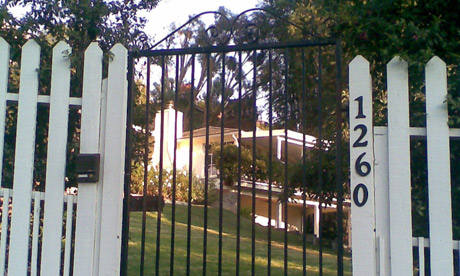
Another quick postcard from LA: this is Igor Stravinsky's house at North Wetherly Drive, just off Sunset Boulevard in Hollywood, where he lived from the late 1940s. It's a weird place: you turn off the glitz and glamour of Sunset, up a steep, winding street, to find a world of quiet, expansive, and expensive houses. I don't know who owns 1260 now, but behind its genteel, European-style wooden facade, Stravinsky made the most surprising compositional turn of his life, when he adopted his own interpretation of serialism. Arnold Schoenberg, who discovered the 12-note system, lived not far away in LA, but these two oppositional poles of 20th-century music never met. Stravinsky only became a full-scale 12-tonalist after Schoenberg's death in 1951.
I've always thought of Stravinsky's serialism as breathing the same air as his previous music. I understood his late work as just another quixotic turn in a musical life which had seen him refract everything from folk tunes to 18th-century classicism through his thick Russian glasses. But being in LA made me think a bit differently. LA, then as now, is a crucible of modernity. In the 50s and 60s it was the place where dreams of a technological future were made flesh, whether in the freeways and neon of the city, or the visions of the future created by the movie industry, or in cartoons like The Jetsons. Stravinsky's serialism belongs in the LA of that time: it was a masterstroke of self-conscious futurism, and Stravinsky's finger was, as always, unerringly on the pulse. There was no more chic 70-something composer than Stravinsky.
But maybe there's another reason for Igor's atonality: just look at that address again. How could any composer living at 1260 be anything other than a serialist? And especially one noted for his hexachordal rotation, a technique pioneered by Stravinsky, based on parsing the 12-note row into two groups of six notes. Now to try out the Aldous Huxley Variations as an accompaniment to The Jetsons.