Dominique Strauss-Kahn enters the room as if he has assessed all the air in it and already found it wanting. His chest is puffed, his head held high, his arms hang loosely on either side of his broad, barrel-shaped torso. He has bulk and presence but he is not a particularly tall man. His suit is too big: the jacket sleeves fall slightly too far down the back of each hand, revealing stubby fingers. Occasionally he hoicks up the waistband of his trousers when he thinks no one is looking.
When he takes his seat at the front of the Lille courtroom where he is facing charges of aggravated pimping punishable by up to 10 years in prison and a €1.5m fine, he does so with the manner of someone who is owed a seat on the train. He stretches his legs out across the parquet floor, crossing them at the ankle. He leans back so far in his chair that sometimes it looks as though his eyes are closed, even though it is probably just a trick of foreshortening, a confusion of angles that makes it seem as if he is perpetually gazing at a point just below his nose.
His arms are crossed high on his chest. His hair is white, his eyebrows beetle black and his profile that of a powerful politician as drawn by Hergé in a Tintin adventure. His entire demeanour is not arrogant, exactly. It is of someone who believes we are lucky to be awarded his time but who is nevertheless willing to indulge us.
At one point, when evidence against Strauss-Kahn is being recounted by his own lawyer – allegations that he treated women furnished for his pleasure like “pieces of meat”, referring to them as “equipment” in a text message and insisting on having anal sex with a prostitute despite her tearful resistance – he reaches casually for a handkerchief in his trouser pocket and blows his nose.
From the beginning of this three-week trial, during which prosecuting lawyers have attempted to show that Strauss-Kahn colluded with 13 other defendants to provide prostitutes for champagne-soaked swingers’ parties in Europe and America, it seemed visible in the set of his features that he was certain the trial would end in his acquittal. A man doesn’t, after all, get to be head of the International Monetary Fund or be touted as a future president of France, without having a secure notion of his own bruising importance.
When he was pressed by lawyers to remember precisely how many sex parties he had attended over a three-year period stretching from 2008 to 2011, Strauss-Kahn reminded us he’d been too busy to attend more than “four a year” because “without wanting to sound pretentious, I had other things to do”. Those “other things”, of course, included saving the world from the brink of financial implosion.
And, towards the end of the trial last week, it looked as though he might well walk free. Although the verdicts have yet to be returned, the charges against him – described by one of his three lawyers as “a pyramid of sand” – seem to have trickled into nothing, like disappearing grains in an upturned egg-timer. Four key witnesses against him, all former prostitutes, dropped their cases – as did an association which also filed a suit – because of a lack of evidence. Strauss-Kahn’s defence rested on the peculiarly French notion of libertinage: the argument that freewheeling sex between multiple, consensual partners behind closed doors is an acceptable exercise of one’s right to a private life.
“My sexual practices, whether you appreciate them or not, do not concern this court,” he said, when he took the stand. How, his lawyers asked the courtroom, could anyone be expected to know a woman was a prostitute just by looking at her? Yes, Strauss-Kahn’s sexual appetites might be “rougher” than the average person’s, but that did not make him a criminal. Or did it?
After all, rumours had been swirling for years that Strauss-Kahn had a “zipper problem”. When he was arrested for sexual assault after a fracas with a chambermaid in a New York hotel in May 2011, many in France dismissed the American pursuit of justice as a prurient overreaction. In the end, the charges were dropped, but Strauss-Kahn reached a financial settlement with the chambermaid, Nafissatou Diallo, the terms of which have never been disclosed. His wife, the television journalist Anne Sinclair, later divorced him and his hopes of becoming the next French president lay in tatters. Yet in France, a country with stringent media laws and a zealous belief in the right of powerful men to lead private lives, there remained a sense that Strauss-Kahn’s real misfortune was perhaps simply to get caught.
In Lille, the unfolding trial was viewed with suspicion by residents. The case against him was so weak that, in 2013, the state prosecutor had asked for its dismissal – a decision later overruled by magistrates who were handed a 3,500-page legal dossier to examine, including wiretap records from an earlier police investigation detailing Strauss-Kahn’s phone communications with the other defendants.
“In my opinion, it’s voyeurism,” said Marie, a 51-year-old shop assistant. “It’s taking attention away from things that are more important. There are prostitutes on the streets of Lille – minors – and no one is doing anything about them or their clients. But because it’s a powerful, political man, they’re interested. It’s been turned into a media circus. And we don’t think of the impact this is having on his [Strauss-Kahn’s] children or his grandchildren.” Marie shrugs. “Obviously, from the point of view of a woman, there are some things that are unpleasant – but that’s his business.”
According to the French cultural commentator Agnès Poirier, most people couldn’t care less that Strauss-Kahn slept with prostitutes (in fact, a recent poll found that two-thirds of the electorate still believed he would be a more competent president than François Hollande). “The scandal didn’t lie with the fact Strauss-Kahn had slept with prostitutes,” explains Poirier, “but that he hadn’t paid for their services. Others [paid for him], hoping they would get favours in return when he became president, and that was the shocking thing – a clear conflict of interests.”
Strauss-Kahn remains, she says, magnificently unrepentant: “As for shame and apology, these are things only the British excel at. Shame and apology, especially in matters of sex, are not a French forte.”
Still, there were those who hoped the trial might provoke a broader debate about France’s attitude to paid-for sex. Sex with prostitutes is not illegal here but soliciting and pimping are. A private members’ bill that would make it an offence to pay for prostitutes is currently before parliament.
France has long had a fairly relaxed approach towards the oldest profession: in the 19th century brothels were legalised as maisons closes. These were not shut down until 1946, two years after French women got the vote. Today, says Matthew Fraser, professor of communications at the American University in Paris: “They’ve been replaced by upmarket échangiste clubs such as Les Chandelles, where an exclusive clientele of swingers throw themselves extravagantly into libertine orgies. The French are too cynical to be shocked by sexual scandal. They have never understood what they call our puritanical reactions to sexual intrigues..… The main impact of the Strauss-Kahn scandal in France is that it has ended the longstanding media omertà on the sexual antics of powerful men.”
For years, the French media have drawn a discreet veil over the private peccadilloes of their politicians – François Mitterrand fathered an illegitimate son when he was president, while Jacques Chirac conducted numerous affairs. When François Hollande, the current incumbent, was shown to have cheated on his long-term partner Valèrie Trierweiler with an actress, there was a collective yawn. If anything, the public mood turned against Trierweiler for later publishing a no-holds-barred memoir.
This trial was different: 300 journalists from 20 countries descended on the Lille courtroom to watch Strauss-Kahn take the stand, and it appeared to mark a new era of openness. Reverence was being replaced by titillation. Much was made of the “mediatisation” of the trial by Strauss-Kahn’s three lawyers. One of them, Richard Malka, condemned the coverage for turning France into a nation of “66 million voyeurs”, insisting it was impossible for his client to be tried fairly amid such press attention. Malka also represents the satirical magazine Charlie Hebdo and is a cartoonist who counted many of the victims of last month’s terrorist attacks as his friends. In the courtroom he was accompanied every day by two armed guards for his own protection. He wore a twist of black leather on his wrist, visible only when he gesticulated and the sleeve of his ceremonial robe slipped up his arm. When he gave an impassioned speech about Strauss-Kahn’s right to private freedom, it carried real conviction.
As Malka reminded us, in order to prove Strauss-Kahn’s guilt it had to be shown that he knew that the women involved in these licentious gatherings were prostitutes and that he had played a role in organising the events. And there was no evidence he had ever paid his sexual partners, or that he had been party to any of the financial transactions.
But what of the women themselves? Did it matter what they had been through? The court heard from Jade, a former prostitute, who began selling her body after her relationship broke down and she was left with three small children, the youngest of whom was seven months old. One day she opened the fridge and there was nothing inside. She turned to prostitution as a way to keep food on the table. Jade, a tall middle-aged woman with a sensible haircut, took the stand to tell the court that she was paid €500 upfront to attend a swingers’ party with Strauss-Kahn in Belgium in 2009. When she walked into the Tantra club she was so distressed by the “carnage” she witnessed (there were, she said, some 40 people writhing naked on a mattress on the floor) that she decided she did not want to take part. Instead she drove Strauss-Kahn and his girlfriend back to their Brussels hotel in her Peugeot 206 after the party was over.
When, conscious of keeping her end of the bargain, she later went up to their hotel room, Jade claimed tearfully that Strauss-Kahn had sodomised her without asking permission, an act of aggression that: “ripped me apart inside” and haunted her for years afterwards. She felt he viewed her purely as: “an object for his consumption”. In May 2011 she was paid €2,000 to travel to Washington DC in order to attend a swingers’ party with Strauss-Kahn. Once again she said yes because she needed the money. Looking back, she found it risible that he could not have known she was a prostitute.
Then there was Mounia, whose voice trembled when she recalled her “problematic” upbringing: seventh of nine children, sexually abused by one of her brothers, before turning to prostitution as a means of financial escape. Mounia slept with Strauss-Kahn at a gathering in July 2010 at the Hotel Murano in Paris. She told the court she was crying when he had anal sex with her and protested that he was hurting her. Later, Strauss-Kahn insisted he had not noticed Mounia’s tears: “Prostitution is not my conception of sexual relations,” he said calmly. “Me, I like things to be fun, a party. I don’t like to have creepy intimacies. I don’t like there not to be a playful aspect.”
His co-defendants – for the most part a group of Lille businessmen linked by masonic handshakes and a desire for a good time – claimed they had not told Strauss-Kahn the women involved were paid for their services. They had each other’s back, these men in their suits and flash watches, their winks and complicit grins: David Roquet, former head of a local building franchise, who put the cost for the swingers’ parties on his company expenses and described the evenings as necessary “networking”; Emmanuel Riglaire, once a high-profile lawyer who drove a Jaguar during the week and a Land Rover at weekends; René Kojfer, the 73-year-old former head of public relations at Lille’s four-star Hotel Carlton, where many of the swinging parties took place; Fabrice Paszkowski, who ran a medical supply company and a man who became so close to the former head of the IMF that he was one of 25 mourners at the funeral of Strauss-Kahn’s mother.
It became clear, as they spoke, that they had been in thrall to Strauss-Kahn – to the opportunities he represented, the proximity to power he afforded. He was the imposing planet around which they orbited: smaller constellations which shone more brightly in his presence. They talked of women with grotesque casualness, this swaggering band of brothers. They referred to them as “material”, as “negresses”, as “dossiers”. According to intercepted telephone records, Kojfer called a friend to boast of having an 18-year-old in his possession: “She goes to school. I’m going to give her to you so you can devour her. You’ll come back 50 years younger!”
One got the impression, watching them in court, that these were men with hitherto unexceptional lives who were rather enjoying the chance to star in their own primetime court drama. There were endless inquiries into the bureaucratic minutiae of their businesses. The petty administrative details, normally so deadeningly mundane, suddenly acquired a gloss of danger and glamour. There was particular interest in a series of vague invoices pertaining to “cocktail parties”. As the magistrates attempted to determine whether the money for the prostitutes had been processed through false accounting by Paszkowski and Roquet, there was an unintentionally amusing exchange about the relative expense of Moët & Chandon versus Dom Pérignon champagne.
And then there was Dominique Alderweireld, a Belgian brothel-owner who goes by the nickname of Dodo la saumure (saumure is the brine used for curing mackerel and is historic slang for a pimp) who stood accused, along with his girlfriend, Beatrice Legrain, of supplying women to Strauss-Kahn. He prepared for the trial by having his teeth whitened in Spain and printing off a fresh selection of business cards emblazoned with his motto: “Defiscalistion, Patrimoine et Enterprise” (“Tax Reduction, Legacy and Enterprise”). He celebrated his 66th birthday in the dock.
Dodo could always be counted on to offer the waiting television crews a “bon mot” in the court breaks. He was endlessly quotable: “I am a father to the girls [in his brothels],” he said in a newspaper interview in 2007. “Perhaps a bit of an incestuous father sometimes…”
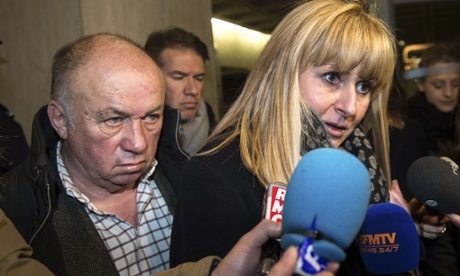
In his summation, even Dodo’s own lawyer called him “reproachable”. But, the lawyer continued, just because someone is unsavoury does not, in fact, make him guilty. It could have been the epigraph for the entire trial.
Salle A in Lille’s Palais de Justice is a 1960s diamond-shaped room, constructed like a gladiatorial amphitheatre in brutalist concrete and faded orange leather: Perry Mason by way of Stanley Kubrick. And at times it did feel as if we were all taking part in a television legal drama. Presiding judge Bernard Lemaire bore more than a passing resemblance to the actor John C Reilly, with a penchant for natty bow-ties, perched jauntily just above the white collar of his official robes. Assistant state prosecutor Aline Clerot looked like a frowning Audrey Tautou.
When Strauss-Kahn’s 84-year-old lawyer Henri Leclerc rose to speak, he did so like an aged polar bear, and then proceeded to deliver staggering set pieces of rhetoric of the kind more often heard in movies starring Jack Nicholson and Tom Cruise. In his closing arguments he quoted both Camus and France’s 1789 Declaration of the Rights of Man.
At other times it resembled a bullring, with Strauss-Kahn, muscled and bristling, being goaded by the verbal red rags of his inquisitors. He remained an unruffled witness – concise, logical and clear. He lost his cool only once, shouting “I’ve had enough” at the persistent questioning of his sexual predilections.
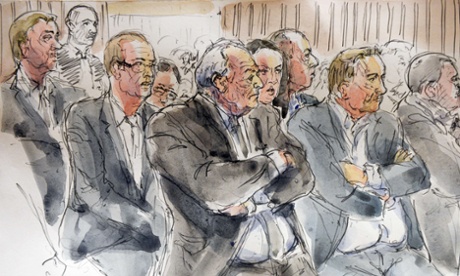
He preferred to see himself not as bull but matador. The most telling glimpses into his character came at the ends of session: those few minutes of bustle as the lawyers gathered their papers and members of the public filed outside for cigarette breaks. In these unguarded moments he liked to pretend he was in charge. When Le Monde’s courtroom artist did a pen-portrait of Strauss-Kahn, the former head of the IMF leaned over to comment that it was “amusingly hunchbacked”. When Leclerc was putting on his anorak, Strauss-Kahn guided one arm into the sleeve then rearranged the collar as if tending to a small child. Leclerc, with his snowy hair and professorial air, seemed bemused.
He has charisma, Strauss-Kahn – however much one might want to deny it. Despite the traumatic testimony of Jade and Mounia, he was not short of female attention from the public gallery. On the last day of his evidence two women approached him as he left the courtroom, wanting to express their support. They giggled and blushed like teenage fans at a boyband concert. Strauss-Kahn shook their hands and gave a wolfish smile that never quite reached his eyes.
Even as he was talking to them, you could see him scanning the room for other opportunities. Eventually his gaze fell on me. For a few moments he sized me up. His look conveyed both his total assurance and his lack of interest in anything other than possession. It was assessment, pure and simple. And then he turned away.
Later, his girlfriend – the television executive Myriam L’Aouffir – came to hear the legal team’s summation, dressed elegantly in bootcut jeans and a navy blue jacket, her blow-dried hair accessorised by glittering drop earrings. During a break in proceedings she stood next to Strauss-Kahn, murmuring. The closer she got, the further back he leaned until he was pressed against the bench with nowhere else to go. He seemed anxious, somehow, that he might be missing out on something just beyond his line of vision.
So, after three weeks, what did we learn? That powerful men can afford excellent lawyers who will argue a convincing case. That a prostitute can give evidence, saying she felt abused and violated and treated like a piece of meat but that, in the end, it comes down to hard evidence: to records of transaction and bills of sale. That distaste for someone’s sexual predilections is probably not a solid enough grounding for a costly and lengthy court case. That Dominique Strauss-Kahn is a survivor. That it would be foolish to discount him just yet.
And amid it all, one image sticks in the mind. It is of Strauss-Kahn walking out of the courtroom after his legal team had mounted their final pleas for acquittal. A young man approaches him, brandishing a thick red book. His name is Thibaut Carlier, a 20-year-old second-year law student in Lille. He normally sits in on criminal cases, rather than civil suits, but decided to make an exception for this one because it seemed like history in the making. He hands the book to Strauss-Kahn and asks him to sign it. Strauss-Kahn, charmed, says a few words and scribbles something on the title page in blue ballpoint pen. Afterwards I ask Carlier what he wrote. He shows me: “Thibaut, Cordially, Dominique Strauss-Kahn”. As for the book? It is a copy of the French penal code. And across it, Strauss-Kahn has written his name.