Filmed at last year’s Aix-en-Provence festival, and released to mark the 150th anniversary of Strauss’s birth, this beautiful, if troubling DVD also forms an unofficial tribute to the production’s director, Patrice Chéreau, who died three months after its premiere. He will probably be best remembered for his 1976 Bayreuth Ring cycle, which overhauled the parameters of Wagnerian stagecraft, and for his 1994 film La Reine Margot, with its uncompromising reconstruction of the St Bartholomew’s Day massacre of 1572. His Elektra shares many of the radical, unsparing qualities that distinguish his finest work.
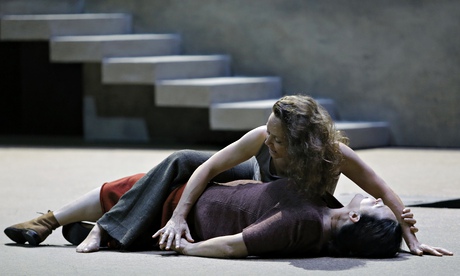
Typically, he dispenses with cliche, and in place of the snarling, expressionist approach found in most stagings, offers a humane modern-dress drama, acted with detailed naturalism against a simple if imposing post-industrialist set, part palace, part factory, by his regular collaborator Richard Peduzzi. The alienation between Evelyn Herlitzius’s self-degrading Elektra and Waltraud Meier’s elegant, dignified Klytemnestra is handled with compassion rather than horror, and haunted by memories – on both sides – of familial closeness now irrevocably lost. Mikhail Petrenko’s Orest, meanwhile, is a vulnerable, tragic figure, slowly and desperately trying to subjugate his emotions to his will.
Yet there are also lapses. In scrutinising the work’s psychology, Chéreau, unusually, loses sight of the social background, leaving us with little sense of the tragedy taking place within a family that wields political power. It is also typical of his radicalism that in an opera in which the principal characters repeatedly demand to be left alone, he should ironically heighten the tension by having their every action observed by curious onlookers – a point which video director Stéphane Metge overemphasises by cutting away from the protagonists far too frequently.
It sounds wonderful, though. Esa-Pekka Salonen conducts the Orchestre de Paris with a grave eloquence that places as much emphasis on the score’s moments of lyrical repose as on passages of churning anguish. Herlitzius is heart-tugging and often revelatory. Meier and Petrenko are exceptional, as is Tom Randle. Adrianne Pieczonka struggles a bit as Chrysothemis, but is utterly convincing dramatically. Highly recommended, despite its occasional flaws.