Strange results taken at a vast experiment could change physics in a fundamental way, researchers say.
The findings could indicate that there is a fifth fundamental force of nature, and that there is something wrong with the standard model of physics.
New measurements taken at the Fermilab laboratory near Chicago suggest there exists an as-yet undiscovered sub-atomic particle or new force, the researchers say.
“Today is an extraordinary day, long awaited not only by us but by the whole international physics community,” said Graziano Venanzoni, one of the spokespeople for the experiment and a physicist at the Italian National Institute for Nuclear Physics, in a statement.
The findings are not yet fully conclusive: there is a one in 40,000 chance the results are happening by chance, equating to a confidence level of 4.2 sigma. 5 sigma is seen as the minimum level for researchers to designate a new discovery.
Read more:
- Aliens would be ‘friendly but we can’t gamble on it’
- Scientists connect human brain to computer wirelessly for first time ever
- Nasa reveals Easter eggs hidden on Mars perseverance
- Scientists may have found a special black hole that could change our understanding of the universe
But they have nonetheless detailed the findings in a set of papers that have been submitted to a variety of physics journals, and hope that research could soon arrive that will verify the promising results.
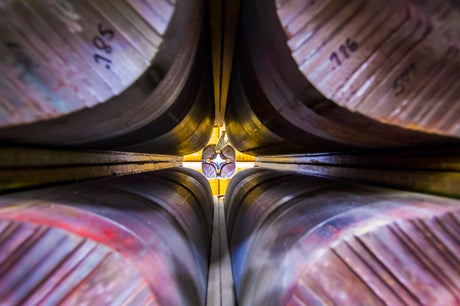
The new findings come from an experiment called Muon g-2, which involves sending a fundamental particle known as the Muon – which are similar to electrons but around 200 times as heavy – around a large ring and then hitting it with a magnetic field.
As that happens, the muons wobble. Scientists are able to predict the rate of that wobbling with reference to the Standard Model, or our current understanding of the law of physics.
But the researchers found that wobble was not happening as expected: in fact, it was going more quickly. That suggests there is something else – unaccounted for in our current understanding – that is contributing to the results, such as a new force or particle.
It is not the only recent result to suggest that the Standard Model could be incomplete. It follows similar findings at the Large Hadron Collider, which also saw anomalies in the way that muons and electrons were interacting.