The Japan Meteorological Agency will substantially improve its system for observing and forecasting storm surges from next fiscal year, in a bid to more swiftly and accurately convey the threat from storm surges so that residents can take steps to protect themselves.
Storm surges are expected to cause greater damage due to global warming. The upgraded system will be capable of calculating tide levels about 90 minutes faster than the present system, and of predicting more specifically where storm surges might occur.
Thursday marked 60 years since the Isewan Typhoon (see below) struck Japan. It inflicted the worst damage from a storm surge since the Meiji era (1868-1912), with more than 5,000 people dead or missing.
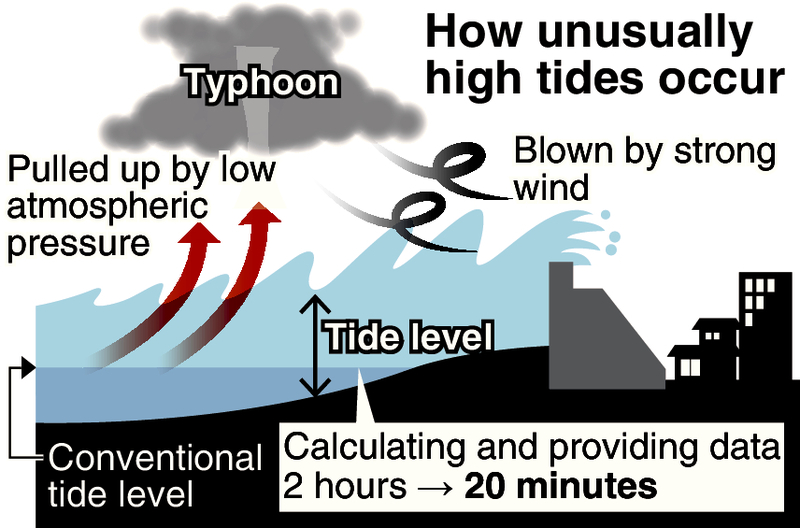
A storm surge is a phenomenon generated when a typhoon or an intense low-pressure system pulls up water near the surface of the ocean and then blows it toward the coast, resulting in an abnormally high tide. Huge volumes of seawater could inundate coastal areas, and the flooding can quickly spread and damage low-lying areas.
When Typhoon No. 21 came ashore in the Kinki region in autumn last year, a storm surge of 3.29 meters was recorded in Osaka Bay and flooded many places, including Kansai International Airport.
The agency provides meteorological observatories across Japan with information about storm surge levels based on measurements taken at automatic tide gauge stations installed in coastal areas around the nation. Local governments notified by these observatories use such data to issue evacuation and other information to residents.
However, when calculating the height of the storm surge, data relating to small waves and spray must be excluded because it could lead to an error in the figures. Workers do this operation on computers, and it takes about 2 hours for the tide level calculations to be provided.
To reduce this time and make this information available more quickly, the agency decided it would introduce a new computer system next fiscal year. The new system can automatically do work such as removing error-causing data and will slash the time required to provide storm surge information to about 20 minutes.
The new system also will improve the accuracy of forecasting which specific areas a storm surge might affect. Currently, the agency can predict to within an area of one square kilometer, but the new system will compress this range to 500 square meters. Because the height of a storm surge could change depending on a coastal area's geographical features, being able to more precisely predict where the water will rise could make it easier to implement effective countermeasures. Meteorological observatories will use this data, which will enable storm surge warnings and alerts to be quickly issued.
The timing of a storm surge can be affected by the typhoon's path. Predictions so far have been made for a maximum of 39 hours in advance, but the agency plans to introduce another new computer system within a few years that will enable forecasts up to 72 hours ahead.
Forecasts are currently used only within the weather agency, but the agency is considering making such information available to disaster management departments at local governments within five years.
Local governments also are pushing ahead with their own storm surge and flooding countermeasures. A powerful typhoon could trigger flooding that submerges about 90 percent of residential areas in the five Tokyo wards of Sumida, Koto, Adachi, Katsushika and Edogawa. Some of these local governments have created a video featuring computer graphics to demonstrate the damage such flooding could cause, and are stepping up efforts urging residents to evacuate before such a situation occurs.
-- Isewan Typhoon
A powerful typhoon that made landfall at Cape Shionomisaki, Wakayama Prefecture, on the evening of Sept. 26, 1959, and caused widespread devastation, especially in the Tokai region. Many areas were flooded and a 3.89-meter storm surge was recorded in Nagoya Port. The typhoon left 5,098 people dead or missing, and destroyed or damaged more than 150,000 houses. It took about three months until the water completely receded.
Read more from The Japan News at https://japannews.yomiuri.co.jp/