European markets close lower after Trump ban
The uncertainty and chaos caused by Donald Trump’s travel ban has sent stock markets tumbling.
With a number of Asian markets falling overnight - the Nikkei lost 0.5% - Europe and the US soon followed suit. In the UK, the FTSE 100 lost all the gains made so far this year, closing at its lowest level since 28 December. Things would have been worse without a boost from Vodafone after the mobile phone group said it was in talks about merging its Indian business with Idea Cellular. Chris Beauchamp, chief market analyst at IG, said:
The market narrative has shifted once again. For the past three months a Trump presidency has been heralded as great for stocks. Now, with Dow 20,000 behind us, it seems his government can be blamed for the bout of selling that has engulfed markets. The truth, as ever, probably lies somewhere in between these two extremes but there is probably some truth in the idea that geopolitical jitters are playing a part in price action today. The FTSE 100 has now surrendered all its gains for the year...Markets overall have been ripe for a correction for some time now, and were merely in need of a reason to begin; Trump’s rambunctious opening to his presidency, and the lighter volumes caused by holidays in Asian markets, may well have provided the bears with the opening they needed.
The final scores in Europe showed:
- The FTSE 100 finished down 0.92% or 66.01 points at 7118.48
- Germany’s Dax dropped 1.12% to 11,681.89
- France’s Cac closed down 1.14% at 4784.64
- Italy’s FTSE MIB fell 2.95% to 18,759.40
- Spain’s Ibex ended 1.5% lower at 9361.3
- In Greece, the Athens market lost 3.53% to 614.08
On Wall Street, the Dow Jones Industrial Average is currently down 183 points or 0.92% at 19,910.
On that note, it’s time to close for the evening. Thanks for all your comments, and we’ll be back tomorrow.
Italy’s biggest bank has said its capital ratios at the end of 2016 would not meet requirements set down by the European Central Bank.
The bank is launching a €13bn rights issue to help bolster its finances, which should put it back on track to meet the ECB levels. It said:
[We envisage] a temporary deficit versus the corresponding applicable capital requirement as at 31 December 2016 .... by approximately 2% which is expected to be fully restored upon completion of the rights issue, which, subject to regulatory approvals, is expected to be settled before March 10th, 2017 on the basis of the current timetable.
The bank also said it expected to make an €11.8bn loss for 2016, with further negative one-off items:
Group financial results are impacted by a number of negative non-recurring items of which approximately €12.2bn were disclosed at UniCredit’s Capital Markets Day, on December 13th, 2016, in the context of the presentation of the 2016-2019 Strategic Plan..
The Group has taken into account a number of additional negative one-off items amounting to approximately €1.0bn, which are expected to be recorded in 2016. Such one-off items primarily result from a higher write-down of the investment in the Atlante Funds, on some participations and Deferred Tax Assets for temporary differences and extraordinary contributions to the National Resolution Fund.
As a result, the 2016 Group’s estimated net financial result is expected to record a loss of approximately €11.8bn.
Unicredit’s shares fell 5.45% on the news, helping drag the Stoxx 600 Banking Index down 1.68%.

Despite the slump in markets following Trump’s travel ban, most are still within reach of record highs.
But Larry Summers, former US Treasury Secretary, has told Bloomberg TV he is concerned about the recent rises in markets:
What I think is a clear error, is to confuse several months of strong markets, with strong fundamentals. The period post-election when markets did best in the twentieth century was the period between Herbert Hoover’s election and his inauguration. And of course, as a presidency, that was the biggest economic disaster that we had. So I don’t know what’s going to happen next in markets, but nobody should be serene just because markets are behaving well.
On the Trump ban he said he was not surprised that the technology sector has spoken out against it:
As global businesses, they have a huge stake in the United States being a nation of the Statue of Liberty rather than being a nation of refugee camps and barbed wire. They have a huge stake in the United States supporting an open and tolerant global system, they have that stake for their employees, they have it for their customers, they have it for the reputation of the United States and they have spoken out.
And on chief executives being threatened by the prospect of Trump tweeting against their companies, he said:
I’m sure most of them share the values of inclusion, the values of American tradition that were reflected in the statements that John McCain and Lindsey Graham made, the statements that Jeff Immelt made.
And I don’t know whether it’s a sadder thing if others don’t have those values or whether it’s a sadder thing if they are being intimidated by the prospect of a tweet. But it’s an extraordinary thing if business leaders in the United States are being intimidated by a president’s threats of calling them out when the president’s been in office for one week. That is an extraordinary change in what the United States is about.

Back with the markets, and the Dow’s fall back below 20,000, Spreadex financial analyst Connor Campbell said:
In what is a fairly significant development the Dow Jones opened under 20000 this Monday, causing the Trump travel ban losses to increase across the board.
The Dow plunged by 150 points after the bell, US investors equally unhappy with the instability brought on by Trump’s actions as their European cousins.
Now, the fact that a potentially March rate-hike signalling Fed meeting looms on Wednesday, alongside the first Trump-era non-farm jobs report on Friday, may have something to do with the Dow’s losses. However, there is no doubt that the main catalyst for the drop has been the Muslim travel ban executive order from the President, not for moral reasons that have caused outrage elsewhere but instead the potential ramifications it could have for trade from the Middle East and elsewhere.
With the Dow dipping below its landmark 20000 level there was no reason for the European indices to change tack this afternoon. The FTSE maintained a 0.8% decline as the day went on, keeping the UK index at a 2017 low despite the pound’s own slide against the dollar and euro. The DAX and CAC, meanwhile, gradually saw their losses intensify after the US open; the German and French indices are now both down 1.1%.
Still with housing, but moving to Ireland, and credit ratings agency Moody’s predicts that Irish house prices could rise by 5% this year. Henry McDonald adds:
The number of homeowners in the Republic who are trapped in negative equity or have fallen behind in their mortgage repayments has also dropped dramatically, Moody’s say.
In their new year analysis of the Irish housing market, which was one of the main factors contributing to Ireland’s economic collapse towards national bankruptcy in the recession, the Moody’s report found that negative equity in the Republic is “still high.”
However, Moody’s have found that the number of borrowers in arrears or negative equity has fallen from its peak in 2013 to one third of all homeowners. In the aftermath of the financial crash, almost two-thirds of Irish homeowners were exposed to mortgage arrears or negative equity.
Its report also forecasts a supply shortage in new or available homes which will fuel rising house prices in the state.
Overall Moody’s projects that rising house prices and few mortgage arrears will continue to spread to Irish banks and their bonds which are backed up by home loans
According to the Irish Mortgage Holders Organisation there are 35,000 home owners in the Republic who have been in mortgage arrears for over two years.
Signs of strength in the US housing market.
Pending home sales rebounded in December after a decline the previous month, with the National Association of Realtors’ index rising by 1.6% to 109. Analysts had been expecting a 1% increase. Lawrence Yun, the association’s chief economist, said:
Pending sales rebounded last month as enough buyers fended off rising mortgage rates and alarmingly low inventory levels1 to sign a contract. The main storyline in the early months of 2017 will be if supply can meaningfully increase to keep price growth at a moderate enough level for households to absorb higher borrowing costs. Sales will struggle to build on last year’s strong pace if inventory conditions don’t improve.
The news has done little for the market, where investors are more worried about the uncertainty caused by Donald Trump’s travel ban.
Wall Street opens lower with Dow back below 20,000
Unsurprisingly given the chaos and uncertainty caused by Donald Trump’s travel ban and the falls it has caused in Asian and European markets, Wall Street has opened sharply lower.
The Dow Jones Industrial Average has dropped 0.66% or 130 points to 19,963 - below the 20,000 barrier it struggled for so long to achieve.
The S&P 500 opened 0.41% lower and the Nasdaq Composite 0.46%. Losses were not confined to one particular sector but spread across the board.
Updated
In the UK market, one of the day’s big risers is engineering and consultancy group WS Atkins.
Its shares have jumped more than 7% following a report in the Times (£) that US peer CH2M had approached the group about a possible merger. Atkins - which has partnered the US group on projects - is not commenting, but analysts at Liberum said the idea was credible:
A response from Atkins in relation to the rumoured merger with CH2M is possible in the next day. A merger would almost double the size of the current business and would have more than 50% sales to the US. The business would be particularly strong in Energy, Water and Transportation. We believe that speculation is credible given the industry trend towards consolidation and would potentially create a top 5 global design company. Although the history of M&A is chequered in the sector, we see the potential combination as an early cycle play on growth in US infrastructure. CH2M’s third quarter trading update indicated lower earnings year on year. CH2M has had a challenging time but the suggested valuation of $2bn appears to be a reasonable market cap. The enterprise value is significantly higher, given debt, preference shares, pensions, and perhaps joint venture liabilities. The pension will be a key factor although liabilities have reduced post a controversial deal with the PPF. Premature to assess value creation, but expect limited cost-savings and an interesting debate on revenue synergies.
Atkins has already said it is hoping to benefit from Donald Trump’s proposed infrastructure spending plans.
Updated
Back with the German inflation figures, and despite consumer prices increasing by 1.9% year on year in January, that does not mean the ECB should rein in its stimulus programme, says economist Dr Andreas Rees at UniCredit:
Four weeks ago when the December figure was released, there was an outcry by some media and politicians about rising inflation risks in Germany. The ECB should act by unwinding QE as quickly as possible before it is too late, so the story went. It is likely that you will read such statements once again even the latest headline inflation figure came in a tad below expectations. In our view, this kind of thinking is not based on economic facts for two reasons. First, there are no signs of a persistent upward trend in consumer prices. Instead, it is largely about oil. Second, German private households’ inflation expectations remained well anchored.
Let us state the obvious: Rising inflation at the turn of the year has primarily been caused by energy prices, or more precisely by the higher oil price. The latest driver was the agreement between OPEC and non-OPEC countries such as Russia at the end of November to curb output. It was the first agreement of a global oil cartel since 2001. According to our calculations based on federal states data, inflation excluding food and energy was up a more moderate 1.4% year on year after 1.5% in the previous month....
More important, the latest inflation excitement in the media and by some policymakers has been crying wolf as flagged by forward-looking surveys. Private households do not anticipate any surging inflation which goes beyond the energy rise. As a matter of fact, inflation expectations of Germans for the next 12 months hit its trough in spring of last year and rose since then, pretty much in line with what one would expect in the light of the oil price increase. The latest inflation expectations survey for January (conducted by the EU Commission) shows that they still remained below its long-term average. In other words, the allegedly so inflation averse Germans have noticed higher fuel price at the gas stations but they are not really concerned for good reason.
Going forward, we expect further rising inflation rates in a range of 2¼%-2½% year on year for the next three months or so before a stabilisation is kicking in. It will be all about the oil price ... whose effects (on a year on year basis) will be fizzling out in the further course of 2017. On average, we expect +1.8% in consumer prices this year after +0.5% in 2016.
Updated
Trump turmoil keeps markets in the red
There’s no sign of a recovery in the European stock markets:

FXTM’s vice president of market research, Jameel Ahmad, says the turmoil caused by the Trump administration in the last few days is to blame.
Whether it is building a wall, banning certain nationalities, starting a trade war or pretty much anything else President Trump may do to upset people, it does risk both creating and deepening a negative perception of the US.
What if someone now reacts by banning US products, or even worse US nationals from entering their nations? What if investors now decide to take money out of US funds? Over one million Britons have already reacted by signing a petition to stop an upcoming visit from Trump to the United Kingdom, something that will put even more pressure on Theresa May as she has not only just concluded a meeting with the new President but is already under pressure to meet her own deadline to invoke Article 50 within the next two months.
Although it is expected and understood that the UK will be aiming to strengthen relationships around the world following the result of the EU Referendum, I am unsure how people will react to Theresa May strengthening a relationship with the United States that appears on track to isolate itself from globalisation.
Fresh US consumer spending figures show that the American public kept spending last month.
Consumer spending rose by 0.5% in December, up from +0.2% in November, suggesting the economy ended 2016 in solid shape.
The report also shows inflation picking up; the Personal Consumption Expenditure index (a measure of the cost of living), jumped to 1.6%, or 1.7% if volatile factors like food and energy are excluded.
*U.S. PCE CORE PRICE INDEX INCREASED 1.7% IN DECEMBER Y/Y
— Michael Hewson (@mhewson_CMC) January 30, 2017

The jump in German inflation to 1.9% this month will intensify the pressure on the European Central Bank to rein in its stimulus programme.
The ECB is currently keeping interest rates at 0%, charging banks which leave money with them, and buying €80bn of government and corporate debt each month with newly created money.
With German inflation on the brink of 2%, Berlin will argue that the ECB needs to tighten policy now - even though prices are rising more modestly in other countries.
Carsten Brzeski, chief economist at ING, says Germany’s ‘bogeyman’ has returned. But we’re not back in the 1920s yet.....
As Brzeski puts it
The common German reflex to criticize the ECB and call for an end of QE is, in our view, overblown.
First of all, there is very little the ECB can do about an increase in inflation, almost exclusively driven by energy and food prices. Secondly, even in an economy operating at full employment and which is most advanced in the current cycle, underlying inflationary pressure remains low...
Thirdly, even if German inflation was to exceed 2% sustainably, it is simply a mathematical prerequisite for the inflation in the entire Eurozone to also get close to 2%.
German inflation hits 3.5 year high
Newsflash: Inflation in Germany has hit its highest level since July 2013, in the latest sign that the cost of living is picking up in Europe.
Germany’s Consumer Prices Index jumped to 1.9% in January, according to flash estimates, up from 1.7% in December.
Some economists had expected it to hit 2% - just over the official target for inflation across the eurozone.
German inflation downside surprise! YOY came in at 1.9%, which was faster than last month's 1.7%, but below the 2.0% economists had expected
— Joe Weisenthal (@TheStalwart) January 30, 2017
Jan #German #consumer #price #inflation up to 1.9% as y/y rise in energy prices up to 5.8% & food up to 3.2% but services inflation dipped
— Howard Archer (@HowardArcherUK) January 30, 2017
Updated
There are also signs today that the eurozone debt crisis is bubbling up.
The yield, or interest rate, on Greek two-year bonds has jumped from 6.8% to 8.6% today. That means investors are keen to offload the debt, following the IMF’s warning that Greece needs substantial debt relief.
Shares in several travel companies have fallen today.
Air France-KLM are down 2.2%, IAG (parent company of British Airways) have lost 1.2% and InterContinental Hotels are 1.6% lower. They would all suffer if the global economy slows, or enters an era of greater protectionism.
Travel stocks decline in Europe in wake of Trump’s immigration order https://t.co/nXCA0j0Cww
— MarketWatch (@MarketWatch) January 30, 2017
AXA to compensate travellers caught up in Trump's travel ban
Insurance group AXA UK has pledged to will honour claims from customers affected by Trump’s travel clampdown - even though they’re not technically covered for such disruption.
Here’s the official statement:
“In light of the sudden and unexpected decision by the Trump administration to block entry to the US for nationals from Syria, Somalia, Sudan, Iraq, Iran, Libya and Yemen, AXA Insurance UK confirms that individuals who have been denied entry as a result of the executive order, will be able to claim on their policy.
Although not technically covered, we view the current situation as unprecedented and unforeseen and as such we are extending the cover under our policies.
For those intending to travel to, or return from, the United States of America we recommend allowing extra time due to protests currently taking place at a number of airports.”
Updated
European stock markets remain in the red as lunchtime approaches, with the German, French and UK indices all down around 0.8%.
CMC Markets’ Michael Hewson says the US president’s ban visitors from Iran, Iraq, Libya, Somalia, Sudan, Syria and Yemen is causing alarm.
Global Indices have started on the back foot this morning, after US President Trump announced one of his most radical policies yet, in the form of a travel ban.
The resulting press criticism and mass protests appear to have pushed some investors to the sidelines as rising uncertainty in the ability of the President not to cause damage to the US economy starts to increase, and uncertainty rarely bodes well for financial markets.
Bloomberg has flagged up that the tech industry has particular reasons to worry about Trump:
Trump is working on another immigration executive order directly impacting tech companies. https://t.co/fMiLTDycwp pic.twitter.com/ajKqYn76Si
— Joe Weisenthal (@TheStalwart) January 30, 2017
A glimmer of good news; economic confidence across the euro area has hit its highest level in almost six years.
The EC’s Economic Sentiment Indicator, which tracks business and consumer confidence, has jumped to 108.2 from 107.8 in December, the best reading since March 2011.
Eurozone economic confidence surges to fresh pre-debt crisis high: A stellar start to a crucial year. https://t.co/lcE3VHThFN pic.twitter.com/QpdB8eRLVj
— BSIC (@BSICBocconi) January 30, 2017
But with Trump causing anxiety worldwide, and crunch elections in Germany and France this year, can confidence hold up?
Only a handful of the 100 companies on the blue-chip Footsie index have risen this morning; the rest have been dragged down by concerns over Trump’s policies.
Joshua Mahony, market analyst at IG, says the FTSE 100 is ‘floundering’ this morning, as it sheds 60 points to its lowest level of 2017.
Friday’s dour finish across US markets seems to have paved the way for this morning’s weak trade, with markets turning their focus away from Donald Trump’s business friendly measures and towards his more controversial decision to ban citizens and refugees from seven states in the Middle East and Africa.
As we enter February, we are due the typical raft of economic data, with the Bank of England’s ‘Super Thursday’ and Friday’s US jobs report meaning that volatility is expected to grow as the week progresses.

UK public anger about Trump’s actions continues to build; one million people have now signed the petition opposing him receiving a state visit.
Trump petition breaks through ONE MILLION..... https://t.co/tZJ8v1DrjO
— Fiona Walsh (@_fionawalsh) January 30, 2017
If Trump comes to Britain, there won't just be protests, there will be riots. This public hostility is unprecedented. He must be uninvited.
— Rupert Myers (@RupertMyers) January 30, 2017
Updated
The US stock market is expected to dip when trading begins in five hours time.
The futures market indicates the Dow Jones industrial average will shed 40-ish points to around 20053, having hit record highs last week.
Remo Fritschi, institutional Sales Manager at ADS Securities in London, believes Trump’s refugee clampdown could spur a burst of profit-taking on Wall Street.
Wall Street is looking at a softer start to the week as questions begin to mount over just how damaging the new US immigration policy will be to a number of multinational businesses.
Sweeping bans on admission to the country from a number of nations risks undermining the globalisation agenda that has helped pump valuations in a range of US-listed stocks over the last few years, whilst the prospect of similar restrictions being applied to US citizens could also hamper overseas trade initiatives.

Back in the eurozone, Spain’s economy has posted another quarter of solid growth.
Spanish GDP expanded by 0.7% in October-December, matching the growth rate in the previous three months. It means Spain grew by 3.2% in 2016, the third year of growth since its recession during the euro debt crisis.
Reminder, we get more eurozone GDP data on Tuesday.
FTSE has just hit its lowest level all year at 7117, a monthly low.
— Alice Ross (@aliceemross) January 30, 2017
Paul Donovan, economist at UBS, has warned clients that investors in the Middle East could pull money out of America, if they feel Trump is persecuting Muslims.
Paul Donovan (UBS) on Trump, the dollar, and Middle East investors pic.twitter.com/YNS72TWxrl
— Katie Martin (@katie_martin_fx) January 30, 2017
European markets are falling
European stock markets are all in retreat this morning, as the US travel ban hits sentiment across the continent.

The share price rally sparked by Trump’s shock election win in November has now fizzled out; the FTSE 100 is now in the red for 2017.
Connor Campbell of SpreadEx says:
Pretty much everything slipped into the red this morning, the markets reacting to the fresh bout of instability brought on by Donald Trump over the weekend.
Though the Trump rally may have lifted the markets to their current peaks, the global outrage that has greeted the President’s first week in office, the most recent instance being the well-placed disgust at his Muslim travel ban, is now beginning suppress investors’ appetites especially since, as mentioned, the indices are trading so high.
Naeem Aslam, analyst at Think Markets, says Trump is creating “more uncertainty and jitters among investors.”
The major US tech giants have also strongly condemned the president’s executive order which is not helping business confidence.
Starbucks, the US coffee giant, announced today that they will hire 10,000 refuges over the next 5 years, sending a clear message to Trump’s anti-immigrant and biased policies. You could certainly say that the tourism sector over in the US might also feel the pinch as holidaying stateside is not an ideal scenario for visitors in light of his new anti-immigration policies.
After a blizzard of executive orders on immigration, border control, oil pipelines and trade, it’s becoming clear that Trump actually means what he said during last year’s campaign.
This may be an unwelcome shock to investors who hoped the billionaire would take a different path once in office.
James Woods, global investment analyst at Rivkin Securities in Sydney, explains (via Reuters):
“Trump always stated these were policies he would implement.
“Quite a lot of it was brushed off as ‘campaign rhetoric’ but he is following through.
“This renews concerns about a trade war with China that would significantly affect both Asian and the global economy.”
Markets hit by fears over Trump travel ban

Stock markets and the US dollar are both starting the week on the back foot, as Donald Trump’s controversial travel ban worries investors.
Shares have fallen in Asia, amid fears that Trump’s policies will hurt the US economy, and trigger a new phase of protectionism.
Japan’s Nikkei fell 0.5%, while Australia’s S&P/ASX index shed almost 1%.
European stock markets are under pressure too, with London’s FTSE 100 dropping by 55 points, or 0.75%, to 7129 in early trading.
The US dollar also retreated against the Japanese yen, dropping by 0.2% to ¥114.88.
State of play. pic.twitter.com/MdqrDcsJ8H
— Eddie van der Walt (@EdVanDerWalt) January 30, 2017
Dollar drops as Trump ban confuses allies, businesses—and Trump aides too. https://t.co/m5tK883dhN pic.twitter.com/l1WoFMCNlT
— Holger Zschaepitz (@Schuldensuehner) January 30, 2017
The selloff comes after Trump imposed a 90-day ban on citizens from Iraq, Syria, Iran, Sudan, Libya, Somalia or Yemen travelling to the US, and temporarily halted America’s refugee programme.
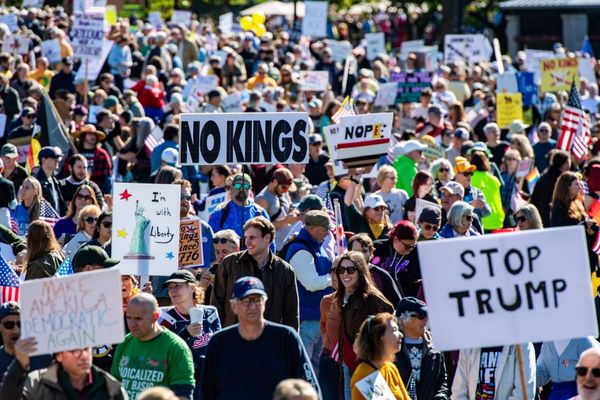
The move has sparked heavy criticism around the globe, and protests in several American cities.
In Britain, a petition against Trump being granted a state visit to Britain has already attracted almost one million signatures.
Financial analysts are concerned that the backlash against Trump’s plans could have serious economic consequences.
Stephen Innes, a senior trader at OANDA, summed the situation up well:
“World leaders were quick to condemn President Trump’s executive order to ban U.S. travel from seven Muslim countries. The global reaction has been one of universal condemnation.
The fear here is that the market may start to think that personal vendetta is clouding the Oval Office judgment and they could express a huge vote of non-confidence through the markets.
“The increase in civil unrest alone should be a concern for investors, and with a lack of clarity on the economic policy front, markets will be cantankerous early in the week as they’re completely uncertain of what’s next from President Trump on the geopolitical landscape.”

Updated
The agenda: Big week for news
Good morning, and welcome to our rolling coverage of the world economy, the financial markets, the eurozone and business.
This is going to be a big week for news, with European growth data being released, two key central bank meetings, and a new healthcheck on America’s jobs market.
On Tuesday, we get new eurozone GDP figures showing how the currency bloc fared in the last three months of 2016, plus euro inflation data for January.
Wednesday brings a Federal Reserve meeting; the US central bank isn’t expected to raise interest rates, but could hint at a hike in March.
Here’s Bloomberg’s take:
This is going to be an insane week. On top of political fallout from Friday, a huge week for data. Via @5thrule pic.twitter.com/wQE3sE0AaE
— Joe Weisenthal (@TheStalwart) January 29, 2017
On Thursday the Bank of England will announce its interest rate decision, and publish its quarterly inflation report. With inflation picking up, the BoE could face pressure to raise rates sooner than expected.
Finally, Friday will bring the latest US jobs data, in the Non-Farm Payroll report. That will show if America’s labour market is slowing down, after years of solid growth under Barack Obama.
Coming up today....
The week starts with new inflation figures from Germany, at 1pm GMT, and America at 1.30pm GMT.
Economists predict that Germany’s inflation rate may have risen to 2% in January, slightly over the eurozone’s target, and ahead of other European countries.
German politicians are already anxious that the European Central Bank is too relaxed about the rising cost of living, so today’s data could fuel that debate.

Analysts at RBC Capital Markets say:
The consensus call is that the German inflation rate rose to 2% y/y in January, in line with the ECB’s own target with the likelihood that the rate will rise further in coming months which will likely see further public calls from Germany policy makers and commentators for the ECB to begin to consider normalising policy.
We’ll also have an eye on Greece, as talks with its creditors drag on. Experts fear trouble ahead unless the latest phase of Athens’ bailout is signed off by 20 February.
We’ll be tracking all the main events through the day....
Updated